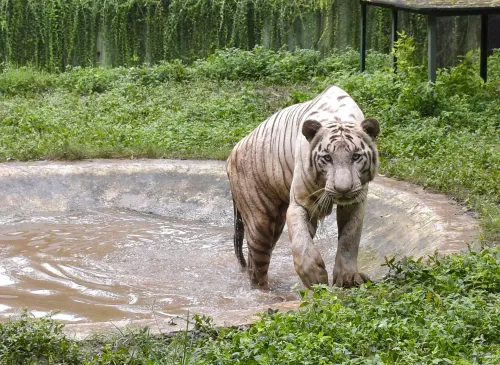
Is the Sundarbans Tiger Census Set to Begin with Over 1,400 Cameras?

Synopsis
The Sundarbans Tiger Census is underway, utilizing a network of over 1,400 cameras to scientifically track the Royal Bengal Tigers. This initiative aims to assess the population and food availability within the mangrove forest, providing critical data for conservation efforts.
Key Takeaways
The Sundarbans tiger census utilizes over 1,400 cameras.
The initiative aims to monitor the Royal Bengal Tiger population.
The forest will be closed to tourists on December 11 and 12.
Data collected will help assess prey availability.
The last census recorded 101 tigers in the Sundarbans.
Kolkata, Nov 27 (NationPress) The tiger census initiative has officially kicked off in the Sundarbans mangrove forest of West Bengal, as officials from the Forest Department have started setting up a network of over 1,400 trap cameras to photograph the Royal Bengal Tigers.
These cameras will be strategically positioned, particularly near canals, to gather accurate scientific data regarding the tiger population, as stated by a senior official in the forest department.
Images captured by these robust, night-vision cameras will be sent to Dehradun for analysis, an essential step in determining the final census numbers for the Sundarbans.
The Sundarbans, a vital habitat for the Royal Bengal Tiger, will be closed to tourists on December 11 and 12 while the tiger census is conducted.
As per the directives from the Sundarbans Tiger Reserve (STR), all types of tourism activities—including boat rides, launches, and cruises—will be suspended during these two days, with online bookings also being temporarily halted to focus on the collection of accurate scientific data.
Camera installations have already commenced in various areas of the Sundarbans, including Matla, Raidighi, Ramganga, and Sajnekhali. In total, 1,484 cameras will be deployed across the forests to monitor tiger movements over an area of 4,100 square kilometers.
The tiger census, which will span over a month, will not only track tiger movements but also assess the availability of prey within the region.
"We aim to determine whether there is adequate food for the tigers in the Sundarbans," an official from the Sundarbans Tiger Reserve mentioned, adding that the survey will also monitor the presence of herbivores like deer and wild boar—key components of the tigers’ diet.
A dedicated app has been developed to facilitate the analysis of the data collected from these cameras.
According to a Sundarbans Tiger Reserve official, this initiative will help evaluate if the forests provide sufficient sustenance for the tiger population.
The previous tiger census conducted in 2022, released in late 2024, recorded a population of 101 tigers in the Sundarbans, an increase from 88 in 2018. Out of these, 80 were located within the core Sundarbans Tiger Reserve, while 21 were found in the adjacent South 24 Parganas division.
Generally conducted every four years, the Sundarbans tiger census is complemented by smaller surveys and specific area observations conducted annually.
Point of View
The Sundarbans tiger census represents a crucial effort in wildlife conservation in India. It highlights the importance of scientific data collection to ensure the sustainability of the Royal Bengal Tiger population, a symbol of our natural heritage. The Forest Department's proactive measures are commendable, and such initiatives must be supported for the preservation of biodiversity.
NationPress
27 Sept 2026
Frequently Asked Questions
What is the purpose of the Sundarbans tiger census?
The main purpose of the Sundarbans tiger census is to accurately track the population of Royal Bengal Tigers and assess the availability of their prey in the region.
How many cameras will be installed for the census?
A total of over 1,400 trap cameras will be installed throughout the Sundarbans to monitor tiger movements.
When will the Sundarbans be closed to tourists for the census?
The Sundarbans will be closed to tourists on December 11 and 12 for the tiger census.
What kind of data will these cameras collect?
The cameras will capture images of tigers and monitor their movements, as well as the presence of prey species in the forest.
How often is the tiger census conducted?
The Sundarbans tiger census is typically conducted every four years, supplemented by smaller surveys and observations annually.