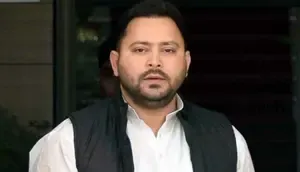
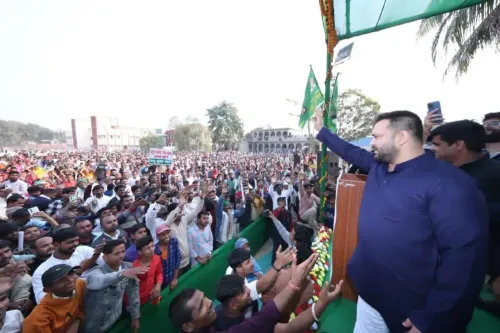
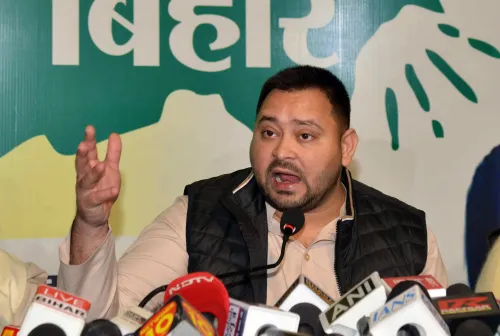
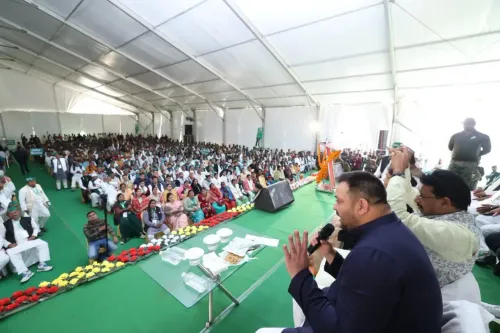
Tejashwi Yadav Critiques Nitish Kumar's Corruption and Liquor Smuggling in Bihar

Synopsis
Tejashwi Yadav has launched a scathing critique of Nitish Kumar's government amid ongoing hooch tragedies in Bihar, alleging rampant corruption and questioning the effectiveness of the state's liquor prohibition strategy.
Key Takeaways
Tejashwi Yadav criticizes Nitish Kumar's liquor prohibition policy.
Alleges a powerful nexus between government officials and the liquor mafia.
Over 11 lakh cases registered since the prohibition began.
Claims that prohibition has led to a 40 percent increase in narcotics trade.
Calls for greater accountability from government officials.
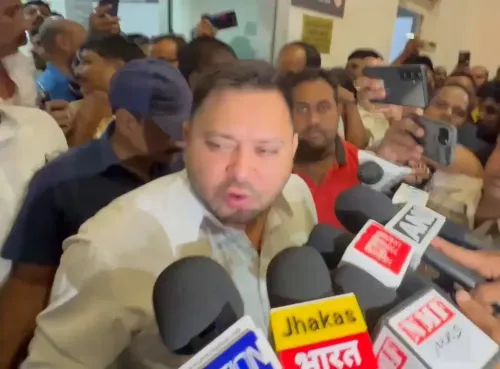
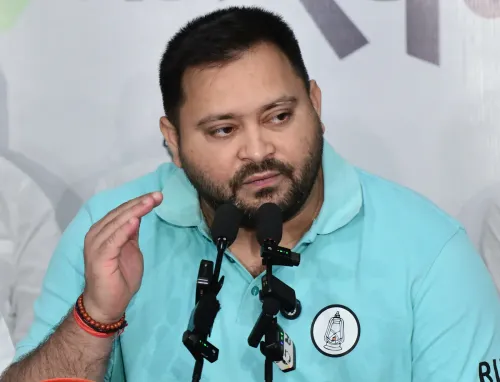
Patna, April 6 (NationPress) In light of the ongoing hooch tragedies plaguing Bihar, RJD leader Tejashwi Yadav launched a fierce criticism of the Nitish Kumar administration on Monday. He condemned the continual occurrences of illegal liquor smuggling and the alleged widespread corruption, raising doubts about the efficiency of the state's prohibition measures.
As the state marks a decade of the liquor ban, Tejashwi asserted that the initiative has not fulfilled its intended goals, pointing to a powerful alliance between certain governmental sectors and the liquor mafia.
“Prohibition has become the most significant form of institutional corruption under Nitish Kumar’s rule,” he stated, alleging it has led to the emergence of an illicit economy worth approximately Rs 40,000 crore.
He highlighted that the enforcement bodies responsible for prohibiting liquor -- including the Home Department and the Excise Department -- have predominantly been under the Chief Minister’s direct oversight, raising concerns regarding accountability.
According to Tejashwi, official statistics reveal that since the prohibition was enacted, over 11 lakh cases have been logged, and more than 16 lakh individuals have been detained statewide. Furthermore, more than 5 crore litres of liquor have been confiscated, with over 2 crore litres seized in just the last five years -- averaging around 11,000 litres per day.
In 2026, he claimed, an average of 3.7 lakh litres of illegal liquor was confiscated monthly.
Tejashwi contended that these numbers represent merely a small part of the actual liquor consumption, labeling them as the “tip of the iceberg”. He estimated that the genuine daily usage could reach as high as 17 lakh litres.
He further referenced government data indicating an 18 percent increase in liquor seizures in 2026, highlighting a rise in illegal supply despite existing prohibition laws.
The RJD leader alleged that the ineffectiveness of the prohibition has resulted in a 40 percent surge in the trade of narcotics and other intoxicants, claiming that the youth in Bihar are increasingly engaging with substances like cannabis and heroin.
Challenging the enforcement system, Tejashwi questioned how such vast amounts of liquor continue to infiltrate the state. “Liquor doesn’t just appear magically. The government needs to clarify when, how, and with whose assistance this is occurring,” he urged, calling for authorities to disclose consumption statistics rather than just focusing on seizure data.
He also referred to historical patterns, asserting that the number of liquor outlets in Bihar escalated dramatically -- from fewer than 500 in rural areas in 2004-05 to over 6,000 by 2015 -- alleging that this growth occurred during Nitish Kumar’s leadership and facilitated easier access to alcohol prior to prohibition.
Continuing his critique, Tejashwi Yadav drew a historical parallel to question the motives behind Bihar’s prohibition initiative. “From Independence in 1947 to 2005 -- a period of 58 years -- approximately 3,000 liquor shops were established in Bihar. However, from 2005 to 2015, under Nitish Kumar, this number doubled to nearly 6,000. Previously, the average was about 51 shops annually, but it jumped to almost 300 each year in that decade,” he alleged.
Tejashwi further accused the Chief Minister of presenting himself as a social reformer disguised under the prohibition while actually promoting what he termed “institutionalised corruption”.
He asserted that the policy has rendered parts of the administrative machinery unaccountable, corrupt, and authoritarian, dubbing the prohibition law a complete farce.
Expressing concern over its application, he claimed that the law disproportionately impacts the underprivileged. “Of the more than 16 lakh individuals arrested under prohibition, the majority are from poor, Dalit, Backward, and Extremely Backward communities,” he stated.
Mentioning judicial remarks, Tejashwi alleged that the Supreme Court of India had commented on the police's role in facilitating liquor smuggling. He claimed that despite numerous arrests, significant action has primarily targeted lower-level offenders, while suppliers, smugglers, and senior officials go unpunished.
“Even after such extensive enforcement, no substantial measures have been taken against high-ranking officials such as SPs or DSPs. This suggests selective enforcement, where the government targets only those it chooses,” he remarked.
Questioning the accountability of the administration, Tejashwi demanded to know why no stringent actions are taken against officials allegedly involved in subverting prohibition through corruption.
In the meantime, the death toll from the East Champaran hooch tragedy has risen to 9, with over 15 individuals admitted to Sadar Hospital, Motihari, fighting for their lives.
Frequently Asked Questions
What allegations did Tejashwi Yadav make against the Nitish Kumar government?
Tejashwi Yadav accused the Nitish Kumar government of rampant corruption and ineffectiveness in enforcing the liquor prohibition policy in Bihar, leading to illegal liquor smuggling and significant economic consequences.
How many cases have been registered since the prohibition was enacted?
Since the implementation of the prohibition, over 11 lakh cases have been registered, with more than 16 lakh people arrested across the state.
What impact has the prohibition had on narcotics trade in Bihar?
Tejashwi Yadav alleged that the failure of prohibition has led to a 40 percent increase in the trade of narcotics and other intoxicants among the youth in Bihar.
What did Tejashwi Yadav say about the accountability of officials?
He questioned why no significant actions have been taken against senior officials allegedly complicit in liquor smuggling, despite extensive enforcement actions against lower-level offenders.
What is the current status of the East Champaran hooch tragedy?
The death toll from the East Champaran hooch tragedy has reached 9, with over 15 individuals hospitalized and fighting for their lives.