Shashi Tharoor Exudes Confidence in UDF's Victory in Kerala Elections Amid Anti-Incumbency
Synopsis
In a recent interview, Shashi Tharoor articulated his optimism regarding the UDF’s chances in the Kerala elections, emphasizing the need for change and downplaying the BJP's significance. His insights into governance issues and national policy debates shed light on the current political landscape.
Key Takeaways
Shashi Tharoor is confident in the UDF's prospects in the Kerala elections.
He emphasizes the need for change among the electorate.
Tharoor downplays the BJP's significance in the state.
The Prime Minister's strategies are viewed with skepticism.
Tharoor advocates for India's proactive role in international conflicts.
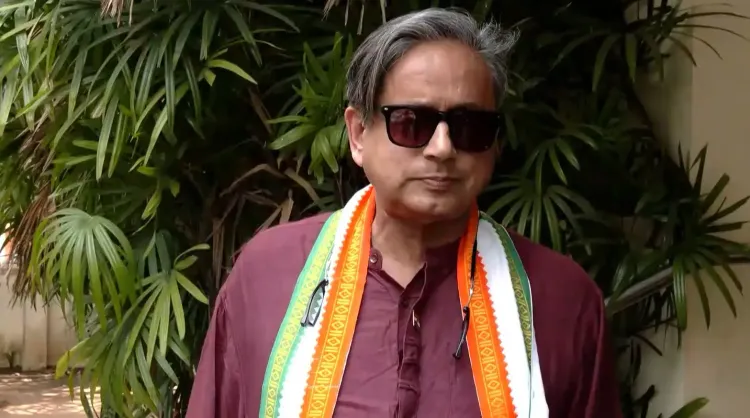
Thiruvananthapuram, April 7 (NationPress) Senior Congress figure Shashi Tharoor expressed unwavering confidence in the United Democratic Front’s (UDF) chances in the upcoming Kerala elections, forecasting a decisive win for the alliance while minimizing the Bharatiya Janata Party’s (BJP) influence in the region.
In a detailed discussion with IANS, he shared insights on Prime Minister Narendra Modi’s campaigning strategies, governance challenges, pivotal national policy matters, and India’s diplomatic stance on global disputes.
Here is the text of the interview:
IANS: What is your perspective on the Kerala elections? Is it an easy path for Congress, or is the competition fierce?
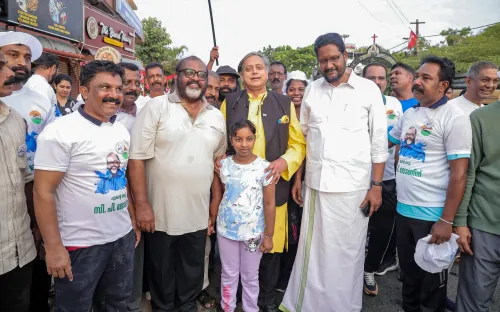
Shashi Tharoor: I strongly believe we are looking at a very evident UDF win when citizens cast their votes on April 9, and when the results are tallied on May 4. I am anticipating a distinctly favorable outcome for the UDF. I have visited 59 constituencies across 12 of the 14 districts. While I wished to cover all 14, the Election Commission's limited timeframe has posed challenges. However, what I have observed is an overwhelming enthusiasm and backing for our candidates, coupled with a robust, almost unanimous call for change within the state.
IANS: The Prime Minister is dedicating significant attention to Kerala, holding numerous rallies. How do you view his appeal?
Shashi Tharoor: I pity the Prime Minister for squandering his time here, as the people understand he will not be the Chief Minister. Any minimal gains the BJP may achieve in parliamentary terms are inconsequential regarding who will govern Kerala. The BJP is essentially a zero-seat party in this state. Even if they rise from zero to one, two, or perhaps three seats, it won't influence governance meaningfully. I assert that the anti-incumbency sentiment is genuine, and voters desiring change should not misallocate their votes to the BJP. They should back the UDF to allow us to establish a strong and effective government with a substantial majority.
IANS: The ruling party (LDF) is encountering multiple obstacles, including issues related to Wayanad. What is your take on this?
Shashi Tharoor: Regarding the Wayanad situation, we must acknowledge that when calamity strikes, accountability rests with the ruling administration. They have access to the Chief Minister’s Distress Relief Fund, national disaster grants, as well as the Prime Minister’s relief fund. Given these resources, it is the incumbents who should face scrutiny. We need to ask: what actions have you taken, what is your accountability, and what have you achieved for the populace? While the opposition's assistance is admirable and serves as a form of public service, it is not a formal legal obligation for them to rebuild homes for disaster victims. Nevertheless, both the Congress and the Indian Union Muslim League have stepped in to assist, and their efforts deserve commendation.
IANS: The Prime Minister has been promoting ‘One Nation, One Election’ and the Uniform Civil Code. What is your viewpoint on these?
Shashi Tharoor: The concept of ‘One Nation, One Election’ proposed by the Prime Minister is quite intriguing. While there isn’t anything fundamentally wrong with the idea—it might even seem efficient—historically, India followed this system between 1952 and 1967. However, it was abandoned due to the nature of our parliamentary system. Governments rely on legislative majorities, and should a government lose its majority or a coalition collapse, elections must occur within six months, disrupting any set cycle. Since 1967, various governments have crumbled at different times, which is why elections are now frequent across the nation. The Prime Minister appears to perceive this as if India operates under a presidential system where fixed terms are viable, but in a parliamentary setup, one must choose between the two.
IANS: How do you assess India's handling of the ongoing conflict in West Asia? Has national interest been prioritized?
Shashi Tharoor: The situation in West Asia, particularly involving Iran, adversely impacts not only the directly involved nations but also those far removed from it. For instance, India significantly relies on the Strait of Hormuz for oil, gas, LPG, and other vital resources. Beyond mere fuel, crucial by-products such as fertilizers and helium are essential for our economy. As long as this conflict persists, its repercussions will be felt globally. Hence, India should firmly advocate for peace. I believe India should adopt a more assertive stance and become a voice for all nations suffering due to this conflict.
IANS: The Prime Minister has reportedly engaged with leaders from Iran, Israel, and Gulf nations. How do you evaluate his approach?
Shashi Tharoor: If the Prime Minister has indeed reached out to these leaders, that is undoubtedly a commendable initiative. However, this engagement must lead to tangible outcomes. The subsequent step should be to issue a public or private appeal—ideally both—on behalf of the region and all impacted nations, urging for peace and de-escalation.
IANS: If you were offered the position of Chief Minister of Kerala, would you contemplate accepting it?
Shashi Tharoor: That is a purely hypothetical scenario. It is not destined to occur. The Congress party follows a well-established process—post-election results, the elected MLAs will be consulted, and leadership decisions will be made. I am not a candidate for that role, nor do I anticipate such an opportunity. Nevertheless, many senior leaders reach out to me for guidance and connections, and I will always be available to support whoever assumes the Chief Minister’s position if they seek my assistance.
Point of View
It's crucial to note the growing sentiment for change among voters in Kerala, as expressed by Shashi Tharoor. His confidence in the UDF's prospects highlights the political dynamics at play, particularly in the face of anti-incumbency sentiments. The interview provides valuable insights into the strategies employed by major political players.
NationPress
7 Oct 2026
Frequently Asked Questions
What are Shashi Tharoor's views on the upcoming Kerala elections?
Shashi Tharoor believes the UDF will achieve a clear victory, emphasizing the public's desire for change.
How does Tharoor perceive the BJP's role in Kerala?
He downplays the BJP's influence, considering it a minimal player in Kerala's political landscape.
What is Tharoor's stance on the Prime Minister's initiatives?
He expresses skepticism about initiatives like 'One Nation, One Election,' arguing they do not fit India's parliamentary system.
How does Tharoor assess the situation in West Asia?
He stresses the importance of India advocating for peace, given the region's impact on global resources.
Would Tharoor consider becoming Chief Minister of Kerala?
He states that it is a hypothetical question and emphasizes the Congress party's established decision-making process.