Did Trump Just Launch the Board of Peace to Transform Gaza?
Synopsis
In a pivotal move at Davos, President Trump unveiled the Board of Peace, a bold initiative aimed at reshaping Gaza through economic revival and disarmament. This effort promises to shift the narrative from conflict to reconstruction, attracting global leaders and aiming for a sustainable future in the region. What does this mean for Gaza and beyond?
Key Takeaways
Board of Peace launched by Trump at Davos.
Aims to promote economic revival in Gaza.
Focus on disarmament and governance reform.
Collaboration with global leaders from various regions.
Potential model for future conflict resolution.
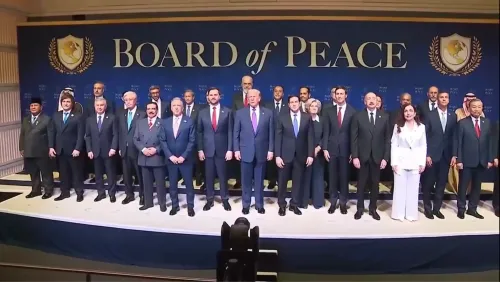
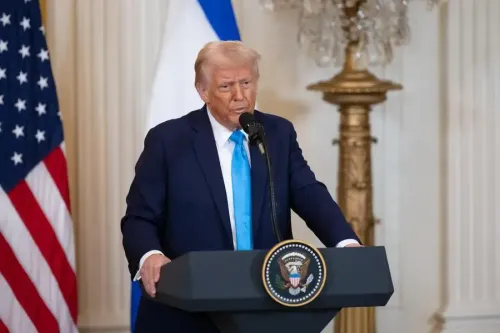
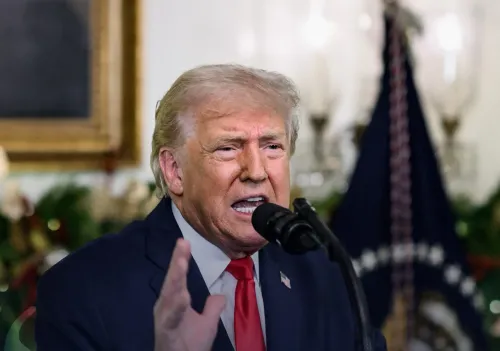
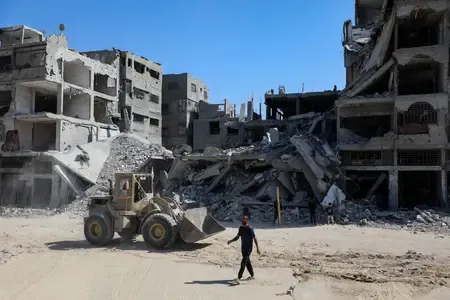
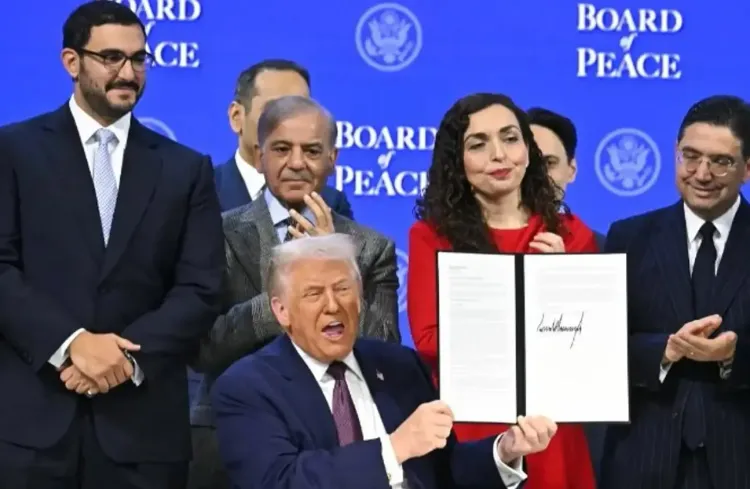
Washington, Jan 22 (NationPress) On Thursday, President Donald J. Trump inaugurated the Board of Peace at Davos, presenting a U.S.-supported initiative aimed at securing peace, facilitating crossings, disarming armed factions, and initiating a comprehensive reconstruction and economic revival in Gaza.
This is a truly remarkable day,” Trump expressed, portraying the initiative as a transition from conflict to reconstruction.
He later articulated Gaza's future in economic dimensions, insisting that redevelopment and geographical advantages could alter the territory's outlook.
“I’m fundamentally a real estate person, and it’s all about location,” Trump remarked. “Consider this location by the sea. Imagine what this stunning property could mean for countless individuals.”
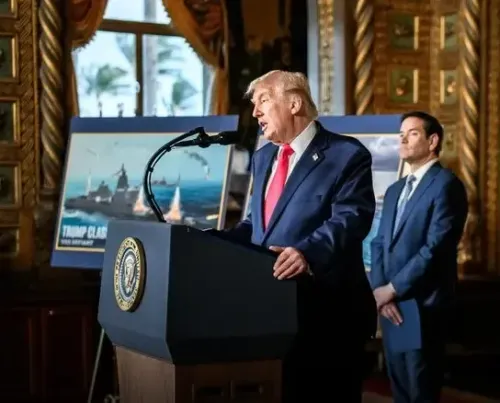
The launch followed the endorsement of the Board of Peace charter. Secretary of State Marco Rubio claimed that the Gaza initiative represented what he referred to as a significant transformation in U.S. diplomacy under Trump’s leadership.
Rubio noted that many had deemed the Gaza conflict unsolvable.
“If we rewind just a few months, people thought the situation in Gaza was beyond resolution,” he stated. “Nobody believed there would be a resolution without further fighting and bloodshed.”
He contended that traditional international bodies had failed to produce tangible outcomes.
“Unfortunately, many institutions that have historically served us effectively over the past 70 years could do nothing to address this issue,” Rubio remarked.
Rubio credited Trump’s determination for advancing negotiations and emphasized that the administration was concentrating on execution rather than mere proclamations.
“This isn’t simply a board of peace,” Rubio clarified. “This is a board of action.”
He underscored the aim of ensuring that the Gaza agreement is sustainable and could serve as a model elsewhere.
“This marks the dawn of a new era and stage,” Rubio asserted. “A prototype for the rest of the world regarding what can be achieved.”
An announcement made during the event revealed that the Rafah crossing between Gaza and Egypt will be opened next week, a crucial step for humanitarian assistance and economic activities.
U.S. special envoy Steve Witkoff stated that the administration has pursued an agreement many believed impossible.
“We have secured a peace agreement in Gaza,” he declared. “All the hostages are home, all except for one body, and we will recover that body as well.”
Witkoff emphasized that the accord generated momentum for larger changes.
“Perhaps most significantly, we have fostered a sense of hope for what the future holds in Gaza,” he stated.
Senior presidential adviser Jared Kushner followed with a visual presentation detailing the reconstruction strategy and the hurdles of transitioning from ceasefire to governance and growth.
“How do you actualize peace?” Kushner questioned. “Peace is distinct from a business transaction because it requires a shift in mindset.”
Kushner acknowledged that Gaza’s crisis extends beyond the recent conflict.
“There were two years of intense warfare,” he remarked. “For Gazans, it has been more than just two years of war; they have endured 20 years of despair.”
He asserted that security and governance are prerequisites for economic revival.
“Without security, no one will invest,” Kushner noted. “No one will come to build there.”
Kushner stated that Gaza cannot rely on aid indefinitely.
“For a long time, 85% of Gaza’s GDP has been reliant on aid,” he pointed out. “This is unsustainable. It strips individuals of dignity and hope.”
The plan aims to substitute dependency with job creation and private investment.
“We intend to apply free market principles,” Kushner stated, emphasizing the goal is “to empower these individuals to prosper and lead fulfilling lives.”
The Board of Peace comprises leaders from Bahrain, Morocco, Argentina, Armenia, Azerbaijan, Bulgaria, Egypt, Hungary, Indonesia, Jordan, Kazakhstan, Kosovo, Mongolia, Pakistan, Paraguay, Qatar, Saudi Arabia, Turkey, United Arab Emirates, and Uzbekistan, as per a White House announcement.
The Davos launch united governments from the Middle East, Europe, Central Asia, and South America as part of a broader initiative to stabilize Gaza through disarmament, governance reform, and rebuilding—an approach the Trump administration asserts could redefine post-conflict recovery efforts beyond the region.
Point of View
I recognize the significance of the Board of Peace. This initiative not only aims to stabilize Gaza but also reflects a shift in U.S. diplomacy under Trump. While challenges remain, the emphasis on economic revival and reconstruction is a welcome approach. We must monitor the implementation closely to ensure it translates into tangible benefits for the people of Gaza.
NationPress
20 Sept 2026
Frequently Asked Questions
What is the Board of Peace?
The Board of Peace is an initiative launched by President Trump aimed at promoting peace in Gaza through economic development, disarmament, and reconstruction.
What goals does the Board of Peace aim to achieve?
The goals include securing peace, opening crossings, demilitarizing armed groups, and initiating long-term reconstruction and economic revival in Gaza.
Who are the members of the Board of Peace?
The Board includes leaders from various countries including Bahrain, Morocco, Argentina, and many others, focusing on collaborative efforts for stabilization.
How does the initiative plan to ensure its success?
The initiative focuses on action-oriented strategies, emphasizing the importance of security, governance, and attracting private investments to facilitate economic growth.
What impact could this have on Gaza's future?
If successful, the Board of Peace could serve as a model for conflict resolution and economic revitalization, not just in Gaza, but in other regions facing similar challenges.