What Message is the US Indo-Pacific Commander Sending to Adversaries?
Synopsis
In a New Year's address, Admiral Samuel Paparo Jr. emphasizes the need for the US and South Korea to bolster their defense posture to convey a strong message to adversaries regarding the costs of aggression. This comes amid rising tensions in the Taiwan Strait and a call for a united front in the Indo-Pacific region.
Key Takeaways
Strengthened Defense Posture: The US and South Korea need to enhance their joint defense strategy.
Clear Message to Adversaries: The cost of aggression must be communicated effectively.
First Island Chain Significance: It is crucial for maintaining US dominance in the region.
Regional Tensions: Recent military mobilizations by China have increased tensions in the Taiwan Strait.
Commitment to Peace: The goal is to ensure peace and security in the Korean Peninsula and the Indo-Pacific.
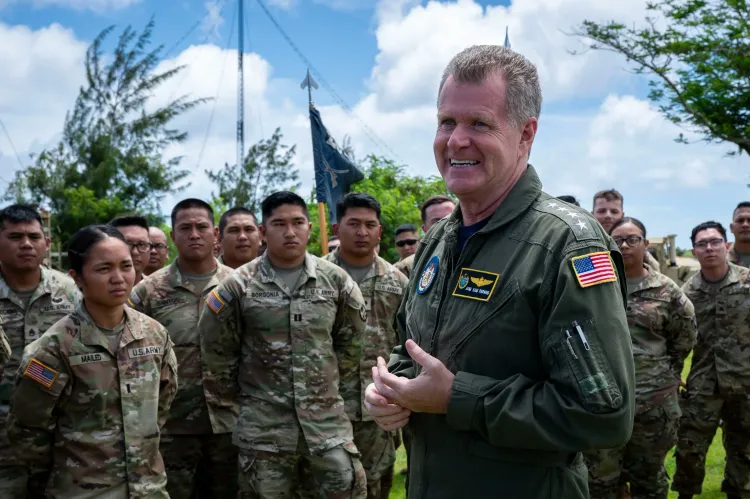
Seoul, January 2 (NationPress) The commander of the US Indo-Pacific Command has emphasized the necessity for South Korea and the United States to further enhance their joint defense strategy in the new year to convey a strong message to adversaries regarding the consequences of aggression.
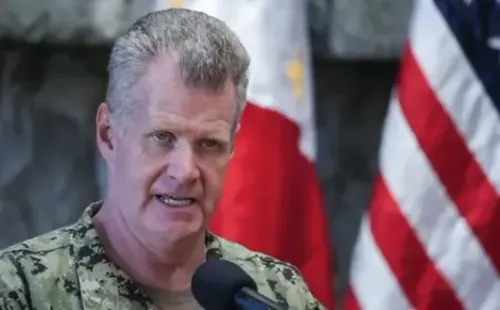
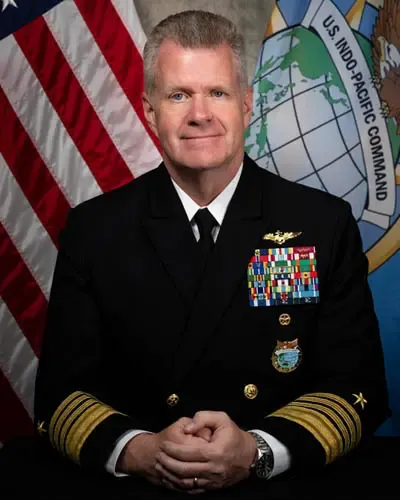
Admiral Samuel Paparo Jr. made this statement in a New Year’s address, urging Washington to encourage Seoul and other nearby allies to play a role in safeguarding the First Island Chain, which is crucial for maintaining America’s dominance against China in the region.
“We must also continue to develop a powerful, united defense, sending a clear message to any adversary that the cost of aggression would be excessively high,” Paparo stated in a message shared via the Korea-US Alliance Foundation (KUSAF) and the Korea Defence Veterans Association (KDVA), as reported by Yonhap News Agency.
This statement from the top INDOPACOM official follows Beijing's recent mobilization of Army, Navy, Air Force, and Rocket Force personnel in the Taiwan Strait and its surrounding areas, which the Chinese military referred to as a serious warning against “separatist forces” and “external interference.”
In reaction, the US State Department has urged Beijing to cease its military intimidation toward Taiwan and pursue meaningful dialogue.
In his message, Paparo highlighted how Seoul and Washington have reiterated their unbreakable commitment through bilateral discussions among their leaders, defense heads, and high-ranking military officials in 2025, calling on the allies to adopt a path of shared innovation.
“Our collective mission is to transform this momentum into decisive action that guarantees peace and security for the Korean Peninsula and the wider Indo-Pacific region,” he remarked.
Meanwhile, US Forces Korea (USFK) Commander Gen. Xavier Brunson expressed gratitude to the organizations for their role in maintaining the bond that has supported the Alliance for over seven decades.
“Thanks to organizations like KUSAF, our Alliance remains robust, relevant, and prepared for future challenges,” Brunson stated.
Point of View
I believe that the ongoing collaboration between the US and South Korea is vital in ensuring regional stability. The commitment to a robust defense strategy serves not only to deter aggression but also to promote peace in a geopolitically sensitive area.
NationPress
30 Sept 2026
Frequently Asked Questions
What is the main message from the US Indo-Pacific Commander?
The US Indo-Pacific Commander emphasizes the need for stronger defense cooperation between South Korea and the US to deter aggression from adversaries.
Why is the First Island Chain important?
The First Island Chain is crucial for America's strategic dominance against China in the Indo-Pacific region.
What recent actions have escalated tensions in the Taiwan Strait?
China recently mobilized its military forces in the Taiwan Strait, which it described as a warning against separatist forces.
How has the US responded to China's military pressure?
The US State Department has urged China to cease its military pressure on Taiwan and engage in meaningful dialogue.
What does the term 'ironclad commitment' refer to?
It refers to the strong and unwavering alliance between the US and South Korea, reaffirmed through various bilateral meetings.