Has the US Senate Passed a Bipartisan Bill to Combat Foreign Fraud Networks?

Synopsis
The US Senate has passed the SCAM Act, a bipartisan bill aimed at dismantling foreign fraud networks targeting Americans, especially seniors. This legislation seeks to enhance law enforcement capabilities and foster international cooperation to combat the growing threats of cyber-enabled scams.
Key Takeaways
SCAM Act aims to combat foreign fraud targeting seniors.
Bipartisan support highlights the urgency of the issue.
Legislation strengthens coordination among US agencies.
International partnerships are key to fighting fraud.
Focus on human trafficking linked to fraud networks.
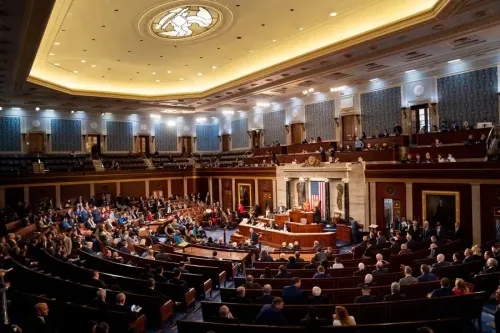
Washington, Dec 13 (NationPress) The US Senate has successfully passed a bipartisan legislation designed to dismantle fraudulent operations from abroad that primarily target Americans, especially the elderly. Lawmakers raised alarms regarding the escalating threat posed by cyber-enabled fraud linked to international criminal networks.
The legislation, officially named the Scam Compound Accountability and Mobilisation (SCAM) Act, aims to disrupt overseas scam operations while enhancing collaboration among US federal agencies, according to Senator Rick Scott, chairman of the Senate Special Committee on Aging. This law also aims to broaden international partnerships and hold transnational criminal organizations accountable for human trafficking and forced criminality associated with fraud schemes, as stated in a media release.
As per Scott's office, this bill is a response to what lawmakers have described as an “exploding threat” of foreign scams that siphon billions from Americans every year, especially targeting vulnerable groups.
“We must intensify efforts to hold accountable those criminals in Communist China and globally who are preying on innocent Americans through scam operations,” Scott asserted. “The SCAM Act is a vital move toward safeguarding our seniors and every American affected by ensuring our law enforcement agencies are adequately resourced to combat this abuse.”
Scott urged the House of Representatives to act swiftly, expressing gratitude for the bipartisan cooperation in finding a solution and encouraging rapid passage to protect the American populace.
The bipartisan support for this legislation crossed party lines, with senators from both parties acknowledging the growing sophistication of international fraud rings and their connections to coercion and human trafficking.
Senator John Cornyn emphasized that this measure is targeted specifically at organized criminal networks that compel individuals to participate in scam operations aimed at Americans. “Transnational criminal organizations that ensnare innocent victims and force them to defraud Americans must be held responsible,” he stated. “This legislation would implement strategic initiatives to counter the increasing threat of cyber scams posed by criminals linked to China and other malicious entities, ensuring the protection of Americans and their finances.”
Senator Jeanne Shaheen underscored the extensive financial repercussions and the human toll these schemes impose. “Criminal enterprises abroad are trafficking individuals into forced criminality within scam centers, draining billions from Americans annually,” she noted.
The SCAM Act is a culmination of extensive efforts by Scott and the Senate Aging Committee to combat fraud targeting older Americans. His office indicated that the chairman has concentrated on enhancing oversight and improving federal responses as scams evolve technologically, utilizing methods such as artificial intelligence and deepfake technology.
In pursuit of this goal, Scott has spearheaded the bipartisan 2025 Fraud Report, organized a congressional field hearing in Florida, and introduced several legislative proposals, including the STOP Scammers Act, the GUARD Act, the National Strategy for Combating Scams Act, and the National Slam the Scam Day Resolution.
He has also revealed the committee’s toll-free Fraud Hotline, aimed at broadening access to education and prevention resources, as well as providing direct assistance to help families identify, report, and recover from fraud.
This bill has garnered co-sponsorship from Senators Pete Ricketts, James Lankford, Tammy Duckworth, Maggie Hassan, Jacky Rosen, and Tim Kaine. Advocacy organization AARP has endorsed this legislation, highlighting its emphasis on protecting seniors and bolstering enforcement against international fraud networks.
If enacted, the SCAM Act would represent one of the most thorough legislative efforts in the US aimed at tackling overseas scam operations, an issue that has garnered increasing focus from law enforcement and policymakers.
Point of View
The passage of the SCAM Act by the US Senate represents a proactive approach to an increasingly complex issue. The focus on protecting vulnerable populations, particularly seniors, demonstrates an understanding of the evolving nature of fraud and the need for robust legislative measures. It is crucial for lawmakers to maintain bipartisan efforts to address these challenges effectively, ensuring that the American public feels secure from the threats posed by foreign fraud networks.
NationPress
1 Oct 2026
Frequently Asked Questions
What is the SCAM Act?
The SCAM Act, or Scam Compound Accountability and Mobilisation Act, is a bipartisan bill passed by the US Senate aimed at dismantling foreign fraud operations targeting Americans, particularly seniors.
Who sponsored the SCAM Act?
The SCAM Act has been co-sponsored by Senators including Rick Scott, Pete Ricketts, James Lankford, Tammy Duckworth, Maggie Hassan, Jacky Rosen, and Tim Kaine.
What are the main objectives of the SCAM Act?
The SCAM Act aims to disrupt overseas scam operations, enhance coordination among US federal agencies, and hold transnational criminal organizations accountable for fraud schemes and human trafficking.
Why is the SCAM Act necessary?
The SCAM Act is necessary to address the growing threat of cyber-enabled fraud that drains billions from Americans every year, particularly targeting vulnerable populations.
How does the SCAM Act protect seniors?
The SCAM Act includes measures to strengthen law enforcement's ability to combat fraud schemes that specifically target seniors, ensuring they have the resources to protect themselves.