US senators introduce 4 bills to close China tech loopholes, track AI
Synopsis
A rare bipartisan consensus in the US Senate: four bills introduced together to track China's AI arsenal, extend prosecution windows for tech smuggling to ten years, plug affiliate-company loopholes, and fast-track specialist hiring at the Bureau of Industry and Security. The House already passed one of them 47-0 — a signal that Washington's technology guardrails against China are tightening across party lines.
Key Takeaways
Jon Husted (Republican, Ohio) and Sen.
Mark Warner (Democratic, Virginia) introduced a package of four bipartisan bills on 12 August targeting China's tech access.
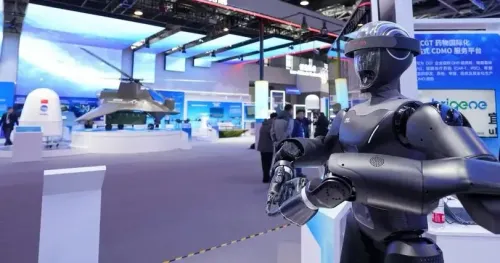
The China AI Power Report Act mandates annual government assessments of China's AI chips, data centres, humanoid robots, and export-control evasion attempts.
A second bill extends the statute of limitations for export-control violations from 5 to 10 years , addressing slow-moving tech-smuggling investigations.
The ADVERSARIES Act would close loopholes allowing US affiliates of blacklisted foreign firms to access controlled technology their parent companies cannot.
The BIS STRENGTH Act allows up to 25 outside specialists to be hired at BIS for up to five years to bolster enforcement capacity.
The House Foreign Affairs Committee approved the House version of the China AI Power Report Act 47-0 on 21 January 2026 .
Two US senators — Republican Sen. Jon Husted of Ohio and Democratic Sen. Mark Warner of Virginia — on 12 August introduced a bipartisan package of four bills targeting export-control gaps, China's artificial intelligence capabilities, and foreign espionage against American technology. The legislation is designed to close loopholes that foreign adversaries, particularly China, could exploit to acquire or replicate US innovations.
What the Four Bills Propose
The China AI Power Report Act would require the secretaries of commerce and state to submit an annual assessment of China's advanced AI capabilities, with the first report due within 180 days of enactment and annual reports mandated for three years. The assessment would cover China's AI chips, semiconductor factories, manufacturing equipment, data centres, computing capacity, AI models, research programmes, and humanoid robots — and would also track attempts to evade US export controls and illicitly acquire intellectual property. The report would be submitted in unclassified form but could include a classified annex.
A second bill would extend the statute of limitations under the Export Control Reform Act from five to ten years for civil or criminal cases. The lawmakers noted that Chinese technology-smuggling operations frequently take longer than five years to uncover and prosecute, making the current window insufficient for effective enforcement.
The ADVERSARIES Act would direct the Commerce Department's Bureau of Industry and Security (BIS) to review, within 90 days of enactment, whether US-based affiliates of companies on the Entity List or Military End User List are obtaining controlled products that their foreign parent companies are barred from accessing. The review would also examine national security threats involving foreign-controlled information and communications technology services.
The BIS STRENGTH Act would grant BIS temporary authority to recruit up to 25 specialists from outside the civil service at any given time, with each appointment capped at five years. The hiring authority itself would expire after five years.
What the Senators Said
'America must continue to compete and win in the technology race, but we know that communist China's strategy has never been to compete, but to steal and exploit,' Sen. Husted said. He added that 'this bipartisan package would strengthen our understanding of China's action, improve enforcement and protect American companies, workers and innovations from Chinese espionage.'
Sen. Warner said, 'The US must continue to lead in the technologies that will define the future, and we cannot allow China or other foreign adversaries to exploit American innovation and turn our own technologies against us.' He described the bills as 'commonsense improvements that will strengthen America's national security, protect our technological edge, and bolster our global competitiveness.'
Legislative Status and Bipartisan Support
All four measures have bipartisan companion bills in the House of Representatives. Notably, the House Foreign Affairs Committee approved its version of the China AI Power Report Act by a unanimous 47-0 vote on 21 January 2026, signalling broad cross-party support for tightening oversight of China's technological ambitions.
Why This Matters
The legislation comes amid sustained concern in Washington over China's ability to access advanced US technology through indirect channels — including subsidiaries, front companies, and allied third-party nations. Critics of existing export-control frameworks have long argued that enforcement capacity at BIS is understaffed relative to the scale of the threat, a gap the BIS STRENGTH Act directly addresses. This is among the most comprehensive legislative attempts to simultaneously close enforcement gaps, extend prosecutorial windows, and build an intelligence baseline on Chinese AI — all within a single package.
The bills now await Senate committee consideration; if enacted, their combined effect could significantly reshape how the US monitors and enforces technology transfer restrictions targeting China.
Point of View
From affiliate-company workarounds to understaffed enforcement bureaus. The 47-0 House committee vote on the AI reporting bill suggests this is not performative politics. The harder question is implementation: BIS has historically struggled to keep pace with the sophistication of Chinese acquisition networks, and adding 25 temporary hires does not fundamentally change that ratio. The ten-year prosecution window is the most consequential change — it removes the clock as a shield for slow-moving smuggling operations. Whether these bills survive Senate markup intact will be the first real test of how deep the bipartisan consensus actually runs.
NationPress
26 Sept 2026
Frequently Asked Questions
What are the four bipartisan bills introduced by US senators targeting China?
The four bills are the China AI Power Report Act, a bill extending export-control prosecution windows from 5 to 10 years, the ADVERSARIES Act, and the BIS STRENGTH Act. Together, they aim to track China's AI capabilities, close affiliate-company loopholes, extend enforcement timelines, and boost staffing at the Bureau of Industry and Security.
What does the China AI Power Report Act require?
It requires the US secretaries of commerce and state to submit an annual assessment of China's advanced AI capabilities, with the first report due within 180 days of enactment and reports mandated for three years. The assessment covers AI chips, semiconductor factories, data centres, humanoid robots, and attempts to evade US export controls.
Why is the statute of limitations for export-control cases being extended to 10 years?
The lawmakers noted that Chinese technology-smuggling operations frequently take longer than five years to uncover and prosecute, making the existing five-year window insufficient. Extending it to ten years gives investigators and prosecutors more time to build and bring complex cases.
What is the ADVERSARIES Act and who does it target?
The ADVERSARIES Act directs the Commerce Department's Bureau of Industry and Security to review, within 90 days of enactment, whether US-based affiliates of companies on the Entity List or Military End User List are accessing controlled products that their foreign parent companies are barred from obtaining. It targets a key loophole in existing export-control enforcement.
How far has this legislation progressed in Congress?
All four bills have bipartisan companion legislation in the House of Representatives. The House Foreign Affairs Committee approved its version of the China AI Power Report Act by a unanimous 47-0 vote on 21 January 2026. The Senate package now awaits committee consideration.