AI threatens management education by killing entry-level jobs: CEA Nageswaran
Synopsis
India's Chief Economic Adviser did not mince words at IMC 2026: AI's real threat to management education isn't making textbooks obsolete — it's sawing off the bottom rungs of the career ladder. If entry-level analytical jobs vanish, the apprenticeship model that built generations of managers disappears with them, and no AI elective can plug that gap.
Key Takeaways
CEA V Anantha Nageswaran addressed the 16th Indian Management Conclave (IMC 2026) in Noida on 18 September 2026 .
He warned that AI could eliminate entry-level jobs over the next 20–30 years , dismantling the apprenticeship model of professional learning.
Nageswaran said 'adding one AI elective will not be enough' — institutions must reorient entirely toward teaching judgement .
He described the challenge as potentially 'the whole problem' for management education, not a peripheral concern.
Routine and codified tasks — the first to be automated — are also the tasks that have historically trained young professionals.
He called for case studies and decision-making exercises as tools to build judgement that AI cannot easily replicate.
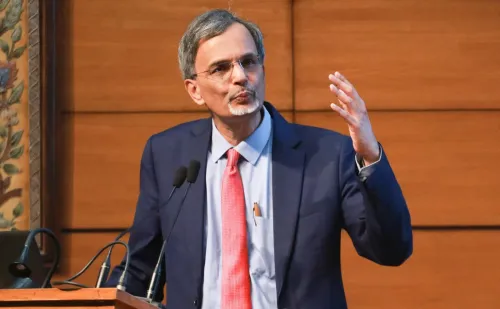
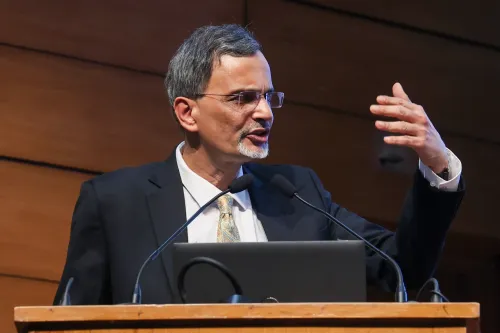
Chief Economic Adviser V Anantha Nageswaran on Friday, 18 September 2026, warned that artificial intelligence could pose the defining challenge to management education over the next two to three decades — not by making courses obsolete, but by eliminating the entry-level work through which young professionals have traditionally learnt their trade. He was addressing the 16th Indian Management Conclave (IMC 2026) in Noida.
The Core Warning: Apprenticeship at Risk
Nageswaran argued that the most consequential threat AI poses to business education is not the disruption of classrooms but the erasure of early-career apprenticeships. Routine and codified tasks — the very assignments that once taught junior professionals how to analyse, decide, and learn — are among the first to be automated.
'The bottom rungs of the ladder are being sawn off. The routine tasks that once taught the young their trade are the first to be automated,' he said. Without those formative years of on-the-job learning, he questioned how the next generation would develop the capacity for complex decision-making: 'For a century, we learn judgement on the job, slowly through apprenticeship…and if AI removes the apprenticeship, where will the next generation of judgement be?'
Why Adding an AI Elective Is Not Enough
Nageswaran was direct in dismissing superficial curriculum fixes. He said management institutions that respond by merely appending AI-related modules to their syllabi would miss the point entirely. 'Adding one AI elective will not be enough,' he said, stressing that the real imperative is to rebuild how students are taught to think.
He identified the manager's fundamental asset as a clear and patient mind — and argued that this asset is already under pressure before students even reach campus, eroded by the same technology that will later compete with them professionally. 'The manager's core tool is a clear and patient mind. That tool is under attack before the students even reach the campuses. So these are India's real challenges over the next 20 to 30 years,' he said.
Teach Judgement, Not Just Technique
The CEA called for a fundamental reorientation of what management education prioritises. As AI grows capable of performing analysis, the differentiating skill will be knowing what questions to ask and whether AI-generated answers can be trusted — neither of which can be drilled through conventional coursework alone.
'First, teach judgement, not just technique,' Nageswaran said. He suggested that case studies and structured decision-making exercises offer a more productive path toward building judgement than lecture-based instruction. Notably, he acknowledged the inherent difficulty: the very skills that AI cannot easily replicate are also the hardest to transmit through a classroom.
'This is not a small problem for management education, it could be the whole problem,' he said.
Broader Implications for India's Workforce
Nageswaran's remarks carry weight beyond the seminar room. India produces hundreds of thousands of management graduates annually, many of whom enter firms in analytical and process-driven roles that are precisely those most exposed to AI automation. If the entry-level pipeline narrows significantly, the consequences could ripple across hiring, compensation, and the long-term pipeline of experienced managers — a structural shift with no easy policy lever.
This comes amid a broader global debate on how higher education should respond to generative AI, with institutions from Harvard Business School to IIM Ahmedabad reportedly reviewing curriculum frameworks. Nageswaran's intervention signals that India's top economic policymakers are now treating the question as a priority, not a distant hypothetical. How management schools respond in the next few years will likely determine whether India's talent pipeline adapts in time.
Point of View
Which is precisely the superficial fix he is cautioning against. The harder question — how you institutionalise judgement-building at scale without real-world apprenticeship — has no obvious answer, and the fact that India's chief economic policymaker is raising it publicly suggests the window for easy fixes is already closing.
NationPress
18 Sept 2026
Frequently Asked Questions
What did CEA Nageswaran say about AI and management education?
Nageswaran warned at IMC 2026 on 18 September 2026 that AI could be the defining challenge for management education over the next two to three decades by automating the entry-level, routine work through which young professionals traditionally build their skills. He said this threatens the apprenticeship model that has underpinned professional development for a century.
Why does AI eliminating entry-level jobs matter for management graduates?
Entry-level analytical and routine tasks have historically served as on-the-job training for young managers, helping them develop judgement over time. If AI automates these roles, the traditional pathway through which professionals learn to make complex decisions disappears, leaving a gap that classroom instruction alone cannot fill.
What did Nageswaran recommend for management institutions?
He called on business schools to prioritise teaching judgement over technique, using case studies and structured decision-making exercises rather than simply adding AI-related electives. He argued that the skills AI cannot replicate — sound judgement, knowing what questions to ask, critically evaluating AI outputs — must become the core of management curricula.
What is the Indian Management Conclave (IMC 2026)?
The Indian Management Conclave is an annual forum for business education leaders, policymakers, and industry. The 16th edition was held in Noida in September 2026, where Nageswaran delivered the remarks on AI's impact on management education.
How serious is the AI threat to management jobs in India?
According to Nageswaran, it is potentially the central challenge for management education rather than a peripheral one — 'This is not a small problem for management education, it could be the whole problem.' India produces hundreds of thousands of management graduates annually, many entering analytical roles most exposed to AI automation.