AYUSH Ministry signs MoU with IndiaAI to drive AI-powered traditional medicine research
Synopsis
India's Ministry of Ayush has formally tied up with the national AI mission — IndiaAI — to put traditional medicine datasets on the AIKosh platform and tap subsidised supercomputing power. It is the first institutional bridge between Ayurveda-era knowledge systems and India's AI infrastructure push, and it signals a deliberate bet that ancient medicine can be evidence-validated through modern machine learning.
Key Takeaways
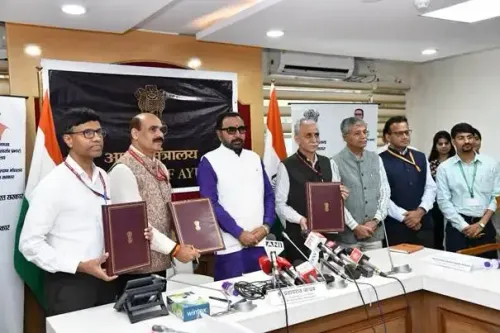
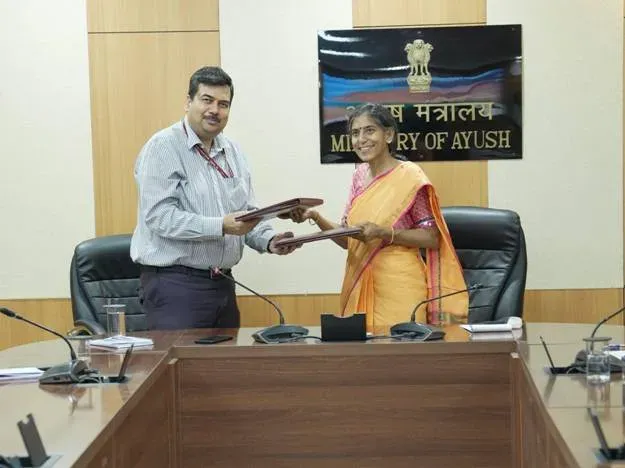
The Ministry of Ayush and IndiaAI (MeitY) signed an MoU on 31 July 2025 in New Delhi .
The AIKosh platform will host Ayush health research artefacts including datasets, AI models and toolkits.
The partnership covers research, medicinal plants, drug administration and capacity building .
Subsidised access to GPU-based and high-performance computing infrastructure will be made available under defined service-level agreements.
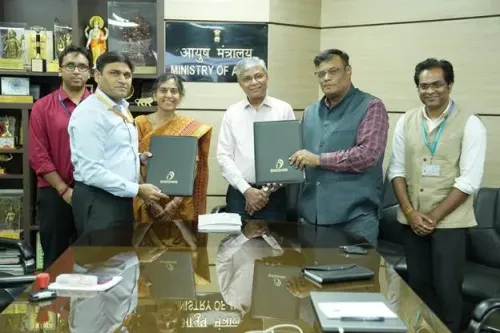
Kavita Jain (Ministry of Ayush), Sudeep Srivastava (MeitY) and Naman Goyal (Ayush Grid) represented the respective organisations at the signing.
The Ministry of Ayush on 31 July 2025 signed a Memorandum of Understanding (MoU) with IndiaAI, operating under the Ministry of Electronics and Information Technology (MeitY), to accelerate artificial intelligence-driven innovation across the Ayush sector. The agreement covers research, digital health, capacity building, medicinal plants and drug administration, according to an official statement.
Key Developments
Under the MoU, the Ministry of Ayush will onboard the AIKosh platform — India's centralised AI assets repository — to share eligible health research artefacts, including datasets, metadata, AI models, toolkits and relevant use cases. The integration is intended to foster greater collaboration and responsible development of AI solutions tailored to traditional medicine systems.
The partnership will also unlock access to GPU-based and high-performance computing infrastructure through the IndiaAI initiative at subsidised rates, subject to defined service-level agreements. This is expected to address critical infrastructure gaps and support the scaling of sophisticated AI research in healthcare and traditional medicine.
What Officials Said
Kavita Jain, Joint Secretary and Chief Vigilance Officer, Ministry of Ayush, said the integration of artificial intelligence with Ayush 'will open new avenues for evidence-based research, knowledge management and innovation.' She added that the collaboration would help leverage advanced AI capabilities across research, medicinal plants, drug administration and capacity building, making the Ayush ecosystem 'more technology-driven and future-ready.'
Sudeep Srivastava, Joint Secretary, MeitY, highlighted the importance of integrating modern technology with India's traditional knowledge systems, noting that the partnership 'will enrich AIKosh with traditional healthcare datasets and will empower researchers and practitioners of traditional medicinal sciences through AI-enabled innovation.'
Naman Goyal, OSD, Ayush Grid, noted that under its Emerging Technologies component, Ayush Grid is already developing AI-driven platforms to accelerate the digital transformation of the Ayush sector — a process this MoU is expected to significantly advance.
Significance for the Ayush Ecosystem
India's Ayush sector — encompassing Ayurveda, Yoga, Naturopathy, Unani, Siddha and Homoeopathy — has historically operated with limited digital infrastructure. This collaboration marks the first formal institutional bridge between traditional medicine governance and India's national AI mission. By placing Ayush datasets on AIKosh, the partnership could generate training data for AI models that are grounded in verified traditional knowledge, rather than unstructured or anecdotal sources.
This comes amid a broader government push to digitise healthcare, with the Ayush Grid initiative already laying the groundwork for technology adoption across the sector. The MoU now adds the computational muscle of IndiaAI's high-performance infrastructure to that effort.
What Happens Next
The immediate next step is the onboarding of Ayush health research artefacts onto the AIKosh platform. Subsidised GPU infrastructure access will follow under defined service-level agreements. Stakeholders in traditional medicine research, pharmaceutical development and capacity-building programmes are among those expected to benefit directly from the expanded digital resources.
Point of View
Not the signing ceremony. Ayush datasets have historically been fragmented, poorly standardised and rarely peer-reviewed — feeding such inputs into AIKosh risks embedding noise into India's national AI repository. The subsidised GPU access is a genuine incentive, but without a rigorous data-curation protocol, the partnership could produce AI models that lend a veneer of scientific credibility to claims that have not cleared clinical scrutiny. The government would do well to publish the data-governance framework before the onboarding begins.
NationPress
31 Jul 2026
Frequently Asked Questions
What is the MoU between the Ministry of Ayush and IndiaAI about?
The MoU, signed on 31 July 2025, establishes a formal partnership to integrate artificial intelligence into the Ayush sector, covering research, digital health, capacity building, medicinal plants and drug administration. It also enables Ayush to onboard health research artefacts onto the AIKosh platform and access subsidised high-performance computing infrastructure.
What is the AIKosh platform and how will Ayush use it?
AIKosh is India's centralised repository for AI assets, managed under the IndiaAI mission. The Ministry of Ayush will upload eligible health research artefacts — including datasets, metadata, AI models and toolkits — to facilitate collaboration and responsible AI development in traditional medicine.
Who are the key officials involved in this partnership?
Kavita Jain, Joint Secretary and Chief Vigilance Officer of the Ministry of Ayush, Sudeep Srivastava, Joint Secretary at MeitY, and Naman Goyal, OSD at Ayush Grid, were the principal representatives at the MoU signing.
What computing benefits does the MoU offer to Ayush researchers?
The MoU provides access to GPU-based and high-performance computing infrastructure through the IndiaAI initiative at subsidised rates, subject to defined service-level agreements. This is intended to support scaling of sophisticated AI research and applications in healthcare and traditional medicine.
Why does this MoU matter for India's traditional medicine sector?
It is the first formal institutional link between India's traditional medicine governance bodies and the national AI mission, potentially enabling evidence-based validation of Ayush practices through machine learning and enriching India's AI ecosystem with traditional healthcare data.