BRICS transport ministers adopt joint declaration in Nagpur on sustainable mobility

Synopsis
At the 3rd BRICS Transport Ministers' Meeting in Nagpur, member nations unanimously backed a joint declaration covering sustainable aviation fuel, urban mobility, rail research, and logistics — the most comprehensive transport agenda the bloc has formalised yet, and a test of whether India's chairship can convert declarations into durable cross-border infrastructure cooperation.
Key Takeaways
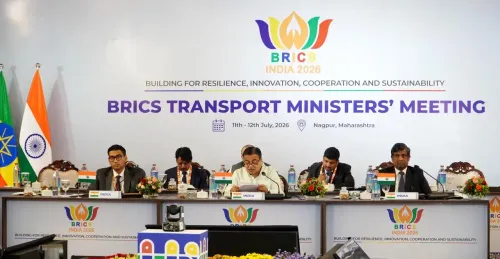
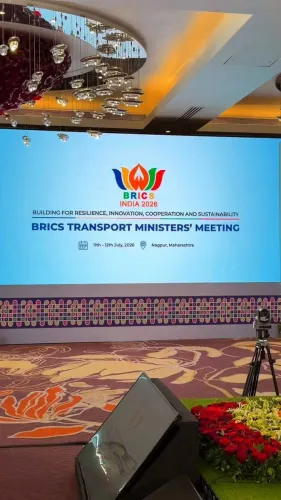
The 3rd BRICS Transport Ministers' Meeting concluded in Nagpur, Maharashtra on 11 July 2026 under India's BRICS Chairship 2026 .
Member nations unanimously adopted a joint ministerial declaration on sustainable transport, logistics, and low-carbon mobility.
The declaration formally establishes the BRICS Railway Research Network and includes cooperation on Sustainable Aviation Fuel (SAF) and transport decarbonisation .
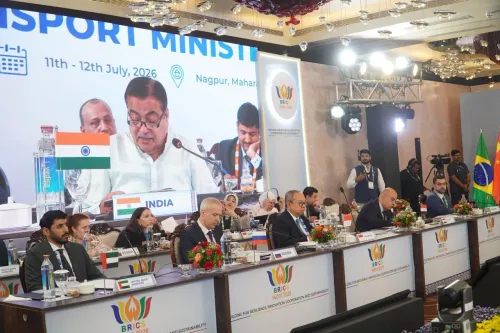
Union Minister Nitin Gadkari thanked participating delegations; India reaffirmed commitment to a smooth handover to the next BRICS Chair.
The meeting was preceded by the BRICS Transport Working Group Senior Officials' Meeting held on 9–10 July 2026 .
The 3rd BRICS Transport Ministers' Meeting concluded in Nagpur, Maharashtra, on 11 July 2026 with member nations unanimously adopting a joint ministerial declaration that establishes a shared framework for cooperation on sustainable transport, logistics, rail research, and low-carbon mobility — all under India's BRICS Chairship 2026. The outcome was announced on 12 July, marking a significant milestone in the bloc's infrastructure and climate agenda.
What the Declaration Covers
The joint declaration outlines cooperation across several priority areas, including circularity in infrastructure, Sustainable Aviation Fuel (SAF), transport decarbonisation, urban mobility hubs, and logistics and supply chain cooperation. It also formally establishes the BRICS Railway Research Network, a new institutional mechanism aimed at deepening rail-sector collaboration among member countries.
According to the official statement, the declaration reflects the collective commitment of BRICS nations to advance cooperation through consensus and mutual participation, guided by the bloc's foundational principles of mutual respect and equality.
How the Meeting Was Structured
The four-day programme brought together transport ministers, senior officials, and technical experts from across the BRICS grouping. It was preceded by the 3rd BRICS Transport Working Group (TWG) Senior Officials' Meeting, held on 9 and 10 July, where officials finalised the agenda and draft declaration ahead of ministerial approval. The broader programme also included bilateral engagements and cultural presentations designed to strengthen people-to-people ties among delegations.
What the Government Said
Union Minister for Road Transport and Highways Nitin Gadkari thanked all participating delegations for their support in delivering a successful outcome. India also expressed appreciation for the constructive engagement and contributions of all BRICS member countries, and reaffirmed its commitment to facilitating a smooth handover of agreed initiatives to the next BRICS Chair.
Why This Matters
The Nagpur declaration arrives at a moment when BRICS nations — collectively accounting for a substantial share of global freight and passenger movement — are under growing pressure to align transport systems with climate targets. The inclusion of SAF and decarbonisation frameworks signals a shift from infrastructure-volume ambitions toward emissions-quality commitments. Notably, this is the third consecutive BRICS transport ministerial, reflecting an institutionalisation of the transport agenda within the bloc's annual calendar. With India set to hand over the chairship, the durability of these frameworks will depend on how the incoming chair prioritises implementation.
Point of View
Which creates an institutional hook for follow-through, and the SAF cooperation clause, which is commercially consequential given the aviation growth trajectories of India, China, and Brazil. Whether these survive the chairship transition is the question mainstream coverage is not asking. India's diplomatic capital is invested in the outcome; the next chair's priorities will determine whether Nagpur is a foundation or a footnote.
NationPress
11 Oct 2026
Frequently Asked Questions
What was decided at the BRICS Transport Ministers' Meeting in Nagpur?
BRICS member nations unanimously adopted a joint ministerial declaration on 11 July 2026 in Nagpur, establishing a shared framework for cooperation on sustainable transport, logistics, Sustainable Aviation Fuel, urban mobility hubs, and the new BRICS Railway Research Network.
Where and when was the 3rd BRICS Transport Ministers' Meeting held?
The meeting was held in Nagpur, Maharashtra, on 11 July 2026, under India's BRICS Chairship 2026. It was part of a four-day programme that began with a Senior Officials' Meeting on 9–10 July.
What is the BRICS Railway Research Network?
The BRICS Railway Research Network is a new institutional mechanism established under the Nagpur declaration to deepen rail-sector research and collaboration among BRICS member countries.
What role did India play in the meeting?
India hosted the meeting under its BRICS Chairship 2026 and chaired the proceedings. Union Minister Nitin Gadkari led the Indian delegation and thanked participating nations. India also reaffirmed its commitment to handing over agreed initiatives smoothly to the next BRICS Chair.
Why is the BRICS transport declaration significant?
The declaration is significant because it moves the BRICS transport agenda beyond infrastructure volume toward climate-linked commitments, including transport decarbonisation and Sustainable Aviation Fuel — areas with direct commercial and emissions implications for member nations.