BRICS Industry Ministers' Meeting in Jaipur: Joint Declaration adopted under India's chair
Synopsis
India's BRICS presidency moved from words to deliverables in Jaipur on 6 August, with member nations adopting a joint declaration, greenlighting a BRICS Startup Innovation Fund, and finalising frameworks for SME and photovoltaic industry cooperation — setting the stage for the Trade Ministers' Meeting the very next day.
Key Takeaways
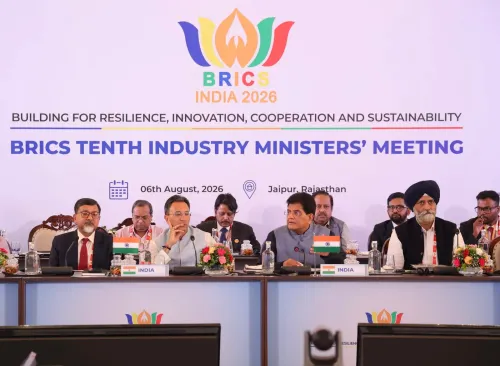
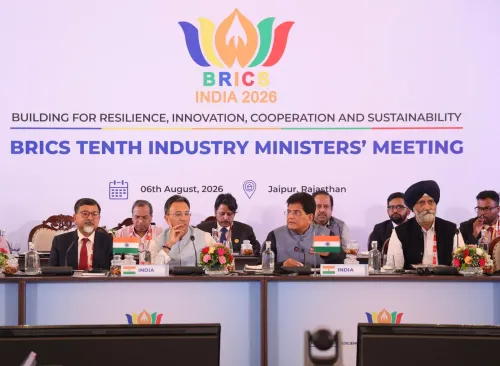
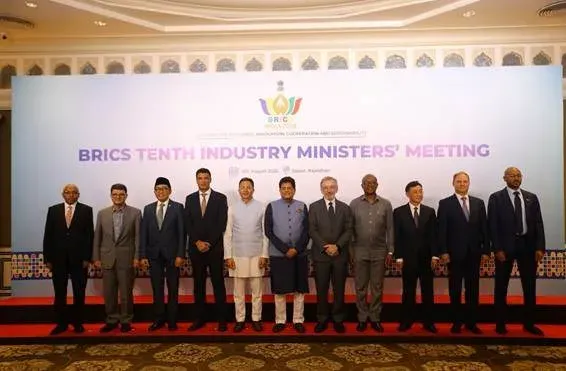
The 10th BRICS Industry Ministers' Meeting concluded in Jaipur on 6 August 2026 under India's chairmanship.
A Joint Declaration was adopted, committing member nations to practical industrial cooperation under PartNIR .
India proposed a BRICS Incubator Network and a BRICS Startup Innovation Fund to drive entrepreneurship and technology collaboration.
Key decisions included frameworks for the BRICS SME Working Group and the BRICS Working Group on the Photovoltaic Industry .
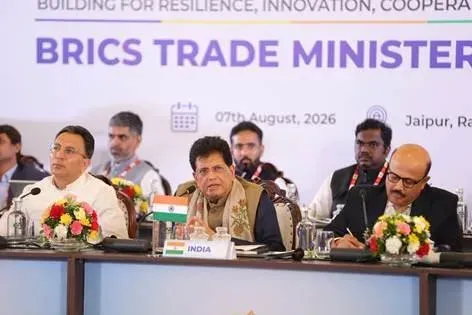
The 16th BRICS Trade Ministers' Meeting is scheduled in Jaipur on 7 August under Minister Piyush Goyal's chairmanship.
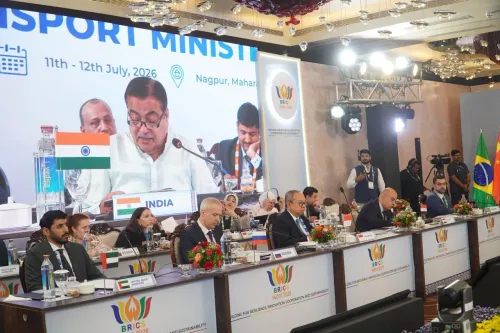
The 10th BRICS Industry Ministers' Meeting concluded in Jaipur on 6 August 2026 under India's chairmanship, with member nations adopting a joint declaration to deepen industrial cooperation through the BRICS Partnership on New Industrial Revolution (PartNIR). The gathering marked a significant milestone in India's presidency of the bloc, translating multilateral dialogue into concrete institutional commitments.
Key Outcomes and Decisions
The meeting, held under the theme 'Building for Resilience, Innovation, Cooperation and Sustainable Development', produced several actionable outcomes across four priority areas. These included the finalisation of a cooperation framework for the BRICS SME Working Group, adoption of Terms of Reference and a Work Plan for the BRICS Working Group on the Photovoltaic Industry, and approval of an action plan to promote innovation-led growth through startups.
Ministers also agreed to strengthen transport and logistics networks, incorporating GIS-based infrastructure planning and city logistics systems as part of the industrial modernisation agenda.
India's Proposals: Incubator Network and Startup Fund
India put forward two landmark proposals during the meeting: the creation of a BRICS Incubator Network and a BRICS Startup Innovation Fund. Both initiatives are aimed at fostering entrepreneurship, accelerating technology collaboration, and driving innovation-led economic growth across member states.
Union Commerce and Industry Minister Piyush Goyal, who chaired the meeting, welcomed delegates by describing Jaipur as a city that blends centuries-old craftsmanship with modern industrial ambition. He stressed that BRICS nations must convert shared aspirations into practical cooperation by leveraging complementary strengths to build resilient, self-reliant industries.
What the Government Said
Goyal recalled that the BRICS journey began with the first summit in Yekaterinburg, Russia, in 2009, acknowledged Brazil's leadership during its 2025 presidency, and reaffirmed India's commitment to advancing the partnership through a pragmatic approach. He said India's presidency aims to promote trust among businesses, investors, and innovators while delivering tangible outcomes for all member nations.
Union Minister of State for Commerce and Industry Jitin Prasada reinforced India's position, stating that 'cooperation, innovation and mutual trust are essential for building a resilient, sustainable and inclusive industrial future.'
Joint Declaration and What It Signals
The adopted Joint Declaration reflects member countries' commitment to moving beyond dialogue toward practical cooperation — with initiatives designed to strengthen industrial competitiveness, accelerate digital transformation, promote sustainable industrial development, and expand knowledge-sharing under PartNIR. Notably, participating nations welcomed progress achieved during India's 2026 BRICS presidency and agreed that PartNIR-driven initiatives would support the development of future-ready industries.
What Comes Next
Following the third meeting of the BRICS Contact Group on Economic and Trade Issues (CGETI) held in New Delhi on 3–4 August, India is set to host the 16th BRICS Trade Ministers' Meeting in Jaipur on 7 August, also under Goyal's chairmanship. That meeting will focus on strengthening trade cooperation and advancing the broader BRICS economic agenda — keeping the momentum of India's presidency intact.
Point of View
Trade ministers the next — is a deliberate signal of presidency ambition. But the real test lies in whether the BRICS Startup Innovation Fund and Incubator Network move beyond declaration to funded, operational structures. Past BRICS industrial initiatives have often produced well-worded communiqués with limited follow-through. With the bloc now expanded and geopolitically more complex, India's ability to secure consensus on actionable deliverables — not just frameworks — will define the legacy of its 2026 presidency.
NationPress
21 Sept 2026
Frequently Asked Questions
What was decided at the 10th BRICS Industry Ministers' Meeting in Jaipur?
The meeting adopted a Joint Declaration committing member nations to deeper industrial cooperation under PartNIR. Key decisions included frameworks for the BRICS SME Working Group, a Work Plan for the Photovoltaic Industry Working Group, and approval of a startup-focused innovation action plan.
What is the BRICS Partnership on New Industrial Revolution (PartNIR)?
PartNIR is the primary platform through which BRICS nations advance industrial cooperation, focusing on digital transformation, sustainable development, innovation ecosystems, and knowledge-sharing. India has used its 2026 presidency to expand PartNIR's institutional frameworks.
What new proposals did India put forward at the meeting?
India proposed the creation of a BRICS Incubator Network and a BRICS Startup Innovation Fund, both aimed at encouraging entrepreneurship, technology collaboration, and innovation-driven growth across member states.
Who represented India at the BRICS Industry Ministers' Meeting?
Union Commerce and Industry Minister Piyush Goyal chaired the meeting, and Union Minister of State for Commerce and Industry Jitin Prasada also participated, reaffirming India's commitment to deepening industrial partnerships within BRICS.
What is next on India's BRICS agenda after the Jaipur meeting?
India will host the 16th BRICS Trade Ministers' Meeting in Jaipur on 7 August 2026, also chaired by Piyush Goyal, focusing on strengthening trade cooperation and advancing the BRICS economic agenda.