Intra-BRICS trade hits $1.17 trillion, up 13-fold in 21 years: Commerce Secretary
Synopsis
Intra-BRICS merchandise trade has multiplied thirteen times in two decades to reach $1.17 trillion — yet it still represents just 5 per cent of global trade. Commerce Secretary Rajesh Agrawal's remarks at Gandhinagar frame that gap not as a failure, but as the bloc's single largest untapped opportunity, with India's own $82 billion merchandise and $31.3 billion services exports to BRICS members pointing the way.
Key Takeaways
Intra-BRICS merchandise trade grew thirteen-fold from $84 billion in 2003 to $1.17 trillion in 2024 .
Commerce Secretary Rajesh Agrawal made the disclosure at the 2nd CGETI meeting in Gandhinagar on 17 May 2025 .
Despite the surge, intra-BRICS trade accounts for only around 5 per cent of global trade, signalling significant headroom.
India's merchandise exports to BRICS nations were estimated at $82 billion in FY26 ; services exports stood at $31.3 billion in CY24 .
India holds the BRICS Chairship for the fourth time , having previously led in 2012, 2016, and 2021.
Key agenda items included MSME internationalisation, value-chain resilience, and expanding the services trade corridor.
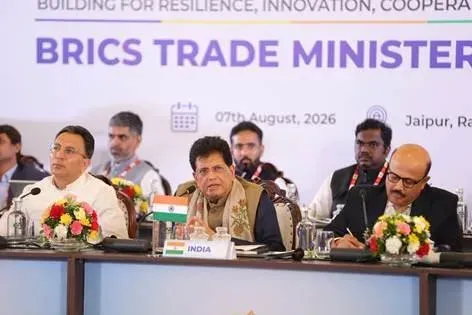
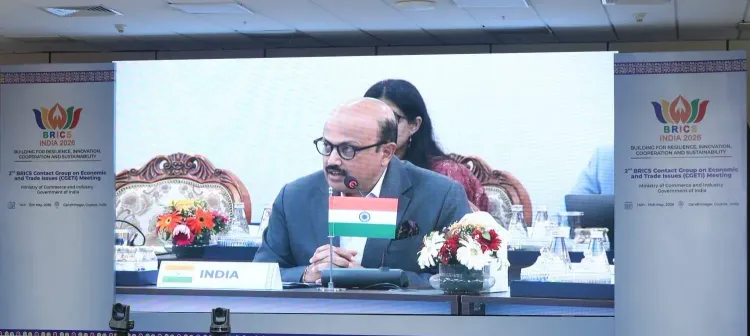
Intra-BRICS merchandise trade has surged thirteen-fold over two decades — from $84 billion in 2003 to $1.17 trillion in 2024 — outpacing overall global trade growth, Commerce Secretary Rajesh Agrawal said on Saturday, 17 May 2025, at the 2nd BRICS Contact Group on Trade and Economic Issues (CGETI) meeting in Gandhinagar. The figures, he said, reflect the bloc's growing role as a resilience anchor for emerging markets and developing economies.
Key Developments at CGETI Gandhinagar
Speaking at the two-day gathering held under the theme 'Building for Resilience, Innovation, Cooperation and Sustainability', Agrawal underscored that BRICS has consolidated its standing as an influential voice for the Global South. 'This has happened despite rising protectionism, geopolitical tensions, supply chain disruptions, inflationary pressures and growing uncertainty,' he said.
The meeting follows the first CGETI session held virtually in March 2026, and builds on work undertaken under previous BRICS Chairships. India holds the BRICS Chairship for the fourth time — having previously led in 2012, 2016, and 2021.
India's Trade Footprint Within BRICS
According to the Ministry of Commerce and Industry, India's merchandise exports to BRICS member nations stood at an estimated $82 billion in FY26, while services exports to the grouping reached $31.3 billion in CY24. Officials highlighted services and connectivity as the two most important drivers of future intra-BRICS growth.
Notably, despite the headline surge in absolute trade volumes, intra-BRICS commerce still accounts for only around 5 per cent of global trade — a figure Agrawal cited as evidence of significant untapped potential for deeper integration and value-chain linkages.
Agenda: MSMEs, Services, and Balanced Trade
Deliberations at CGETI covered a broad range of contemporary trade priorities: reinforcing the multilateral trading system, internationalising micro, small and medium enterprises (MSMEs) to generate employment, diversifying global value chains, and expanding the services trade corridor. The meeting also examined ways to open new economic opportunities for farmers, women, entrepreneurs, and businesses through greater intra-BRICS commerce.
What Comes Next
With India at the helm of BRICS for 2025, the Gandhinagar meeting is expected to feed into the broader BRICS Leaders' Summit agenda later in the year. Analysts note that as the bloc continues to expand its membership, translating trade momentum into a higher share of global commerce — well beyond the current 5 per cent — will be the defining test of BRICS' economic ambitions.
Point of View
But the 5-per-cent share of global trade tells a more sobering story: BRICS has grown largely in proportion with its own economies, not by capturing a bigger slice of world commerce. India's services exports to the bloc at $31.3 billion are a bright spot, yet merchandise at $82 billion reveals how much bilateral trade still flows outside formal BRICS frameworks. The real question for India's Chairship is whether the bloc can move from celebrating absolute growth to engineering structural integration — common payment rails, mutual recognition of standards, and genuine value-chain convergence — before the next membership wave dilutes focus further.
NationPress
19 Sept 2026
Frequently Asked Questions
How much has intra-BRICS trade grown over the past two decades?
Intra-BRICS merchandise trade has risen thirteen-fold, from $84 billion in 2003 to $1.17 trillion in 2024, outpacing overall global trade growth according to Commerce Secretary Rajesh Agrawal.
What share of global trade does intra-BRICS commerce represent?
Despite the sharp absolute rise, intra-BRICS trade still accounts for only around 5 per cent of global trade. Commerce Secretary Agrawal cited this as evidence of significant untapped potential for deeper integration.
What are India's trade figures with BRICS member countries?
India's merchandise exports to BRICS nations were estimated at $82 billion in FY26, while services exports stood at $31.3 billion in CY24, according to the Ministry of Commerce and Industry.
What is the BRICS CGETI meeting and why was it held in Gandhinagar?
The BRICS Contact Group on Trade and Economic Issues (CGETI) is a working-level forum that deliberates on trade and economic cooperation among BRICS members. The 2nd CGETI meeting was held in Gandhinagar on 17 May 2025 under India's BRICS Chairship, following a virtual first session in March 2026.
How many times has India held the BRICS Chairship?
India has assumed the BRICS Chairship for the fourth time in 2025, having previously led the grouping in 2012, 2016, and 2021.