Is the Govt's Multi-Year Semiconductor Initiative Delivering Results? Ashwini Vaishnaw Thinks So!
Synopsis
Union Minister Ashwini Vaishnaw lauds the government's semiconductor initiative, which is fostering a self-reliant ecosystem in India. With 24 startups now thriving, the vision set forth by Prime Minister Modi is turning into reality. Read on to discover how this initiative is reshaping India's technology landscape.
Key Takeaways
India's semiconductor initiative is yielding significant results.
24 startups are currently benefiting from the DLI Scheme.
The program aims to expand support to 50 fabless companies.
Focus on critical technologies is pivotal for India's growth.
Government's commitment to innovation is reshaping the tech landscape.
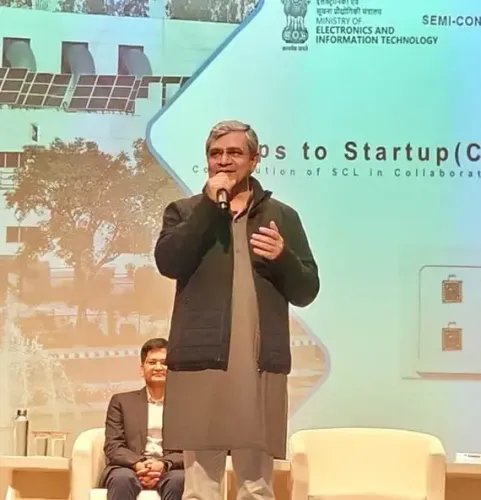
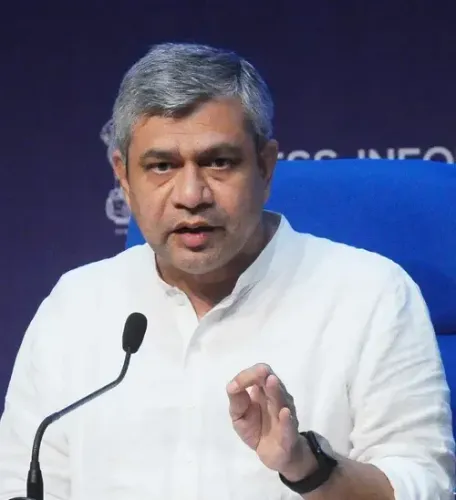
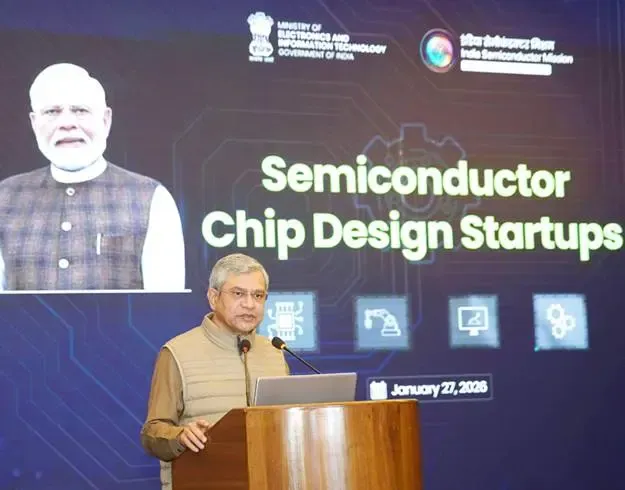
New Delhi, Jan 27 (NationPress) Union Minister for Electronics and Information Technology Ashwini Vaishnaw announced on Tuesday that the government’s long-term, ecosystem-focused strategy for semiconductor development is yielding significant outcomes.
He emphasized that India is progressively establishing a robust and self-sufficient chip design and manufacturing ecosystem.
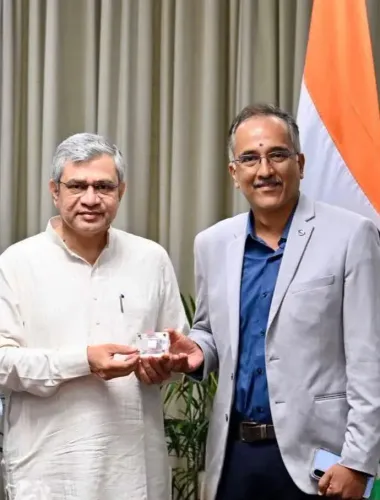
During a discussion with semiconductor chip design firms that are part of the Design Linked Incentive (DLI) Scheme under the Semicon India Programme, he mentioned the meeting's aim was to assess the advancement of these firms, learn about their design innovations, and reinforce the government’s pledge to enhance domestic semiconductor capabilities.
“The semiconductor initiative, launched in 2022, was driven by a clear long-term vision articulated by Prime Minister Narendra Modi to develop a comprehensive semiconductor ecosystem, as opposed to executing fragmented initiatives,” Vaishnaw stated.
“The objective is to transition India from a services-based economy to a product-oriented nation with substantial capacities in critical technologies,” he further elaborated.
Vaishnaw highlighted the success of the DLI Scheme, revealing that though initial expectations were modest, the program now backs 24 startups.
“Many of these companies have successfully completed tape-outs, validated their offerings, and gained market presence,” he noted.
“This has validated the government’s strategy of alleviating major obstacles faced by semiconductor startups by granting access to advanced design tools, intellectual property libraries, wafer support, and tape-out facilities,” he clarified.
The Minister remarked that the backing provided through the India Semiconductor Mission is among the most thorough globally.
He announced that the government plans to expand the program further, aiming to empower at least 50 fabless semiconductor companies in the next phase.
“India is on a promising path to developing globally competitive fabless companies in the near future,” Vaishnaw asserted.
The DLI-supported firms are engaged in various semiconductor design domains, including indigenous system-on-chips and application-specific integrated circuits for surveillance, networking, and embedded systems.
Their efforts also encompass RISC-V based processors, AI-enabled low-power chips for IoT and edge applications, telecom and wireless chipsets, power management ICs, and solutions for critical sectors like automotive, energy, space, and defense.
Point of View
It's crucial to recognize the significance of this development in India's semiconductor landscape. The government's strategic approach, led by Prime Minister Modi, aims to elevate India's position in the global technology arena. This initiative not only fosters innovation but also strengthens national self-reliance, aligning with the overall growth strategy. Nation's commitment to advancing its semiconductor capabilities is commendable and essential for future competitiveness.
NationPress
9 Oct 2026
Frequently Asked Questions
What is the Design Linked Incentive (DLI) Scheme?
The Design Linked Incentive (DLI) Scheme is a component of the Semicon India Programme aimed at promoting semiconductor design and innovation in India by supporting startups with resources and incentives.
How many startups are currently supported under the DLI Scheme?
As of now, the DLI Scheme supports 24 startups in the semiconductor design sector.
What are the key goals of India's semiconductor initiative?
The primary goals include establishing a self-sufficient semiconductor ecosystem, transitioning to a product-driven economy, and enhancing domestic capabilities in critical technologies.
What types of semiconductor technologies are being developed?
Developments include indigenous system-on-chips, RISC-V based processors, AI-enabled low-power chips, and solutions for sectors like automotive and defense.
How does the Indian government support semiconductor startups?
The government provides access to advanced design tools, intellectual property libraries, wafer support, and tape-out facilities to alleviate challenges faced by startups.