GST reforms 2026: Industry backs penalty cuts, faster SME registration
Synopsis
The GST Council's latest reforms — cutting penalties, streamlining e-commerce registrations, and launching a ₹10,000 crore SME Growth Fund — have drawn broad industry support. But the real test is whether benefits reach Tier-3 and Tier-4 city businesses, not just metro-based enterprises.
Key Takeaways
The GST Council approved reforms on 9 October 2026 including reduced penalties and faster MSME registration.
Abhishek Kumar , President of the Entrepreneurs Association of India , called the penalty cuts a 'significant step' towards building confidence in the GST system.
Small businesses on e-commerce platforms can now register without maintaining offices in multiple states.
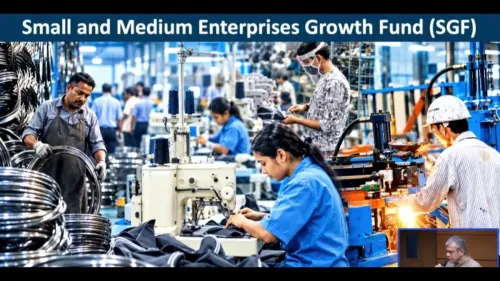
A ₹10,000 crore SME Growth Fund was approved to help smaller enterprises scale and pursue export-oriented growth.
Industry bodies urged the government to ensure fund benefits reach businesses in Tier-3 and Tier-4 cities , not only metros.
MSMEs contribute roughly 30% of India's GDP and employ over 11 crore people, according to official estimates.
Industry bodies across India on Friday, 9 October 2026 welcomed a fresh set of GST reforms, saying the changes would deepen trust in the tax system and meaningfully ease compliance burdens, particularly for micro, small and medium enterprises (MSMEs). The reforms — approved by the GST Council — include reduced penalties, accelerated registration for e-commerce sellers, and a ₹10,000 crore SME Growth Fund (SGF).
Key Reforms Welcomed by Industry
Abhishek Kumar, President of the Entrepreneurs Association of India (EAI), said the penalty reduction addresses a demand that industry groups have raised for years. 'Lowering penalties has been a long-pending demand to ensure that GST is not seen as a punitive mechanism but as an inclusive framework that supports businesses. This is a significant step towards building confidence in the GST system and the overall business environment,' he said.
Kumar also highlighted the decision to speed up GST registration for small businesses operating through e-commerce platforms, calling it a major boost for entrepreneurs. He noted that businesses would now be able to register without maintaining offices in multiple states — a compliance hurdle that had long constrained expansion.
₹10,000 Crore SME Growth Fund: Scope and Reach
The establishment of the ₹10,000 crore SME Growth Fund drew particular attention. Kumar said the fund's impact should extend well beyond large urban centres. 'Given the size and diversity of India, assistance for MSMEs should not remain limited to metro cities. The new fund will help smaller enterprises scale up, expand operations and achieve export-oriented growth. Such funding support has been a long-standing requirement,' he said, crediting the Prime Minister for approving the initiative.
Notably, calls for directing MSME support to Tier-3 and Tier-4 cities reflect a broader concern that policy benefits disproportionately concentrate in metropolitan economies, leaving smaller industrial clusters under-resourced.
Industrial Estates Back the GST Council's Moves
Ravi Sood, President of the Badli Industrial Estate Association, also backed the GST Council's measures, saying they would encourage industrial growth, especially at the grassroots level. 'The steps taken by the GST Council to support industries, particularly MSMEs, are commendable. We hope the government continues with such reforms, leading to greater liberalisation and enhancing confidence among both consumers and traders,' Sood said.
Sood added that Indian entrepreneurs have the potential to emerge as global leaders if policy support is sustained. 'If the government continues to back them through such measures, achieving the vision of a developed India well before 2047 will become a realistic goal,' he said.
Context: Why These Reforms Matter Now
India's GST framework, introduced in 2017, has undergone multiple rounds of rationalisation, but compliance costs — particularly for smaller businesses — have remained a persistent criticism. The latest reforms come amid a broader government push to improve the country's ease of doing business rankings and formalise the MSME sector, which accounts for roughly 30% of India's GDP and employs over 11 crore people, according to official estimates.
The e-commerce registration streamlining is especially significant: India's online seller base has grown sharply over the past five years, yet many small vendors have struggled to navigate multi-state GST compliance requirements. With these reforms now in motion, stakeholders and policymakers will be watching closely to see how swiftly implementation follows announcement.
Point of View
But it should not obscure the pattern: each reform cycle generates goodwill announcements without a public dashboard tracking whether compliance costs actually fell for small businesses. The ₹10,000 crore SME Growth Fund is meaningful on paper, but the Tier-3 and Tier-4 distribution concern raised by industry is the right one — past MSME schemes have been disproportionately absorbed by metro-adjacent businesses with better access to paperwork and banking. The e-commerce registration simplification is arguably the most structurally important move here, given India's exploding base of online micro-sellers. The acid test will be how quickly the backend IT systems of the GST Network are upgraded to make that simplification real, not just regulatory.
NationPress
9 Oct 2026
Frequently Asked Questions
What are the new GST reforms approved by the GST Council?
The GST Council approved a package of reforms including reduced penalties for businesses, faster GST registration for small e-commerce sellers, and the establishment of a ₹10,000 crore SME Growth Fund. The changes are aimed at reducing compliance burdens and strengthening confidence in the tax framework.
How does the ₹10,000 crore SME Growth Fund work?
The SME Growth Fund (SGF) is a government-approved corpus of ₹10,000 crore designed to help micro, small and medium enterprises scale up operations and pursue export-oriented growth. Industry bodies have urged that its benefits extend beyond metropolitan cities to Tier-3 and Tier-4 towns.
Who benefits from the faster GST registration process?
Small businesses — especially those selling through e-commerce platforms — stand to benefit most. The reform removes the requirement for sellers to maintain offices in multiple states solely for GST registration, significantly lowering the cost and complexity of compliance.
Why have penalties under GST been a concern for industry?
Industry groups have long argued that high GST penalties made the tax system feel punitive rather than supportive, discouraging small and medium businesses from formalising. The reduction in penalties is seen as a move to reframe GST as an inclusive framework rather than a punitive one.
What is the broader significance of these reforms for India's MSME sector?
MSMEs account for roughly 30% of India's GDP and employ over 11 crore people. Easing GST compliance and providing dedicated funding could help formalise a larger share of the sector and support India's broader goal of becoming a developed economy by 2047.