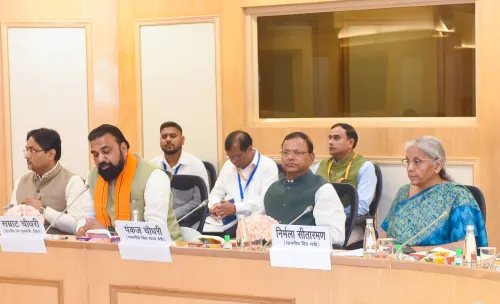
GST Council meet on Oct 8: Faster refunds, e-commerce reform, decriminalisation on agenda
Synopsis
The GST Council's 8 October meeting could mark the most consequential overhaul of India's indirect tax system since 2017 — from scrapping criminal provisions for routine lapses, to allowing small e-commerce sellers to operate nationwide with a single home-state registration. The reforms, if cleared, would structurally alter how credit flows, how exporters are taxed, and how the state deals with compliant-but-late taxpayers.
Key Takeaways
The GST Council meets on 8 October 2026 to consider the next phase of indirect tax reforms across five areas : process, structural, ease of doing business, e-commerce, and export of services.
Refunds are proposed to be acknowledged within 10 days , with 90% released after an automated risk check.
Input tax credit for a buyer who has paid in full — including tax — would no longer depend on upstream compliance by others in the supply chain.
Small e-commerce sellers could operate across India with a single home-state verification , removing the current requirement for state-by-state registration.
A large number of GST offences are proposed to be decriminalised ; taxpayers who are late or mistaken would face fines, not custody.
Small taxpayers supplying only to consumers would file returns once a year instead of monthly; 61% of taxpayers already receive registration within 3 working days .
The GST Council is scheduled to convene on 8 October 2026 to advance the next phase of indirect tax reforms, with proposals spanning faster refunds, easier business registration, expanded input tax credit, simplified e-commerce access for small sellers, and a shift toward trust-based tax administration — including the decriminalisation of a large number of GST offences, according to sources.
Key Reform Areas on the Table
The proposals are structured around five pillars: process reforms, structural reforms, ease of doing business, e-commerce, and export of services. Together, they represent one of the most comprehensive overhauls of the Goods and Services Tax (GST) framework since the levy's rollout in 2017.
On the process side, refunds are proposed to be acknowledged within 10 days, with 90 per cent of the refund amount released after an automated risk check drawing data from customs and banking systems — sharply reducing officer-level intervention.
In litigation, a common standard is being worked out for notices, hearings, and orders, with no notice issued at all below a specified monetary threshold. Return filing is to be streamlined through invoice matching, ensuring that corrections made by a supplier are automatically reflected in the buyer's ledger and that input tax credit is validated at the point of recording — pre-empting the mismatch notices that currently burden compliant taxpayers.
Structural Reforms: Input Tax Credit and Business Lifecycle
The most consequential structural change concerns input tax credit (ITC). Under the proposed framework, a buyer who holds a valid invoice, has received the goods, and has paid the supplier in full — including the tax component — would be entitled to retain the credit. Critically, that entitlement would no longer hinge on whether someone further up the supply chain has discharged their own tax liability — a persistent pain point for compliant businesses under the current system.
Ordinary business costs currently excluded from the credit chain are proposed to be brought back in, ending the practice of such tax cascading into product prices. Similarly, a service resold within the same line of business would not attract double taxation, and refunds would be widened to cover tax paid on services and on plant and machinery.
On the business lifecycle, closing a business is proposed to be made as straightforward as starting one. A registration suspended for a procedural lapse would restore itself automatically once the lapse is rectified, without requiring officer intervention. Small taxpayers supplying only to end consumers are proposed to file returns once a year instead of monthly. Registration, already granted within three working days without officer involvement for 61 per cent of taxpayers, is to be streamlined further for the remainder.
E-Commerce and Export of Services
For small sellers on e-commerce platforms, a significant barrier is proposed to be removed. Currently, a seller must have a registered place of business in every state into which goods are sold — an impractical requirement that effectively confines small operators to their home state while larger players sell nationwide. The reform proposes a single verification in the home state with nationwide applicability thereafter.
On the export of services — the fastest-growing segment of India's external trade — the proposals aim to broaden what qualifies. Billing a foreign client through a branch abroad would no longer cost an Indian firm its export status. Testing, repair, certification, and research conducted in India for a foreign client would qualify as exports even where the goods remain on Indian soil. A single standard for determining when payment counts as received — aligned with Reserve Bank of India (RBI) rules — would replace the existing dual standard. Refunds on services and equipment, where a service exporter's actual costs arise, are also proposed to be widened.
Decriminalisation and Trust-Based Administration
Perhaps the most symbolically significant proposal is the shift to a trust-based enforcement model. A large number of offences are proposed to be removed from the criminal provisions of GST law. Under the new framework, a taxpayer who is late, mistaken, or short of cash would face recovery, interest, and a proportionate penalty — and nothing more. Enforcement would work through fines rather than custody, and through systems designed to detect fraud rather than provisions aimed primarily at deterrence. Invoice matching is positioned as the tool to identify fake credit close to its source and stop it before it propagates through the supply chain.
With the 8 October meeting now days away, industry bodies and tax practitioners will be watching closely to see which of these proposals receive Council approval and at what timeline.
Point of View
If enacted, would end one of the GST system's most inequitable features: punishing compliant businesses for the failures of their suppliers. The e-commerce single-registration proposal is similarly significant; the current state-by-state requirement has functioned as a structural moat for large platforms over small sellers. The decriminalisation push is welcome, but the real test is in the detail — which offences stay criminal, and whether the invoice-matching system is robust enough to make fraud deterrence credible without the blunt instrument of arrest. If these reforms are approved largely intact, October 8 could be remembered as the meeting that completed GST's unfinished architecture.
NationPress
6 Oct 2026
Frequently Asked Questions
What is the GST Council meeting on 8 October 2026 about?
The GST Council is meeting on 8 October 2026 to consider the next phase of reforms to India's indirect tax system, covering five areas: process reforms, structural reforms, ease of doing business, e-commerce, and export of services. Key proposals include faster refunds, decriminalisation of several offences, and a revamped input tax credit framework.
What changes are proposed for GST refunds?
Refunds are proposed to be acknowledged within 10 days, with 90 per cent of the amount released after an automated risk check drawing on customs and banking data — significantly reducing the need for officer intervention and speeding up cash flow for businesses.
How will small e-commerce sellers benefit from the proposed GST reforms?
Under the proposal, a small seller would need to complete verification only once, in their home state, gaining the ability to sell across the country thereafter. Currently, sellers must maintain a registered place of business in every state they sell into, which is impractical for small operators and limits them to their home market.
What does the proposed decriminalisation of GST offences mean for taxpayers?
A large number of offences would be removed from the criminal provisions of GST law. Taxpayers who are late, mistaken, or temporarily short of funds would face recovery of dues, interest, and a proportionate penalty — but not arrest or prosecution. Enforcement would shift toward fines and fraud-detection systems rather than custody-based deterrence.
What structural change is proposed for input tax credit under GST?
The key change is that a buyer who holds a valid invoice, has received the goods, and has paid the supplier in full — including the tax — would be entitled to retain the input tax credit regardless of whether someone further up the supply chain has paid their own tax. This removes a major source of uncertainty for compliant businesses under the current framework.