Hyundai Motor bets on physical AI and robotics to fight Chinese EV threat
Synopsis
Hyundai Motor's stock has nearly halved from its June peak as investor patience with Boston Dynamics — which reportedly lost 1.7 trillion won over five years — runs thin. Now the group is betting on AI-powered factories, a Nvidia-built manufacturing platform, and automated defect inspection to prove its robotics push can actually move the bottom line before Chinese EV rivals move the market.
Key Takeaways
Hyundai Motor Group is accelerating its push into robotics and physical AI to counter rising Chinese EV competition and falling profitability.
The stock reached a record 755,000 won in June after the Atlas robot debut at CES but has since halved to 312,000 won .
Boston Dynamics reportedly incurred cumulative losses of approximately 1.7 trillion won over the past five years; its IPO is reportedly delayed.
Hyundai is co-developing Polaris , an AI manufacturing platform, with Nvidia Corp. at its Uiwang R&D Center .
AI-based vehicle defect inspection technology is set for deployment at Kia's EVO WEST plant in Hwaseong .
A robot-path simulation system is expected to complete development by June 2027 .
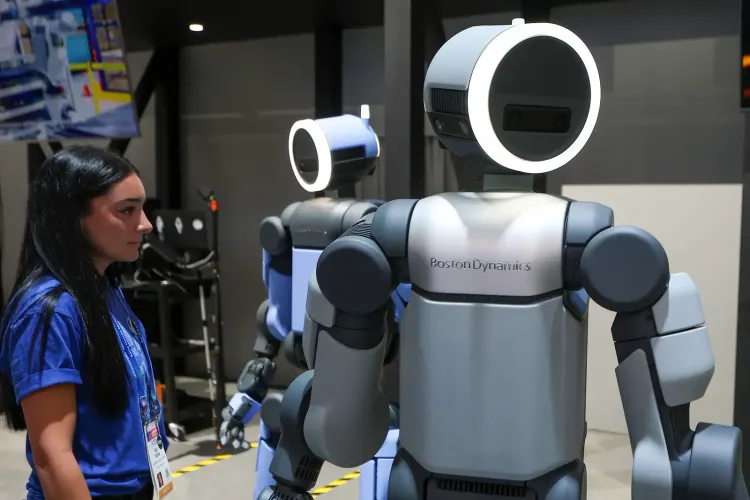
Hyundai Motor Group is accelerating its push into robotics and physical artificial intelligence (AI) as the world's third-largest automotive group confronts two compounding pressures: intensifying competition from lower-priced Chinese electric vehicle (EV) makers and a steep retreat in its own share price. The strategic pivot, centred on AI-powered factory systems and humanoid robots, is aimed at unlocking new revenue streams even as its core carmaking margins come under strain.
The Stock Slump and Boston Dynamics Uncertainty
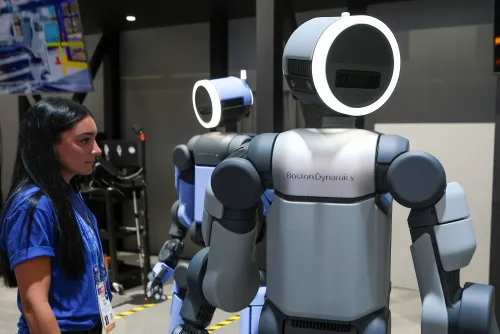
Hyundai Motor Co. shares more than doubled after its U.S. subsidiary Boston Dynamics unveiled its Atlas humanoid robot at the Consumer Electronics Show (CES) in January, touching a record closing high of 755,000 won (approximately US$565.2) in June. That rally has since fully reversed. The stock closed at 312,000 won on Friday — near pre-CES levels — as investor enthusiasm cooled amid weak earnings and mounting doubts about the timeline for robotics to turn profitable.
Speculation over a delayed initial public offering of Boston Dynamics has compounded the uncertainty. The U.S. robotics company reportedly accumulated cumulative losses of around 1.7 trillion won over the past five years, a figure that has prompted investors to question when the group's heavy capital commitments in the sector will begin delivering returns.
Lee Sang-soo, an analyst at iM Securities, noted: 'Shares of Hyundai Motor have fallen sharply amid weakness in its core automotive business. Growing concerns over potential delays in Boston Dynamics' business plans have also fueled calls for lower valuation multiples.'
AI-Powered Factories at the Core of the Strategy
At its Uiwang Research and Development Center, south of Seoul, Hyundai is developing a suite of AI-driven industrial tools designed to lift factory productivity and reduce manufacturing costs. A centrepiece initiative is Polaris — an AI-powered manufacturing platform being developed in partnership with U.S. chip giant Nvidia Corp. The platform is designed to help factory workers access information, analyse production data, and handle routine tasks more efficiently.
Separately, the group is building AI-based inspection systems capable of automatically detecting defects on vehicle exteriors, reducing dependence on outside suppliers and cutting associated costs. The technology is slated for deployment at Kia's EVO WEST plant in Hwaseong, southwest of Seoul.
Robotics Automation and the Road Ahead
A third initiative focuses on using computer simulations to auto-generate movement paths for industrial robots, eliminating much of the manual programming currently required on factory floors. Development of that system is expected to be completed by June 2027.
Taken together, these projects form part of a longer-term road map aimed at building factories where AI and robots handle increasingly complex tasks with progressively less human intervention — a model that Hyundai believes could serve as a competitive differentiator against rivals that compete primarily on price.
The Bigger Picture: Chinese Competition and EV Headwinds
The urgency behind Hyundai's pivot reflects a structural challenge reshaping the global auto industry. Chinese automakers have captured significant EV market share by undercutting legacy players on price, squeezing margins for established groups. This comes amid a broader industry-wide reckoning over EV profitability timelines, with several major manufacturers recalibrating investment schedules.
For Hyundai, the challenge is twofold: defending its position in conventional and EV markets while simultaneously convincing investors that its robotics bets will yield tangible financial returns. The gap between those two tasks — and how quickly it can be closed — will likely determine the stock's trajectory over the coming quarters.
Point of View
And the Atlas CES moment that briefly doubled the stock has evaporated as a catalyst. The deeper problem is that Hyundai is fighting on two fronts simultaneously: defending EV market share against Chinese rivals who compete on cost, and funding a capital-intensive robotics buildout that may not pay off this decade. The Nvidia-Polaris partnership is promising optics, but factory AI tools are a cost-reduction play, not a growth engine. If Boston Dynamics' IPO continues to slip, investors will question whether the robotics narrative was ever anything more than a valuation story.
NationPress
18 Oct 2026
Frequently Asked Questions
Why is Hyundai Motor investing heavily in robotics and physical AI?
Hyundai is pushing into robotics and physical AI to find new growth sources amid intensifying competition from lower-priced Chinese EV makers and weakening profitability in its core automotive business. The group is also seeking to demonstrate that its long-running investment in Boston Dynamics can generate financial returns.
What happened to Hyundai Motor's share price after the Atlas robot launch?
Hyundai Motor's shares more than doubled after the Atlas humanoid robot debut at CES in January, hitting a record closing high of 755,000 won in June 2026. The stock has since slumped to around 312,000 won as investor enthusiasm faded amid weak earnings and concerns over Boston Dynamics' profitability timeline.
How much has Boston Dynamics lost, and what is the IPO status?
Boston Dynamics reportedly accumulated cumulative losses of around 1.7 trillion won over the past five years. Its planned initial public offering is reportedly facing delays, which has added to investor uncertainty about Hyundai's robotics division.
What is the Polaris platform and how does Nvidia fit in?
Polaris is an AI-powered manufacturing platform being co-developed by Hyundai and Nvidia Corp. It is designed to help factory workers access production data, analyse outputs, and handle routine tasks more efficiently — part of a broader effort to boost productivity at Hyundai's manufacturing facilities.
When will Hyundai's new AI factory technologies be operational?
AI-based vehicle defect inspection is slated for deployment at Kia's EVO WEST plant in Hwaseong in the near term. A separate robot-path simulation system, which auto-generates movement instructions for industrial robots, is expected to complete development by June 2027.