Is Unprecedented Preferential Access for Indian Exports in EU FTA a Game Changer?
Synopsis
The recent India-EU FTA presents unprecedented preferential access for over 99% of Indian exports, marking a significant milestone for the industry. This landmark deal promises substantial benefits for key sectors, paving the way for enhanced global trade engagement and sustainable growth aligned with India's vision for 2047.
Key Takeaways
Over 99% of Indian exports will benefit from preferential access in the EU market.
The deal is expected to significantly boost labour-intensive sectors .
Tariffs on European cars will drop from 110% to 10% .
The agreement strengthens India's global trade engagement .
It aligns with India's vision for Viksit Bharat by 2047 .
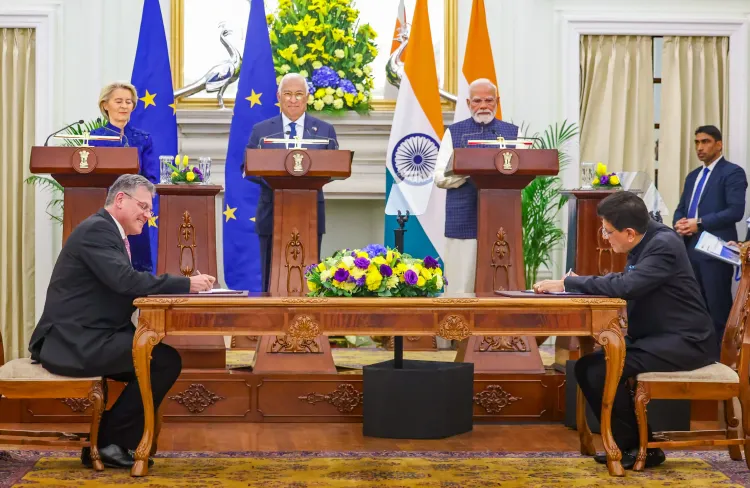
New Delhi, Jan 27 (NationPress) The unprecedented preferential access obtained for over 99 percent of Indian exports marks a significant turning point for the Indian industry, according to the Confederation of Indian Industry (CII) on Tuesday.
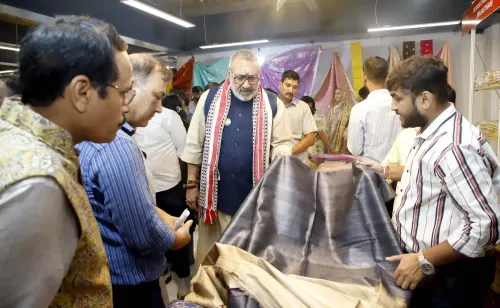
With the India-EU agreement, exports valued at Rs 6.41 lakh crore ($75 billion) are set to surge, particularly benefiting $33 billion in labour-intensive sectors such as textiles, leather, marine products, and precious stones due to the preferential access outlined in the FTA.
Chandrajit Banerjee, Director General of CII, emphasized that this historic agreement signifies a strategic advancement in India’s global trade relations, enhancing collaboration between two prominent democracies and economies that collectively contribute nearly 25 percent of the world’s GDP.
“This agreement significantly boosts competitiveness in the EU’s high-value market, strengthens the position of Indian manufacturers and service providers within global value chains, and accelerates the flow of investment and technology,” Banerjee stated.
“Key focus sectors include textiles and apparel, leather and footwear, precious stones and jewellery, marine products, engineering goods, automobiles, agriculture and processed foods, as well as IT and IT-enabled services,” he added.
The agreement promises tangible benefits for labour-intensive sectors and MSMEs while establishing a future-ready mobility framework for Indian talent, laying the groundwork for sustainable, inclusive, and globally competitive growth, perfectly aligning with India’s vision of Viksit Bharat by 2047, according to CII.
Balbir Singh Dhillon, Brand Director at Audi India, expressed support for the proposed FTA, highlighting its potential to strengthen economic connections with one of the world’s largest trading blocs.
“This proactive trade approach could enhance the automotive ecosystem, fostering innovation, supply-chain efficiency, and technology collaboration. However, any implications regarding pricing and market dynamics can only be evaluated once the final terms are available and thoroughly scrutinized, including the implementation timeline. Until then, it is premature to draw conclusions on specific commercial or product strategies,” he noted.
Dhillon mentioned that the India-EU FTA will cultivate a stable and predictable environment for European automakers, encouraging investment, innovation, and improved service for customers in India.
The FTA will reduce tariffs on European cars entering India to 10 percent from the current high of 110 percent, with this lower duty applicable under an annual quota of 250,000 vehicles. Presently, India imposes a 70 percent duty on imported passenger cars priced below $40,000, while vehicles exceeding that price face an effective customs duty of 110 percent.
This development unlocks new avenues for European car manufacturers within the Indian market, now the world's third-largest by sales.
Point of View
It's crucial to recognize the transformative potential of the India-EU FTA. This agreement not only enhances access for Indian exports but also strengthens global partnerships. It reflects a significant shift towards a more interconnected global economy, benefitting various sectors and aligning with India's long-term developmental vision.
NationPress
2 Oct 2026
Frequently Asked Questions
What sectors will benefit from the India-EU FTA?
Key sectors include textiles, leather, marine products, gems and jewellery, engineering goods, automobiles, and IT services, among others.
How much is the estimated value of exports under the FTA?
The FTA is expected to facilitate exports worth approximately Rs 6.41 lakh crore, or $75 billion.
What are the tariff changes for European cars under the FTA?
The FTA reduces tariffs on European cars entering India from 110% to 10% under an annual quota of 250,000 vehicles.
What is the significance of the India-EU FTA?
It marks a strategic breakthrough in India's global trade engagement, enhancing competitiveness and fostering deeper economic ties.
How will this FTA impact MSMEs?
The agreement is set to deliver tangible gains for labour-intensive sectors and MSMEs, contributing to sustainable and inclusive growth.