Will the India-EU FTA Provide Major Relief on Car Tariffs?
Synopsis
The India-EU FTA marks a significant reduction in car tariffs, down to 10% from 110%, paving the way for European carmakers and expanding trade opportunities across multiple sectors.
Key Takeaways
Tariffs on European cars reduced to 10% .
Applicable under an annual quota of 250,000 vehicles .
India's car market expected to reach six million units by 2030 .
Over 90% of European goods will have reduced tariffs.
New EU-India Security and Defence Partnership established.
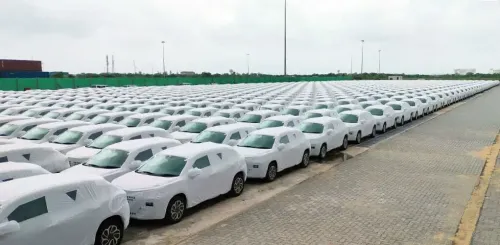
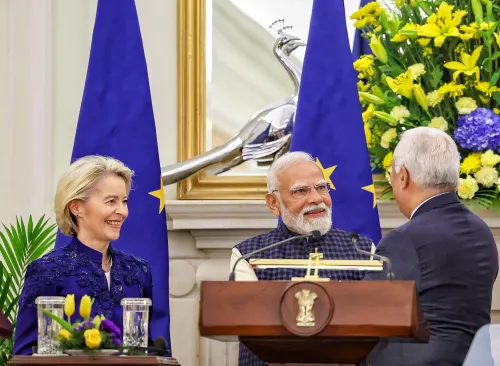
New Delhi, Jan 27 (NationPress) India and the European Union finalized a long-anticipated Free Trade Agreement (FTA) on Tuesday, significantly reducing tariffs on European automobiles entering India from a staggering 110% to just 10%.
This new lower duty will be applicable under an annual quota of 250,000 vehicles. Currently, India imposes a 70% duty on imported passenger cars valued below $40,000, while those priced above that threshold face an effective customs duty of 110%.
This shift opens up substantial opportunities for European car manufacturers in the Indian market, which ranks as the third-largest globally in terms of sales.
With projections indicating India's car market could expand to approximately six million units annually by 2030, numerous European companies are gearing up for new investments.
Renault is re-entering the Indian market with a revamped business approach, aiming to extend its reach beyond Europe where Chinese automakers are making strides.
Additionally, Volkswagen Group is in the process of solidifying its next investment phase in India through its Skoda brand.
The trade agreement extends beyond automobiles, as it will reduce or eliminate tariffs on over 90% of European products exported to India.
This includes significant cuts in duties on machinery, which currently face tariffs as high as 44%, chemicals at around 22%, and pharmaceuticals taxed at about 11%. Most of these tariffs will be phased out gradually.
Moreover, the deal will introduce changes in various sectors. Import duties on European beer will be slashed to 50%, and tariffs on chemicals, aircraft, and spacecraft will be eliminated for nearly all products.
The European Union estimates that this agreement could potentially double EU exports to India by 2032 and yield annual duty savings of up to four billion euros on European goods.
In addition to the trade agreement, leaders at the India-EU Summit inaugurated a new EU-India Security and Defence Partnership, indicating a commitment to deeper cooperation beyond just economic ties.
Point of View
I believe that the India-EU FTA is a significant step forward for both economies. It not only lowers tariffs but also enhances trade relations, fostering collaboration that could lead to innovations in various sectors.
NationPress
8 Oct 2026
Frequently Asked Questions
What is the new tariff rate for European cars in India?
The new tariff rate for European cars entering India is 10% , reduced from the previous rate of 110% .
How many vehicles will the reduced tariff apply to annually?
The reduced tariff will apply to an annual quota of 250,000 vehicles .
What other sectors will benefit from the FTA?
The FTA will lower or eliminate tariffs on over 90% of European goods, including machinery, chemicals, pharmaceuticals, and beer.
What is the expected growth of India's car market?
India's car market is projected to grow to around six million units per year by 2030 .