India-Germany quantum, photonics partnership explored in New Delhi talks
Synopsis
India and Germany's Thuringia are moving beyond traditional bilateral ties into frontier-technology territory — quantum communication, photonics, and space. With India's National Quantum Mission gaining momentum and Thuringia established as a European photonics hub, Tuesday's New Delhi meeting could lay the groundwork for ecosystem-level deep-tech collaboration that goes well beyond government-to-government agreements.
Key Takeaways
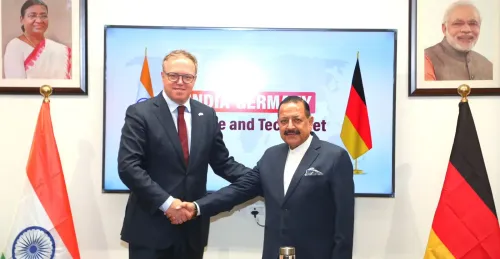
Minister Jitendra Singh met Thuringia Minister-President Mario Voigt in New Delhi on 2 June to explore frontier-technology cooperation.
Focus areas included quantum communication , quantum satellite communication, optical ground stations , photonics and space technologies.
Singh highlighted India's National Quantum Mission , IndiaAI Mission and National Green Hydrogen Mission as platforms for collaboration.
India has launched eleven German satellites via Indian launch vehicles, underpinning the existing ISRO-DLR partnership.
Both sides explored the EuroOGS network framework for standardisation in optical ground station technologies.
Multi-stakeholder participation — government, research institutions and industry — signals intent for ecosystem-level, not just bilateral, integration.
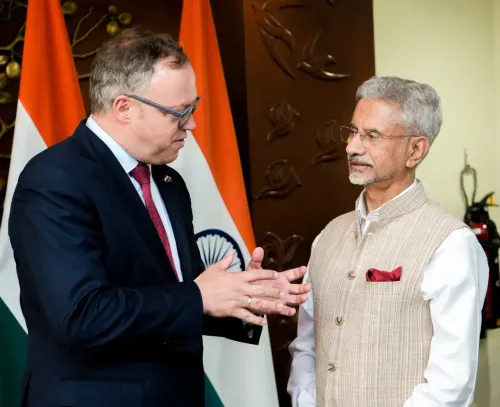
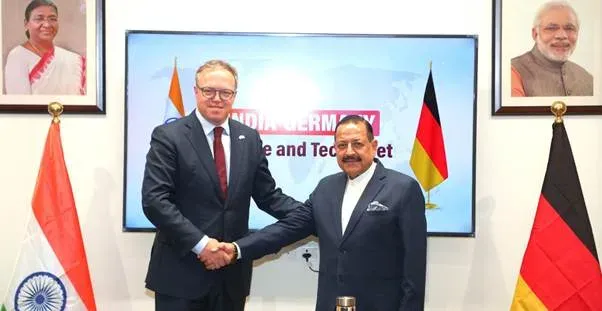
Minister of State for Science & Technology Jitendra Singh on Tuesday, 2 June held talks in New Delhi with Mario Voigt, Minister-President of Germany's Free State of Thuringia, with both sides exploring long-term institutional cooperation in quantum communication, photonics, space technologies and deep-tech innovation. The meeting, which brought together representatives from government, research institutions and industry on both sides, signals a deepening of the India-Germany science and technology partnership at the frontier-technology level.
Key Areas of Cooperation
Discussions centred on quantum technologies and photonics, covering quantum communication, quantum satellite communication, optical ground stations and quantum networks. Officials also examined European frameworks such as the EuroOGS network to advance standardisation and interoperability in optical ground station technologies — an area where Thuringia has emerged as a leading European hub.
Both sides explored pathways for connecting innovation ecosystems, encouraging collaboration among governments, scientific institutions, startups and industry to accelerate the translation of research into globally competitive products and enterprises.
India's National Quantum Mission in Focus
Singh shared progress achieved under India's National Quantum Mission, highlighting advances in secure quantum communication and related technologies. He also outlined India's expanding portfolio of mission-mode programmes, including the IndiaAI Mission, the National Green Hydrogen Mission and biotechnology initiatives — all of which, he noted, are creating new avenues for collaborative research and innovation-led growth.
Thuringia's recognition as a major European centre for photonics, optics and advanced manufacturing makes it a strategically relevant partner for India's own frontier-technology ambitions, according to an official statement.
Space Sector: Building on ISRO-DLR Ties
Strengthening cooperation in the space sector featured prominently in the agenda, with both sides looking to build on the long-standing partnership between the Indian Space Research Organisation (ISRO) and the German Aerospace Centre (DLR). India has to date successfully launched eleven German satellites aboard Indian launch vehicles.
Singh highlighted India's growing space capabilities, recent policy reforms encouraging private participation and the increasing contribution of startups to the country's expanding space economy. Potential collaboration areas discussed include satellite communications, optical communications, human spaceflight, microgravity research, Earth observation, drone technologies and future exploration missions.
Broader Strategic Significance
The discussions reflected the growing strategic importance of quantum technologies globally and the increasing imperative for international collaboration in the field. This comes amid a wider push by India to forge deep-tech partnerships with European nations as it advances its own science and technology capabilities. Notably, the meeting's multi-stakeholder format — spanning government, academia and industry — suggests both sides are looking beyond bilateral agreements toward ecosystem-level integration.
Formal frameworks for scientific exchange, expertise sharing and joint research involving institutions and technology organisations from both countries are expected to be developed as follow-on steps from Tuesday's engagement.
Point of View
Giving India access to European standards bodies and supply chains without going through the slower machinery of EU-level negotiations. The real question is whether this engagement moves beyond exploratory MoUs into joint research programmes with measurable deliverables. India's track record on science diplomacy is strong on announcements and uneven on follow-through. If the National Quantum Mission can serve as a genuine anchor — with Thuringia institutions embedded in its working groups — this could be a model for how India builds deep-tech alliances in the run-up to 2030.
NationPress
17 Oct 2026
Frequently Asked Questions
What was discussed at the India-Germany meeting on 2 June 2025?
Minister of State Jitendra Singh and Thuringia Minister-President Mario Voigt explored cooperation in quantum communication, photonics, space technologies and deep-tech innovation in New Delhi on 2 June. Discussions covered quantum satellite communication, optical ground stations, quantum networks and potential expansion of the existing ISRO-DLR space partnership.
What is India's National Quantum Mission?
India's National Quantum Mission is a government-led initiative to develop quantum technologies including secure quantum communication, quantum computing and related infrastructure. Singh shared progress on the mission during the meeting, presenting it as a key platform for international collaboration.
Why is Thuringia significant for this partnership?
Thuringia has emerged as a major European hub for photonics, optics, quantum technologies and advanced manufacturing, making it a strategically relevant partner for India's own frontier-technology push. Its expertise complements India's growing capabilities in quantum communication and space technology.
How many German satellites has India launched?
India has successfully launched eleven German satellites through Indian launch vehicles, reflecting the depth of the existing ISRO-DLR partnership that both sides are now looking to expand into new domains.
What is the EuroOGS network and why does it matter?
The EuroOGS network is a European initiative focused on advancing standardisation and interoperability in optical ground station technologies. Officials from both sides examined it as a framework that could support India-Germany cooperation in quantum satellite communication and optical communications infrastructure.