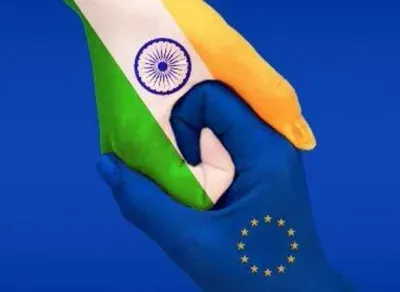
India joins EU's €93.5 billion Horizon Europe programme as talks conclude
Synopsis
India has concluded talks to formally associate with the EU's €93.5 billion Horizon Europe programme — the bloc's highest level of research cooperation for non-members. From January 2027, Indian researchers and institutions will be able to receive direct EU funding and lead major science projects, a structural upgrade from the country's earlier observer-level participation.
Key Takeaways
India and the European Commission concluded negotiations on 6 November 2026 for India's association with Horizon Europe .
Horizon Europe has a budget of €93.5 billion for the 2021–2027 period — the EU's largest-ever research programme.
Indian entities will gain direct funding eligibility and the right to lead projects under Pillar II covering healthcare, digital tech, space, climate and energy.
Association is the EU's highest level of research cooperation available to non-member countries.
The agreement is expected to enter into force from January 2027 after formal signing and internal procedures.
Formal negotiations began in July 2026 , following exploratory talks launched in February 2026 .
India and the European Commission have concluded negotiations on India's formal association with Horizon Europe, the European Union's flagship research and innovation programme with a budget of €93.5 billion for the 2021–2027 period. The announcement, made on Friday, 6 November 2026, is expected to significantly deepen scientific, technological and strategic ties between New Delhi and Brussels.
What the Association Agreement Covers
Once formally signed and ratified through each side's internal procedures, the agreement will allow Indian researchers, businesses and research organisations to participate in Horizon Europe on equal terms with counterparts from EU member states. Crucially, Indian entities will be eligible for direct funding from the programme and will be permitted to lead collaborative projects under Pillar II, titled 'Global Challenges and European Industrial Competitiveness.'
Pillar II supports multinational research and innovation initiatives spanning healthcare, digital technologies, industry, space, climate, energy and bioeconomy — sectors central to both India's developmental priorities and the EU's green and digital transitions. In return, India will make a financial contribution to the programme, as is standard for all associated countries.
Why This Matters for India's Research Ecosystem
Association with Horizon Europe represents the EU's highest level of research cooperation available to non-member nations. It places India in a select group of countries — including the United Kingdom, Switzerland (with restrictions), and several Western Balkan nations — that have negotiated direct access to the EU's research budget rather than merely participating as third-country collaborators.
For India, the practical upshot is substantial: Indian universities, start-ups and public research institutions will now be able to bid for and lead large-scale, multi-year EU-funded projects, gaining both resources and intellectual property access that were previously unavailable. The European Commission noted that the partnership would create fresh pathways for Indian and European researchers to combine expertise, develop new technologies and address shared global challenges.
Diplomatic Timeline and Strategic Context
The agreement follows a relatively swift negotiating arc: exploratory discussions were launched in February 2026, formal negotiations began in July 2026, and a conclusion was reached by November 2026. The partnership is expected to come into effect from January 2027, pending the completion of both sides' procedural requirements.
This comes amid a broader deepening of the India–EU strategic relationship. The two sides already operate under an Agreement for Scientific and Technological Cooperation first signed in 2001 and recently renewed until 2030. Research and innovation were also enshrined as a core pillar of the Joint EU–India Comprehensive Strategic Agenda towards 2030, adopted at the EU–India Summit in January 2026.
Role of the EU–India Trade and Technology Council
In recent years, bilateral cooperation has accelerated through the EU–India Trade and Technology Council (TTC), which focuses on artificial intelligence, digital public infrastructure, semiconductors, high-performance computing, digital skills and next-generation telecommunications. The Horizon Europe association is expected to give the TTC's agenda institutional and financial heft, moving it from dialogue to funded joint research.
As both sides now move towards formal signing, the agreement's true measure will lie in how effectively Indian institutions ramp up their capacity to participate — and whether the partnership produces breakthrough research or remains largely symbolic.
Point of View
But the real question is institutional readiness. India's top research institutions — IITs, IISc, CSIR labs — have historically struggled to compete for large EU grants due to administrative bottlenecks, language barriers in consortium-building and limited experience with EU project management frameworks. Access to €93.5 billion is meaningless if the absorption capacity is not built in parallel. The January 2027 timeline is tight, and without a dedicated national facilitation mechanism — akin to what Israel or South Korea runs for their Horizon participation — India risks holding a first-class ticket but boarding the wrong train. The government's parallel push through the Trade and Technology Council gives cause for optimism, but the gap between diplomatic achievement and research outcome has tripped India before.
NationPress
6 Nov 2026
Frequently Asked Questions
What is Horizon Europe and why is India's association significant?
Horizon Europe is the European Union's flagship research and innovation programme with a budget of €93.5 billion for 2021–2027. India's association grants its researchers, businesses and institutions the EU's highest level of non-member cooperation — including direct funding eligibility and the right to lead multinational projects.
When will India's Horizon Europe association come into effect?
The association is expected to come into effect from January 2027, once both India and the European Commission complete their respective formal signing and internal approval procedures.
What can Indian researchers and organisations do under this agreement?
Indian entities will be able to receive direct funding from Horizon Europe and lead collaborative projects under Pillar II, which covers global challenges in healthcare, digital technologies, industry, space, climate, energy and bioeconomy. They will participate on equal terms with EU-based counterparts.
How does this fit into the broader India–EU relationship?
The agreement builds on the India–EU Agreement for Scientific and Technological Cooperation, first signed in 2001 and renewed until 2030, as well as the Joint EU–India Comprehensive Strategic Agenda towards 2030 adopted at the January 2026 summit. It also complements work under the EU–India Trade and Technology Council on AI, semiconductors and digital infrastructure.
How quickly did negotiations conclude?
Exploratory discussions were launched in February 2026, formal negotiations began in July 2026, and a conclusion was announced by November 2026 — a timeline of roughly nine months from first talks to conclusion.