Will the India-US Trade Deal Help Stabilize the Rupee and Enhance FDI?

Synopsis
Discover how the new India-US trade deal is set to reshape economic ties, narrow the current account deficit, and foster growth in key sectors. This pivotal agreement promises to stabilize the rupee and boost foreign direct investment. Find out what this means for India’s future in the global market.
Key Takeaways
The India-US trade deal is expected to stabilize the rupee.
It aims to reduce the current account deficit.
Foreign direct investment (FDI) inflows are likely to increase.
Key sectors like textiles and pharmaceuticals will benefit from improved access.
The deal aligns with India's manufacturing push and export diversification strategy.
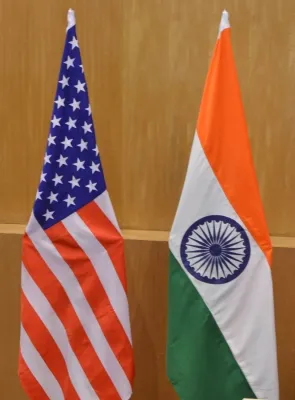
New Delhi, Feb 3 (NationPress) The India-US trade agreement is expected to reduce the current account deficit, stabilize the rupee, and mitigate India’s exposure to global economic shocks, according to a report published on Tuesday.
The United States has agreed to lower the reciprocal tariff on Indian goods from 50 percent to 18 percent.
This trade agreement is fundamentally beneficial for India’s medium-term economic growth and external stability. Enhanced market access and tariff certainty are anticipated to increase exports, foster manufacturing investments, and fortify foreign direct investment (FDI) inflows, as per Axis Securities’ analysis.
Export-focused sectors that have significant exposure to the US market will particularly benefit. Industries such as textiles, chemicals, pharmaceuticals, auto parts, IT services, and select industrials are poised to thrive due to improved market access, tariff adjustments, and enhanced supply-chain reliability.
Over time, increased order inflows, better capacity utilization, and enhanced earnings visibility could drive sustained growth and valuation improvements for these sectors, the report highlighted.
“India–US trade relations are entering a constructive phase following a period characterized by tariff disputes, regulatory challenges, and global supply-chain realignments. With both nations aiming to de-risk supply chains, reduce China-centric dependencies, and strengthen strategic partnerships, the proposed US–India trade deal is emerging as a significant catalyst,” the report observed.
For India, this agreement aligns seamlessly with its manufacturing initiatives (PLI schemes), export diversification efforts, and the goal of advancing up the global value chain.
For the United States, India presents a vast, dependable market and a strategic manufacturing alternative in essential sectors.
The report indicates that for equity markets, the deal enhances earnings visibility, supports valuation improvements—especially for export-driven and capital expenditure-linked sectors—and reinforces India’s standing as a relatively secure option among emerging markets.
“The US–India trade deal should be viewed as a medium-term structural advantage rather than a short-term catalyst. Consistent execution could significantly enhance India’s export competitiveness, manufacturing depth, and global integration. Investors should concentrate on companies with strong US exposure, scalable manufacturing capabilities, regulatory compliance strength, and resilient balance sheets to fully leverage the opportunity,” the report recommended.
Point of View
I believe that the India-US trade agreement marks a significant step forward in enhancing economic collaboration. This deal not only stabilizes the rupee but also opens avenues for growth in various sectors, ensuring a resilient path for India's economy amidst global uncertainties.
NationPress
20 Sept 2026
Frequently Asked Questions
What are the expected benefits of the India-US trade deal?
The deal is anticipated to narrow the current account deficit, stabilize the rupee, and enhance foreign direct investment (FDI) inflows, particularly benefiting export-oriented sectors.
How will the tariff changes impact Indian industries?
The reduction in tariffs from 50% to 18% is expected to boost exports, support manufacturing investments, and improve market access for Indian goods in the US.
Which sectors are likely to benefit most from this deal?
Sectors such as textiles, chemicals, pharmaceuticals, auto parts, IT services, and certain industrials are expected to gain significantly from improved tariff conditions and market access.
What does the deal mean for India's economy in the long term?
In the long term, the agreement is projected to enhance India's manufacturing capabilities, export competitiveness, and overall integration into the global economy.
Is this trade deal a short-term or long-term advantage?
Analysts suggest viewing the trade deal as a medium-term structural advantage rather than a short-term trigger, emphasizing the need for sustained execution to realize its full potential.