₹1,500 crore space funds to drive innovation and commercialisation: Dr Jitendra Singh
Synopsis
India has committed ₹1,500 crore in dedicated space-sector funds — a ₹1,000 crore Venture Capital Fund and a ₹500 crore Technology Adoption Fund — as the government pushes to convert a 400-plus start-up ecosystem into a globally competitive industry. The message at IN-SPACe's 10th Industry Connect was blunt: start-ups have proven the concept; now big industry must step up or India's space ambitions will stall at the prototype stage.
Key Takeaways
Jitendra Singh announced ₹1,500 crore in space-sector funding at the 10th IN-SPACe Industry Connect on 11 June .
The outlay comprises a ₹1,000 crore Venture Capital Fund and a ₹500 crore Technology Adoption Fund .
India's private space ecosystem has grown to more than 400 start-ups plus several hundred large and small enterprises.
The Indian Space Policy 2023 and liberalised FDI norms are the key policy pillars supporting the sector.
IN-SPACe has been credited with enabling and supervising private sector participation across the space value chain.
Government support also includes seed funding, incubation, skill development, and an AICTE-approved Space Technology curriculum .
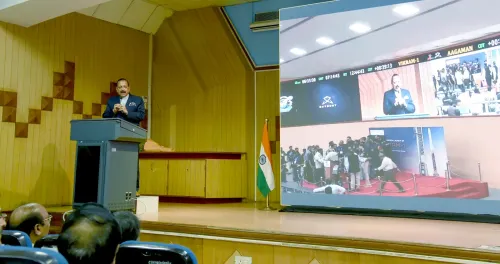
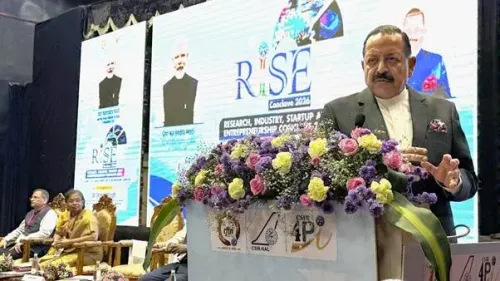
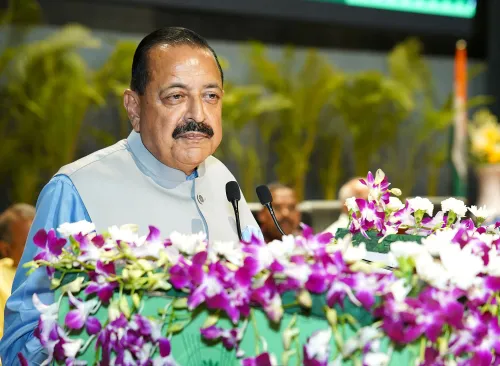
Union Minister of State (Independent Charge) for Science and Technology and Earth Sciences Dr. Jitendra Singh on Thursday, 11 June highlighted the government's twin financial commitments to India's space sector — a ₹1,000 crore Venture Capital Fund and a ₹500 crore Technology Adoption Fund — saying the combined ₹1,500 crore outlay is designed to accelerate innovation and commercialisation across the industry. The Minister made the remarks while addressing the 10th IN-SPACe Industry Connect in New Delhi.
Call to Industry: Scale Up or Fall Behind
Dr. Singh urged established industry leaders to deepen their investments and participation in India's space ecosystem, arguing that stronger financial backing and domestic manufacturing capabilities are indispensable for building globally competitive indigenous technologies. He stressed that reducing dependence on external sources must be a strategic priority, and that start-ups alone cannot carry the full weight of that ambition.
He acknowledged that India's start-up ecosystem has already demonstrated 'remarkable innovation and technological capabilities,' but noted that achieving leadership in the global space economy demands the execution muscle and market access that only large, established enterprises can provide.
Policy Architecture Behind the Push
The Minister pointed to the Indian Space Policy 2023 as having provided strategic direction and regulatory clarity for stakeholders. He added that the liberalisation of foreign direct investment (FDI) norms has attracted fresh capital and strengthened India's integration with global value chains.
Dr. Singh credited the Indian National Space Promotion and Authorization Centre (IN-SPACe) with creating an enabling environment for private sector participation, describing the institution as central to authorising, promoting, and supervising non-governmental activities across the entire space value chain.
Ecosystem Growth: From a Few Pioneers to 400-Plus Start-Ups
India's private space ecosystem, which began with only a handful of pioneering companies, has expanded to more than 400 start-ups alongside several hundred large and small enterprises, the Minister noted. Indian companies are now actively developing launch vehicles, satellites, propulsion systems, Earth observation applications, space situational awareness technologies, and a range of downstream solutions.
Supporting this growth, the government has rolled out seed funding programmes, incubation support, skill development initiatives, and an AICTE-approved Space Technology curriculum aimed at building a future-ready workforce for the sector.
A Structural Reform Under Modi's Watch
Dr. Singh described the opening of India's space sector to private participation under Prime Minister Narendra Modi's leadership as a landmark reform that fundamentally transformed the country's approach to strategic sectors. According to the Minister, the move unlocked India's entrepreneurial potential and significantly expanded opportunities for private enterprises within a short span of time.
With the ₹1,500 crore in new funds now on the table, the next phase will test whether financial incentives can translate into globally competitive products and services — and whether India's growing space ecosystem can move from promising to dominant.
Point of View
500 crore commitment is meaningful in signal but modest in scale — India's space ambitions require sustained, multi-year capital flows, not one-time fund announcements. The more telling data point is the 400-plus start-up count: breadth of participation is not the same as depth of capability. The real gap is in large-system integration, where established defence and industrial conglomerates have been slow to commit. Until they do, India risks building a vibrant but fragmented ecosystem that cannot compete with vertically integrated players abroad. IN-SPACe's authorisation role is also still untested at scale — its execution record over the next 24 months will determine whether the policy architecture holds under commercial pressure.
NationPress
20 Sept 2026
Frequently Asked Questions
What are the ₹1,500 crore space funds announced by Dr. Jitendra Singh?
The ₹1,500 crore comprises two instruments: a ₹1,000 crore Venture Capital Fund and a ₹500 crore Technology Adoption Fund, both recently introduced to drive innovation and commercialisation in India's space sector. They were highlighted by Dr. Jitendra Singh at the 10th IN-SPACe Industry Connect on 11 June.
What is IN-SPACe and what role does it play?
The Indian National Space Promotion and Authorization Centre (IN-SPACe) is the government body responsible for authorising, promoting, and supervising non-governmental space activities across the entire value chain. It has been credited with creating an enabling environment that allowed India's private space ecosystem to grow to more than 400 start-ups.
How has India's private space ecosystem grown in recent years?
India's private space sector started with only a few pioneering companies and has since expanded to more than 400 start-ups along with several hundred large and small enterprises. These companies are now active across launch vehicles, satellites, propulsion systems, Earth observation, and downstream applications.
What policy measures support India's space sector?
Key policy measures include the Indian Space Policy 2023, which provides strategic direction and regulatory clarity, and liberalised FDI norms that have attracted foreign investment. The government has also introduced seed funding, incubation support, skill development programmes, and an AICTE-approved Space Technology curriculum.
Why is established industry participation important for India's space ambitions?
According to Dr. Singh, while start-ups have demonstrated strong innovation, achieving leadership in the global space economy requires the funding depth, market access, and execution capabilities that established large industries bring. Without their deeper involvement, scaling indigenous technologies to global competitiveness will remain difficult.