Indian Stock Markets Decline for Sixth Week Amid West Asia Tensions
Synopsis
As geopolitical tensions escalate in West Asia, Indian stock markets have seen a continuous decline for six weeks. With significant currency fluctuations and market reactions to political developments, investors are left navigating a volatile landscape.
Key Takeaways
Indian stock markets have closed lower for six weeks in a row.
Geopolitical tensions in West Asia significantly influence market movements.
The Sensex and Nifty 50 both experienced notable drops this week.
Sector performances varied, with realty and healthcare showing gains.
Investor sentiment is expected to remain volatile in the upcoming week.
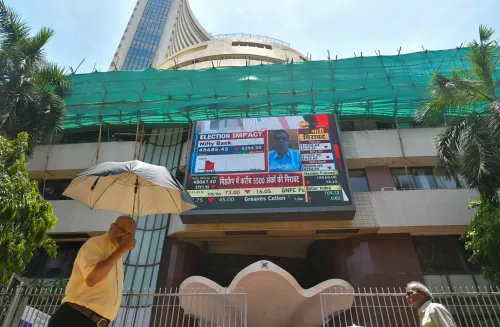
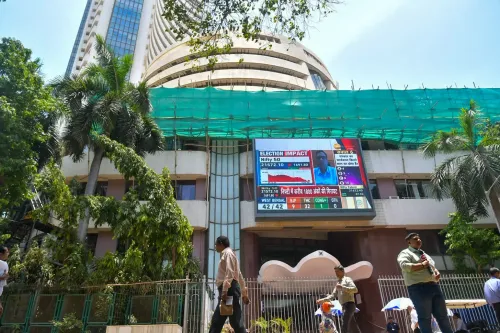
Mumbai, April 3 (NationPress) The Indian stock market concluded the trading week on a downward trend for the sixth week in a row, influenced by rising geopolitical tensions in West Asia along with significant currency fluctuations. Both major indices finished in the negative during this abbreviated four-day trading period.
On Thursday, the Sensex closed at 73,319.55, marking a decline of 263.67 points or 0.35 percent compared to last Friday's closing. Meanwhile, the Nifty 50 ended at 22,713.10, reflecting a drop of 106.50 points or 0.46 percent on a week-to-week basis.
During the last trading session of the week, both indices faced a sharp decline in early trading, with the Nifty 50 tumbling over 500 points and the Sensex falling by more than 1,500 points. This reaction followed a warning from US President Donald Trump regarding potential military action against Iran in the coming weeks, which stirred uncertainty in the markets. However, both indices managed to make a partial recovery by the end of the day.
Among the constituents of the Nifty 50, top losses for the week were recorded by HDFC Life Insurance, Sun Pharma, Dr Reddy's Laboratories, NTPC, and Cipla.
When looking at broader indices, the BSE Midcap 150 lagged behind the benchmarks, showing a decline of 0.6 percent week-on-week. In contrast, the BSE Smallcap 250 defied the trend, gaining 0.8 percent during the same period.
Sector-wise, the realty, healthcare, and banking sectors emerged as leaders, with increases of approximately 3 percent, 2.7 percent, and 1 percent respectively. The metal, power, and consumer durables sectors were the biggest losers, each seeing declines of over 2 percent.
Market experts have indicated that volatility in the equity markets may persist in the upcoming week, as investor sentiment remains closely linked to the developments in the West Asia conflict.
Indian markets are expected to continue experiencing fluctuations, with investor sentiment closely tied to evolving developments in the West Asia situation. As the US evaluates its stance, comments from President Trump suggest a more assertive approach, warning of possible military intervention if diplomatic efforts fail, while still leaving room for negotiations, experts note.
Any signs of de-escalation in the West Asia conflict could provide relief through lower crude prices and currency stabilization, whereas an escalation may extend risk aversion and maintain pressure on foreign investments, analysts have indicated.
Brent crude oil prices have remained high, hovering around $107 per barrel.
The markets will reopen following a three-day break, with anticipation surrounding several significant events, including the RBI monetary policy committee's rate decision, the US Federal Open Market Committee (FOMC) meeting minutes set for Wednesday (April 8), and the onset of the Q4 FY26 earnings season.
It is also worth noting that the stock exchanges will be closed in observance of Good Friday.
Point of View
It is evident that the ongoing geopolitical conflict in West Asia is significantly impacting investor confidence in Indian equity markets. With major indices showing a consistent decline, market participants must remain vigilant and adaptable to rapidly changing conditions.
NationPress
7 Oct 2026
Frequently Asked Questions
What caused the decline in Indian stock markets?
The decline is primarily attributed to escalating geopolitical tensions in West Asia and significant currency fluctuations.
How long have the markets been declining?
The Indian stock markets have experienced a decline for six consecutive weeks.
What sectors performed well during this period?
The realty, healthcare, and banking sectors were the top performers, showing gains during the week.
What impact does geopolitical tension have on markets?
Geopolitical tensions can create uncertainty, leading to increased volatility and risk aversion among investors.
What are the expectations for the upcoming week?
Market analysts predict continued volatility, with investor sentiment closely linked to developments in West Asia.