India's electronics output grows 7x in a decade, adds 25 lakh jobs: MeitY
Synopsis
India's electronics sector has quietly become one of the country's most consequential industrial success stories — production up seven-fold, exports up eleven-fold, and mobile phone exports up a staggering 165 times in a decade. With women making up 70 per cent of the mobile manufacturing workforce, the sector is also reshaping female participation in formal industrial employment.
Key Takeaways
India's electronics production rose from ₹1.90 lakh crore in FY15 to ₹13.11 lakh crore in FY26 — a nearly seven-fold increase.
The sector generated nearly 25 lakh jobs over the past decade; the mobile manufacturing ecosystem alone supports 12 lakh direct and indirect jobs .
Electronics exports surged eleven-fold to ₹4.24 lakh crore , making electronic goods India's third-largest export category at $47.96 billion in FY26.
Mobile phone exports recorded a 165-fold rise, from ₹1,566 crore to ₹2.60 lakh crore over the same period.
Women account for nearly 70 per cent of the direct mobile manufacturing workforce; the PLI scheme created jobs for around 90,000 women .
The PLI scheme attracted cumulative investments of over ₹20,600 crore and drove cumulative production of ₹11.62 lakh crore as of 31 March 2026 .
India's electronics manufacturing sector has generated nearly 25 lakh jobs over the past decade while production has surged almost seven-fold, the Ministry of Electronics and Information Technology (MeitY) said on Wednesday, 15 July. The figures, released by the ministry, frame the country's emergence as a global electronics manufacturing hub anchored by the Make in India initiative.
Scale of Growth
Electronics production climbed from ₹1.90 lakh crore in 2014-15 to an estimated ₹13.11 lakh crore in 2025-26 — nearly a seven-fold increase in just over a decade. Exports expanded even faster, rising from ₹38,263 crore to ₹4.24 lakh crore over the same period, an eleven-fold jump. Electronic goods have now become India's third-largest export category, with shipments reaching $47.96 billion in FY26.
Mobile phone manufacturing has been the standout performer. Production in the segment rose from ₹18,900 crore in FY15 to ₹6.27 lakh crore in FY26 — a 33-fold increase. Mobile exports recorded an even more striking 165-fold rise, from ₹1,566 crore to ₹2.60 lakh crore in the same period.
PLI Scheme's Catalytic Role
MeitY's flagship Production Linked Incentive (PLI) Scheme for Large Scale Electronics Manufacturing has been central to this expansion. As of 31 March 2026, the scheme had attracted cumulative investments exceeding ₹20,600 crore, while cumulative production crossed ₹11.62 lakh crore and exports surpassed ₹6.53 lakh crore.
On the employment front, MeitY's flagship schemes have directly generated more than 5.3 lakh jobs — approximately 1.8 lakh under the PLI scheme alone and another 3.5 lakh through other major government initiatives. The broader mobile manufacturing ecosystem supports around 12 lakh direct and indirect jobs across the value chain.
Women at the Centre of the Workforce
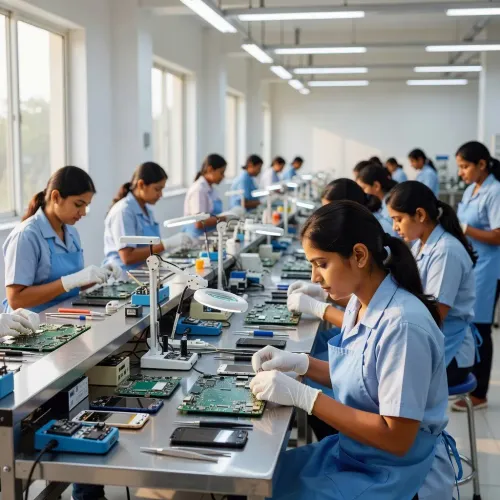
Women have emerged as a defining feature of India's electronics workforce. They account for nearly 30 per cent of the total employment generated in electronics manufacturing over the last decade. In mobile phone manufacturing specifically, women constitute nearly 70 per cent of the direct workforce, making it one of India's most women-intensive manufacturing industries.
The PLI scheme alone has created employment opportunities for around 90,000 women. At one of India's largest electronics manufacturing campuses in Hosur, Tamil Nadu, thousands of young women are engaged in producing smartphones and electronic components for global markets. Across three major facilities operated by a leading electronics manufacturer at the campus, nearly 80,000 people are employed, with women constituting around 65 per cent of the workforce.
What This Signals for India's Industrial Trajectory
This comes amid intensifying global competition for electronics supply chain diversification, with multinationals actively seeking alternatives to China. India's combination of PLI incentives, a large labour pool, and improving infrastructure has positioned it to capture a growing share of that shift. Notably, the eleven-fold export surge indicates that India is no longer just assembling for domestic consumption — it is increasingly supplying global markets. The next phase will test whether the sector can move up the value chain from assembly into component manufacturing and semiconductor integration.
Point of View
But the more important story is compositional. A 165-fold rise in mobile exports in a decade is not organic industrial deepening — it is assembly-led growth driven by Apple and its contract manufacturers shifting capacity out of China. India has captured that wave well, but the PLI framework has so far produced limited evidence of backward integration into components and semiconductors, where the real value lies. The 25-lakh-jobs figure also aggregates direct and indirect employment across a wide value chain, which makes it difficult to assess wage quality or job permanence. The women-in-manufacturing data is genuinely encouraging and underreported — but sustaining it requires investment in skilling and workplace infrastructure that the headline numbers do not address.
NationPress
13 Oct 2026
Frequently Asked Questions
How much has India's electronics production grown in the last decade?
India's electronics production grew nearly seven-fold, rising from ₹1.90 lakh crore in 2014-15 to an estimated ₹13.11 lakh crore in 2025-26, according to MeitY. Over the same period, electronics exports expanded eleven-fold to ₹4.24 lakh crore.
How many jobs has India's electronics sector created?
The sector has generated nearly 25 lakh jobs over the past decade, according to MeitY. The mobile manufacturing ecosystem alone supports around 12 lakh direct and indirect jobs, while MeitY's flagship schemes directly account for more than 5.3 lakh jobs.
What role has the PLI scheme played in electronics manufacturing growth?
The PLI Scheme for Large Scale Electronics Manufacturing has been a key driver, attracting cumulative investments of over ₹20,600 crore and enabling cumulative production of ₹11.62 lakh crore and exports of ₹6.53 lakh crore as of 31 March 2026. It has also directly created around 1.8 lakh jobs and employment for approximately 90,000 women.
Why is India's mobile phone export growth significant?
Mobile phone exports surged 165-fold — from ₹1,566 crore in FY15 to ₹2.60 lakh crore in FY26 — signalling that India has moved well beyond domestic assembly to supplying global markets at scale. Electronic goods are now India's third-largest export category.
What is the role of women in India's electronics manufacturing sector?
Women constitute nearly 70 per cent of the direct workforce in mobile phone manufacturing and around 30 per cent of the total electronics manufacturing workforce created over the last decade. At a major manufacturing campus in Hosur, Tamil Nadu, women make up around 65 per cent of a workforce of nearly 80,000.