Did India Receive the Most Favorable US Trade Deal?
Synopsis
India appears to have landed the most favorable trade deal with the US, potentially reshaping its economic landscape. This interim framework opens doors for various sectors, benefiting farmers, MSMEs, and skilled workers. Discover how this agreement positions India advantageously against regional competitors and strengthens its international trade relations.
Key Takeaways
India has secured the best US trade deal among its peers.
The uniform 18% tariff rate enhances competitiveness.
Exporters in various sectors will benefit significantly.
This agreement strengthens India’s position against regional rivals.
Potential for tariff reductions on a broad range of goods.
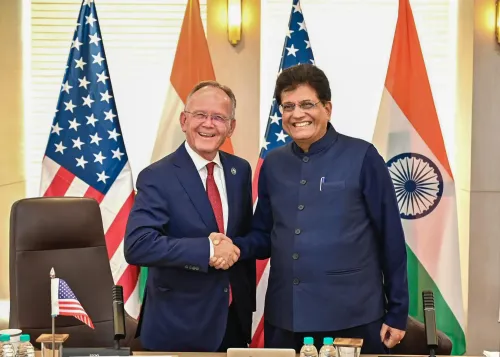
New Delhi, Feb 7 (NationPress) While complete details are still forthcoming, the interim framework for the India-US trade agreement suggests that India has secured the 'most advantageous deal' from the United States in comparison to other nations, including its neighboring countries.
This trade agreement capitalizes on the collaboration of two major democracies striving for the mutual benefit of their citizens, presenting unparalleled opportunities for farmers, MSMEs, entrepreneurs, and skilled laborers.
The consistent 18 percent tariff rate provides India with a competitive advantage over numerous countries in its vicinity and the broader region. Many of these exporters encounter higher tariffs or less reliable access to the US market.
Furthermore, the 18 percent rate significantly reduces the disparity with Europe, which is subjected to a 15 percent tariff.
The US tariffs on Indian exports closely align with those imposed on America's closest allies, such as the United Kingdom (10 percent), the European Union (15 percent), Switzerland (15 percent), Japan (15 percent), and South Korea (15 percent).
Conversely, several countries face exorbitant tariffs from the US, including Brazil (50 percent), Myanmar (40 percent), Laos (40 percent), China (37 percent), and South Africa (30 percent).
This minimized differential enhances the pricing structure for Indian products, benefiting exporters in textiles, apparel, leather goods, chemicals, and engineering sectors.
Moreover, it fortifies India's position against regional competitors that focus primarily on cost. Additionally, the framework paves the way for potential tariff reductions on a wide array of Indian products.
Moreover, the decrease in US tariffs on Indian goods effectively positions India below most ASEAN competitors and gives it a favorable edge over China.
“At this initial stage, this development is undoubtedly positive for the real economy, exports, market sentiment, and financial sectors, pending further specifics,” remarked Radhika Rao, Senior Economist at DBS Group Research. She indicated that textiles, gems and jewelry, engineering products, leather, and chemicals are expected to be among the primary beneficiaries in the short term.
Currently, India holds one of the lowest tariff rates imposed by the Trump administration when compared to other Asian economies like China, Pakistan, Indonesia, Bangladesh, and Vietnam.
Point of View
It's critical to recognize the strategic importance of this trade agreement for India. This deal not only enhances economic prospects but also strengthens India's position on the global stage, fostering better relations with the US while benefiting various sectors at home.
NationPress
23 Oct 2026
Frequently Asked Questions
What is the significance of the 18 percent tariff rate?
The 18 percent tariff rate gives India a competitive advantage over neighboring countries, allowing easier access to the US market for Indian exporters.
How will this trade deal affect Indian farmers and MSMEs?
The trade deal opens up unprecedented opportunities for farmers and MSMEs, enhancing their market potential and economic stability.
Which sectors are expected to benefit the most?
Key sectors like textiles, gems and jewelry, engineering goods, leather, and chemicals are likely to see significant gains.
How does this deal compare with tariffs on other countries?
India's tariff rates are significantly lower than those faced by countries like Brazil and China, positioning India favorably in international trade.
What are the long-term implications of the trade deal?
In the long term, this deal could lead to increased exports, enhanced economic growth, and stronger trade relations with the US.