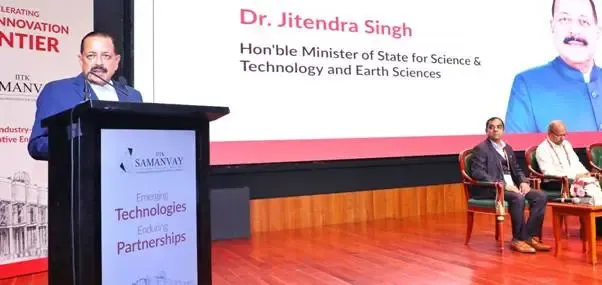
Dr Jitendra Singh at IITK Samanvay 2026: Industry must co-create from lab to market
Synopsis
At IITK Samanvay 2026, Dr Jitendra Singh made the case that industry must stop waiting at the finish line and instead co-create with researchers from day one. Backed by a ₹1 lakh crore R&D Fund and projections of a $45 billion space economy, the minister tied technology self-reliance directly to India's geopolitical sovereignty — raising the stakes well beyond a routine innovation-policy address.
Key Takeaways
Dr Jitendra Singh addressed IITK Samanvay 2026 on 15 October 2026 in New Delhi , calling for industry–researcher collaboration from concept to commercialisation.
PM Narendra Modi's ₹1 lakh crore Research, Development and Innovation Fund was cited as the primary policy vehicle to drive industry participation in deep-tech.
India's space economy is currently estimated at $9 billion , with projections of reaching $45 billion by the end of the decade, supported by over 400 space startups .
The bio-manufacturing sector has grown from approximately $10 billion to nearly $200 billion over about a decade.
India's startup ecosystem has expanded to around 2.5 lakh startups .
Dr Singh framed scientific self-reliance as foundational to India's geopolitical sovereignty and international standing.
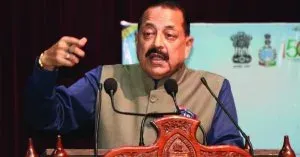
Union Minister of State for Science & Technology and Earth Sciences Dr Jitendra Singh on Thursday, 15 October 2026, called on Indian industry to embed itself in the research process from the very first stage — concept — right through to commercialisation, rather than engaging only after technologies are ready. Addressing the third edition of IITK Samanvay 2026 in New Delhi, he framed industry–researcher collaboration as indispensable to India's deep-technology ambitions.
The Core Ask: Co-Creation, Not Just Adoption
Dr Singh urged industry to work alongside researchers from the earliest stages to identify practical applications, build viable business models, and compress the timeline 'from lab to land, from idea to impact, and from prototype to product,' according to a statement from the Ministry of Science & Technology. He argued that late-stage industry entry — a longstanding pattern in India's innovation cycle — leaves promising research stranded between demonstration and deployment.
The minister also called for greater domestic and international investment in deep technologies and a stronger culture of research philanthropy, an area where India has historically lagged behind the United States, China, and Germany.
Policy Levers: The ₹1 Lakh Crore R&D Fund and FDI Liberalisation
Dr Singh pointed to two enabling policy moves. First, the ₹1 lakh crore Research, Development and Innovation Fund announced by Prime Minister Narendra Modi, which he described as a vehicle for boosting industry participation in deep-tech. Second, the liberalisation of foreign direct investment norms in strategic sectors, which he said was designed to mobilise resources at scale for technology development.
Notably, the fund's effectiveness will ultimately depend on uptake — both from domestic conglomerates and from international players willing to co-invest in India-based research programmes. Neither disbursement timelines nor sector-specific allocations were detailed at the event.
India's Deep-Tech Scoreboard
The minister cited several data points to underscore the pace of India's technology ecosystem expansion. India now hosts over 400 space startups, with the country's space economy estimated at around $9 billion and projected to reach $45 billion by the end of the decade. The broader startup ecosystem has grown to approximately 2.5 lakh startups. The bio-manufacturing sector, meanwhile, has expanded from roughly $10 billion to nearly $200 billion over approximately a decade — growth Dr Singh attributed to policy support, an enabling regulatory environment, and a cultural shift toward innovation and entrepreneurship.
Sovereignty Through Self-Reliance
Dr Singh grounded his remarks in a strategic argument: India's long-term geopolitical standing, he said, will be shaped by its capacity for indigenous manufacturing, technology development, and the effective use of domestic resources. Scientific and technological self-reliance, he argued, is not merely an economic objective — it is a prerequisite for geopolitical sovereignty and a stronger international position. This connects to a broader policy posture the Centre has maintained since at least 2020, accelerated by supply-chain disruptions during the pandemic and ongoing global tech-decoupling trends.
What Comes Next
IITK Samanvay serves as a platform for bridging academia, government, and industry, and the third edition signals growing institutional momentum behind the lab-to-market agenda. Industry bodies and research institutions are expected to take forward the minister's call through structured engagement mechanisms. Whether the ₹1 lakh crore fund catalyses meaningful co-investment or remains underutilised — as some earlier innovation funds have — will be the real test of this policy direction in the months ahead.
Point of View
Dressed in the language of aspiration. The data points — 2.5 lakh startups, a $45 billion space target — are real, but the structural problem he identifies, industry arriving too late in the research cycle, has been noted at similar forums for over a decade without a decisive fix. The ₹1 lakh crore R&D Fund is the most credible policy lever on the table, but its governance structure and disbursement conditions will determine whether it genuinely shifts industry behaviour or becomes another headline number. The geopolitical framing is increasingly standard in Indian tech policy discourse, and while it adds urgency, it can also obscure the mundane execution challenges — procurement delays, IP ownership disputes, risk-averse industry culture — that typically stall lab-to-market transitions.
NationPress
15 Oct 2026
Frequently Asked Questions
What did Dr Jitendra Singh say at IITK Samanvay 2026?
Dr Jitendra Singh urged Indian industry to become a co-creator in the technology journey, partnering with researchers from the concept stage through to commercialisation, rather than engaging only after a technology is market-ready. He also called for greater investment in deep technologies and a stronger culture of research philanthropy.
What is the ₹1 lakh crore Research, Development and Innovation Fund?
It is a fund announced by Prime Minister Narendra Modi designed to boost industry participation in deep-technology development. Dr Singh cited it at IITK Samanvay 2026 as a key mechanism to bridge academia and industry in India's innovation ecosystem.
What is India's space economy target and current size?
India's space economy is currently estimated at around $9 billion, with projections to reach $45 billion by the end of the decade. The sector is supported by over 400 space startups, a figure Dr Singh highlighted as evidence of rapid ecosystem growth.
How large is India's startup and bio-manufacturing ecosystem?
India's startup ecosystem has grown to approximately 2.5 lakh startups, according to Dr Singh. The bio-manufacturing sector has expanded from roughly $10 billion to nearly $200 billion over about a decade, driven by policy support and an increased emphasis on innovation.
Why does Dr Jitendra Singh connect technology self-reliance to geopolitical sovereignty?
Dr Singh argued that India's long-term geopolitical standing depends on indigenous manufacturing, domestic technology development, and the effective use of domestic resources. Scientific self-reliance, in his framing, is not just an economic goal but a determinant of India's sovereign standing in the international arena.