Korean won down nearly 6% in 2025, worst H1 since 1998 Asia crisis
Synopsis
South Korea's won has posted its worst first-half average since the 1998 Asian financial crisis, with foreign investors dumping over $102 billion in domestic stocks — more than five times the sell-off seen during the entire 2008 global financial crisis. The currency has held above 1,500 won per dollar since mid-May, and the pressure shows no clear sign of easing.
Key Takeaways
The South Korean won fell nearly 6 per cent against the US dollar in the first half of 2025 , per Bank of Korea data.
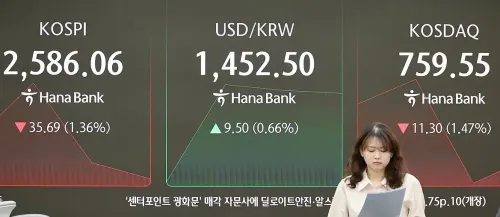
The first-half average exchange rate of 1,484.56 won per dollar is the second-highest on record, behind only the 1998 Asian financial crisis average of 1,493.08 won .
The won breached the 1,500-won level in March 2025 for the first time since the global financial crisis and has stayed above it since mid-May .
Foreign investors sold a net 156.56 trillion won ($102.3 billion) in KOSPI shares — more than five times the net selling recorded in all of 2008 .
Among G20 currencies, only the Turkish lira (-8.23%) and Indonesian rupiah (-6.56%) fared worse than the won in the same period.
The South Korean won has depreciated nearly 6 per cent against the US dollar in the first half of 2025, according to data released by the Bank of Korea's Economic Statistics System on Sunday, 5 July. The slide has been driven largely by a historic wave of foreign equity sell-offs, with overseas investors offloading a net 156.56 trillion won (approximately $102.3 billion) worth of domestic shares on the KOSPI benchmark market.
How Bad Is the Decline
The average exchange rate for the first half of 2025 stood at 1,484.56 won per dollar, the second-highest first-half average ever recorded. The only worse reading came during the Asian financial crisis of 1998, when the first-half average reached 1,493.08 won. As of 3 July, the won had depreciated 5.92 per cent against the dollar compared with the end of last year.
The exchange rate breached the psychologically significant 1,500-won level in March for the first time since the global financial crisis, following the outbreak of conflict in the Middle East. Although it briefly retreated to the low 1,400-won range, it climbed back above 1,500 won in mid-May and has remained above that threshold since.
Among the Worst Performers in G20
Within the Group of 20 currencies, only the Turkish lira (-8.23 per cent) and the Indonesian rupiah (-6.56 per cent) recorded steeper losses against the dollar over the same period, placing the won among the worst-performing major currencies globally in 2025.
Foreign Selling the Key Driver
Analysts point to sustained foreign equity outflows as the primary catalyst. The net foreign selling of 156.56 trillion won on the KOSPI from January through 3 July is more than five times the 34.58 trillion won in net foreign selling recorded across all of 2008 — the year of the global financial crisis. That scale of outflow has placed persistent downward pressure on the currency, overwhelming any near-term support.
What to Watch Next
The won's trajectory will depend heavily on whether foreign investors stabilise their KOSPI positions and on broader global risk sentiment, particularly developments in the Middle East and the direction of US Federal Reserve policy. A sustained stay above the 1,500-won level could prompt the Bank of Korea to consider further intervention measures. For South Korea's export-heavy economy, prolonged currency weakness is a double-edged dynamic — it boosts export competitiveness while raising import costs and stoking inflationary pressure.
Point of View
It raises questions about South Korea's long-term capital market attractiveness, not just short-term sentiment. The won holding above 1,500 is not merely a currency story; it reflects eroding confidence in KOSPI earnings, geopolitical exposure, and the Bank of Korea's limited room to tighten without damaging a fragile domestic economy. Mainstream coverage tends to frame this as a dollar-strength story, but the rupiah and lira comparison is instructive — those currencies face structural vulnerabilities. If South Korea, with its fundamentally stronger economy, is in the same bracket, the sell-off deserves closer scrutiny than it is getting.
NationPress
3 Oct 2026
Frequently Asked Questions
How much has the South Korean won fallen against the US dollar in 2025?
The South Korean won has depreciated nearly 6 per cent against the US dollar in the first half of 2025. As of 3 July 2025, the decline stood at 5.92 per cent compared with the end of last year, according to Bank of Korea data.
Why is the South Korean won falling?
The primary driver is heavy foreign selling of South Korean equities. Foreign investors sold a net 156.56 trillion won worth of KOSPI shares from January through 3 July 2025 — more than five times the net foreign selling recorded during all of 2008. This sustained outflow has placed persistent downward pressure on the currency.
How does the 2025 won decline compare to historical crises?
The first-half average exchange rate of 1,484.56 won per dollar is the second-highest on record for any first half of a year. Only the first half of 1998, during the Asian financial crisis, was worse, at 1,493.08 won per dollar.
How does the won compare to other G20 currencies in 2025?
Among G20 currencies, the won is the third-worst performer in 2025. Only the Turkish lira (-8.23 per cent) and the Indonesian rupiah (-6.56 per cent) have recorded larger declines against the US dollar over the same period.
What level is the Korean won exchange rate at now?
The won has been trading above the 1,500-won-per-dollar level since mid-May 2025. It first crossed that threshold in March 2025 — the first time since the global financial crisis — following the outbreak of conflict in the Middle East.