KOSPI gains 1.29% to 6,901 as IT selling caps Seoul rally
Synopsis
Seoul's KOSPI briefly crossed 7,000 for the first time in recent trade before domestic IT sellers dragged it back to 6,901 — a 1.29% gain that masked a fierce tug-of-war: foreign investors poured in ₩1.01 trillion while local retail and institutional players offloaded nearly as much. The split signals a market at a crossroads, with South Korea's finance ministry simultaneously upgrading its economic recovery assessment to 'strengthening.'
Key Takeaways
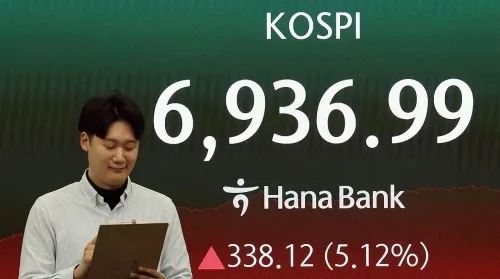
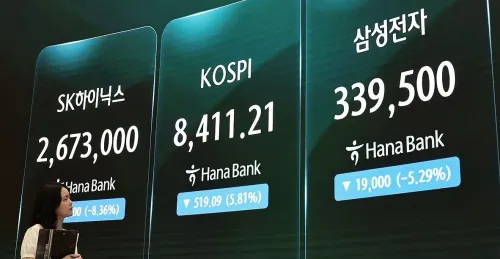
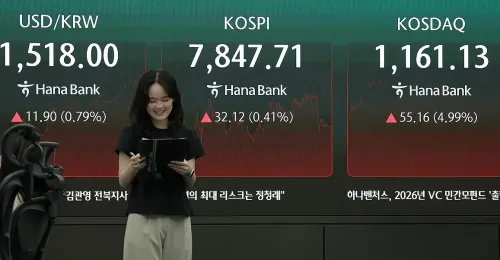
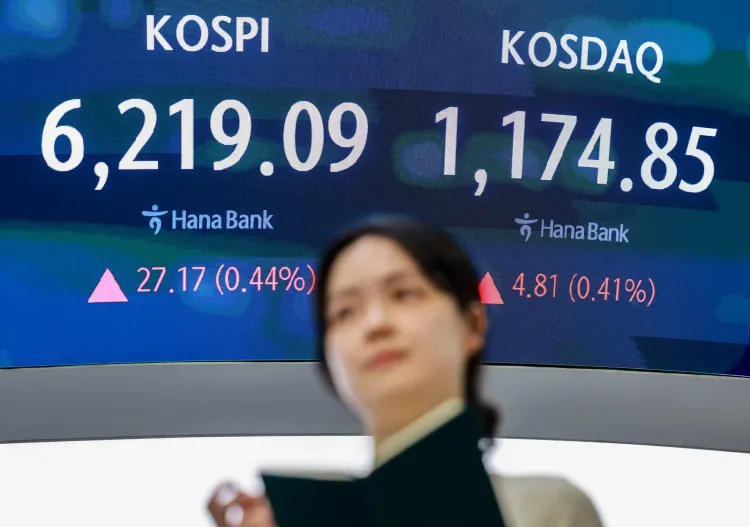
The KOSPI rose 87.95 points (1.29%) to 6,901.29 as of 11:20 a.m. on 14 August , after briefly touching 7,000 .
Foreign investors net-bought 1.01 trillion won (US$714 million) in shares; retail and institutional investors sold a combined 978.9 billion won .
Samsung Electronics gained 0.56% ; SK Hynix rose 3.2% .
The Korean won traded at 1,414.1 per US dollar, up 4.5 won from the prior close.
South Korea's Ministry of Finance and Economy upgraded its economic assessment to 'strengthening' in its latest Green Book , citing robust exports and improving consumption.
The ministry flagged ongoing risks from Middle East uncertainty, high oil prices, and weak employment in vulnerable sectors.
South Korea's benchmark Korea Composite Stock Price Index (KOSPI) pared sharp early gains on Friday, 14 August, rising 87.95 points, or 1.29 percent, to 6,901.29 as of 11:20 a.m. local time, as retail and institutional investors continued offloading large-cap technology stocks even as foreign buyers stepped in aggressively. The index had surged as high as 2.9 percent in early trade, briefly touching the psychologically significant 7,000 mark, before selling pressure trimmed the advance.
Foreign Buyers vs. Domestic Sellers
Foreign investors alone purchased nearly 1.01 trillion won (approximately US$714 million) worth of shares during the session, according to reports. That buying was nearly offset by a combined 978.9 billion won in net selling from retail and institutional investors, underscoring a divergence in sentiment between overseas and domestic market participants. The tug-of-war kept the index well below its intraday peak, illustrating how persistent domestic profit-taking can blunt even strong foreign inflows.
Blue-Chip Movers
Among large-cap stocks, Samsung Electronics — the market's most closely watched bellwether — rose 0.56 percent, while rival chipmaker SK Hynix added a more robust 3.2 percent. The gains in these two names provided a partial floor for the broader index even as the wider technology segment faced selling. The Korean won strengthened slightly, trading at 1,414.1 won against the US dollar as of 11:20 a.m., up 4.5 won from the previous session's close.
Wall Street Tailwinds
Overnight, US equities closed at an all-time high, aided by easing oil prices. The S&P 500 climbed 0.7 percent, the Dow Jones Industrial Average added 0.1 percent, and the tech-heavy Nasdaq Composite gained 0.8 percent. The positive Wall Street close provided the initial impetus for Seoul's gap-up open, though domestic selling quickly capped the upside.
South Korea's Economic Outlook
Separately, South Korea's Ministry of Finance and Economy upgraded its assessment of the country's economic trajectory in its monthly Green Book report released on Friday. The ministry described the recovery as 'strengthening' — a step up from the previous month's characterisation of it as 'solidifying.' The upgrade was driven by a sharp rise in exports and improving domestic consumption.
However, the ministry acknowledged lingering headwinds. 'Recently, the Korean economy has seen its recovery strengthen, with exports rising sharply and domestic demand, including consumption, showing signs of improvement,' the report stated. It also flagged persistent pressures on household livelihoods, including inflationary risks from elevated oil prices and difficult employment conditions for vulnerable groups — risks compounded by ongoing uncertainty from the Middle East conflict.
With the KOSPI hovering just below the 7,000 threshold and domestic investors still in sell mode, the durability of the current recovery rally will hinge on whether foreign buying momentum is sustained and whether export strength translates into broader employment gains.
Point of View
000 despite a ₩1.01 trillion foreign buying surge is the real story here — it reveals how deeply domestic investors distrust the current tech rally. Retail and institutional sellers essentially negated the entire foreign inflow, a pattern that has repeated across Asian markets whenever US tech optimism runs ahead of local earnings visibility. South Korea's Green Book upgrade to 'strengthening' is meaningful, but the ministry's own caveat — oil-driven inflation and vulnerable-sector unemployment — suggests the recovery is uneven. Until domestic investors re-engage with large-cap IT, the 7,000 ceiling may prove stickier than the headline numbers imply.
NationPress
28 Sept 2026
Frequently Asked Questions
Why did the KOSPI pare its early gains on 14 August?
The KOSPI opened 2.7% higher and briefly touched 7,000 but retreated to a 1.29% gain as retail and institutional investors continued selling large-cap technology stocks. Their combined net selling of 978.9 billion won nearly offset 1.01 trillion won in foreign buying.
How much did foreign investors buy in the Seoul market on Friday?
Foreign investors net-purchased approximately 1.01 trillion won (around US$714 million) worth of shares. Despite this, domestic selling pressure from retail and institutional investors capped the market's advance.
How did Samsung Electronics and SK Hynix perform?
Samsung Electronics rose 0.56% while SK Hynix gained 3.2%, making the chipmaker one of the stronger performers among blue-chip stocks. Both provided partial support to the broader KOSPI even as the wider IT segment faced selling.
What did South Korea's finance ministry say about the economy?
The Ministry of Finance and Economy upgraded its monthly Green Book assessment, describing the recovery as 'strengthening' — an improvement from the previous month's 'solidifying.' The upgrade was driven by sharply rising exports and early signs of recovery in domestic consumption, though the ministry flagged inflation and employment risks.
What is the outlook for the KOSPI going forward?
The index remains just below the key 7,000 level, with foreign buying providing support but domestic IT selling acting as a ceiling. Sustained gains will likely depend on whether export-led economic momentum translates into corporate earnings upgrades and whether global risk appetite — particularly in US tech — holds steady.