NADCP: 147 crore FMD vaccine doses cut outbreaks by 70% across India
Synopsis
India's NADCP has cut FMD outbreaks by nearly 70% in six years — from 132 in 2019 to 40 by 2025 — after administering 147.16 crore vaccine doses. With NSP antibody prevalence halved and no Serotype Asia-1 outbreak in three years, the programme is now being consolidated under a single ₹2,010 crore umbrella scheme for 2026–27.
Key Takeaways
The NADCP has administered 147.16 crore FMD vaccine doses, benefiting 8.04 crore farmers .
Reported FMD outbreaks fell from 132 in 2019 to 40 in 2025 ; Brucellosis outbreaks dropped from 22 to 15 in the same period.
NSP antibody prevalence declined from 20.8% to 8.1% between 2019 and 2025, indicating reduced virus circulation.
More than 39 crore livestock registered on the Bharat Pashudhan Portal ; 4,019 Mobile Veterinary Units have treated 276 lakh animals .
NADCP has been merged into the Livestock Health and Disease Control Programme (LHDCP) with a budget of ₹2,010 crore for 2026–27 .
No FMD outbreak caused by Serotype Asia-1 has been recorded in India for the last three years .
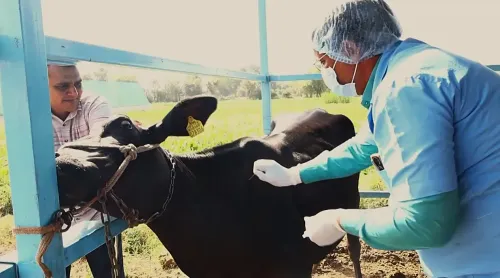
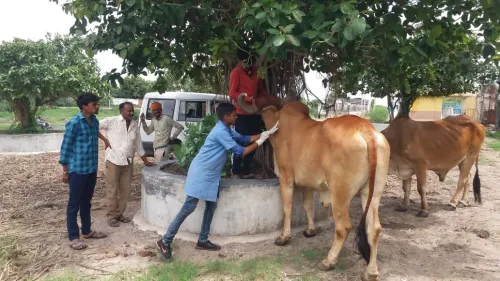
India's National Animal Disease Control Programme (NADCP) has administered 147.16 crore doses of the Foot and Mouth Disease (FMD) vaccine, benefiting 8.04 crore farmers nationwide, according to a government factsheet released on 22 August. The programme, one of the country's largest livestock health initiatives, has driven reported FMD outbreaks down from 132 in 2019 to 40 by 2025 — a reduction of nearly 70%.
Scale of the Programme
More than 39 crore livestock have been registered on the Bharat Pashudhan Portal, building a digital backbone for disease surveillance and animal health management. Alongside this, 4,019 Mobile Veterinary Units have delivered doorstep veterinary services to 136 lakh farmers and treated 276 lakh animals, extending veterinary reach into remote and underserved areas.
The NADCP targets 100% vaccination of all livestock against FMD twice a year, and a single lifetime vaccination against Brucellosis for female bovine calves aged 4–8 months. India's total livestock population, as per the 20th Livestock Census 2019, stands at 535.78 million, including 302.79 million bovines — underscoring the logistical scale of this undertaking.
Disease Incidence: The Numbers
The impact on disease burden has been measurable. Brucellosis outbreaks fell from 22 in 2019 to 15 in 2025. Critically, the Non-Structural Protein (NSP) antibody prevalence — a key marker of active FMD virus circulation — declined from 20.8% in 2019 to 8.1% in 2025, according to the official statement.
'There has been no outbreak of FMD caused by Serotype Asia-1 for the last three years in the country,' the official statement noted. This is a significant epidemiological milestone, as Serotype Asia-1 had historically caused periodic flare-ups in the subcontinent.
Why Livestock Disease Control Matters
Infectious diseases such as FMD and Brucellosis have historically inflicted substantial economic losses on Indian farmers — through reduced milk yield, reproductive failure, and trade restrictions on livestock and livestock products. With 535.78 million animals at stake, even a modest reduction in disease incidence translates into significant income protection for rural households.
This comes amid a broader government push to integrate animal health into a One Health framework, linking veterinary, human health, and environmental surveillance systems. Notably, the NADCP's gains build on sustained investment over six years, rather than a single-season intervention.
Unified Framework and Budget
The government has consolidated disease control efforts under the Livestock Health and Disease Control Programme (LHDCP), which now subsumes the NADCP, the Livestock Health and Disease Control (LH&DC) component, and the Pashu Aushadhi initiative into a single umbrella scheme. The total budget outlay for LHDCP for financial year 2026–27 is ₹2,010 crore.
This integration is intended to streamline implementation, reduce duplication, and create a more comprehensive animal health framework. With digital livestock databases, strengthened veterinary infrastructure, and research institutions now operating under one policy roof, the focus shifts to sustaining these gains and pushing toward eventual FMD-free status.
Point of View
But the harder question is sustainability. Vaccination coverage and outbreak data are government-reported figures; independent epidemiological verification would strengthen credibility. The consolidation into LHDCP is administratively logical, but umbrella schemes in Indian agriculture have a mixed record — gains made under focused single-disease programmes can dilute when folded into broader frameworks competing for the same budget line. The ₹2,010 crore allocation for 2026–27 must be tracked against actual disbursement, not just announcement. The real test of NADCP's legacy will be whether India achieves internationally recognised FMD-free status — a threshold that unlocks livestock export markets worth billions.
NationPress
6 Oct 2026
Frequently Asked Questions
What is the National Animal Disease Control Programme (NADCP)?
The NADCP is one of India's largest livestock health initiatives, focused on controlling and eradicating Foot and Mouth Disease (FMD) and Brucellosis through nationwide vaccination and surveillance. It targets 100% vaccination of all livestock against FMD twice a year and a lifetime Brucellosis vaccination for female bovine calves aged 4–8 months.
How much has the NADCP reduced FMD outbreaks in India?
Reported FMD outbreaks declined from 132 in 2019 to 40 by 2025, a reduction of nearly 70%, according to a government factsheet. NSP antibody prevalence also fell from 20.8% to 8.1% over the same period, indicating reduced virus circulation.
What is the Bharat Pashudhan Portal?
The Bharat Pashudhan Portal is a digital livestock database on which more than 39 crore animals have been registered. It forms the backbone of India's animal disease surveillance and veterinary service delivery infrastructure.
What is the LHDCP and how does it relate to NADCP?
The Livestock Health and Disease Control Programme (LHDCP) is a unified umbrella scheme under which the NADCP, the LH&DC component, and the Pashu Aushadhi initiative have been consolidated. The LHDCP has a budget outlay of ₹2,010 crore for financial year 2026–27.
Why do FMD and Brucellosis matter for Indian farmers?
Both diseases cause significant economic losses through reduced milk yield, reproductive failure in animals, and trade restrictions on livestock products. With India's total livestock population at 535.78 million, controlling these diseases directly protects the livelihoods of millions of rural farming households.