NITI Aayog SDG budgeting workshop: 32 states align spending with development goals
Synopsis
NITI Aayog, the CAG, and UNDP have jointly developed a framework to tag state budgets against specific SDG targets — and they brought officials from all 32 states and Union Territories to Kolkata to learn how to use it. The move signals a shift from aspirational goal-setting to granular expenditure accountability, with performance audits built into the cycle.
Key Takeaways
NITI Aayog held a national SDG budgeting workshop in Kolkata on 2 October 2026 , in partnership with the West Bengal government and UNDP .
Officials from 32 states and Union Territories participated alongside representatives from NITI Aayog, CAG , MoSPI , and international development partners.
The workshop was organised under NITI Aayog's State Support Mission and focused on institutionalising SDG budget tagging at the state level.
A joint 'Guide on Mapping State Budgets to the SDGs' developed by NITI Aayog, CAG, and UNDP was discussed as the core framework.
A separate session addressed private-sector participation in SDG achievement through innovative financing and responsible business practices.
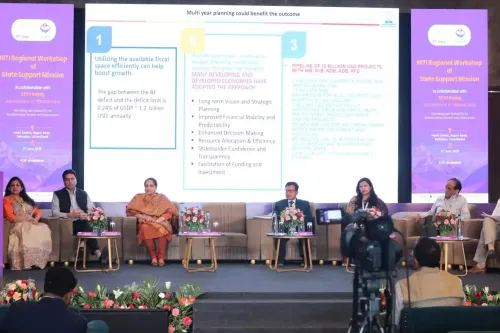
NITI Aayog on 2 October 2026 convened a national workshop on Sustainable Development Goals (SDG) budgeting in Kolkata, in collaboration with the West Bengal government and with technical support from the United Nations Development Programme (UNDP). The workshop, organised under NITI Aayog's State Support Mission, brought together participants from 32 states and Union Territories to align planning and budgeting processes with the SDGs and to institutionalise SDG budget tagging at the state level.
What the Workshop Aimed to Achieve
West Bengal Finance Minister Swapan Dasgupta said SDG budget tagging helps establish a direct link between development goals, targets, budget allocations, and the agencies responsible for spending. The exercise, he emphasised, gives policymakers a clearer line of sight from rupee outlay to measurable development outcome.
NITI Aayog Member R. Balasubramaniam described the mapping of SDGs to state expenditure as a 'significant step' towards ensuring that government spending was aligned with development priorities. This framing positions the initiative not merely as a compliance exercise but as a governance reform.
The SDG Budget Tagging Framework
A central focus of the workshop was the 'Guide on Mapping State Budgets to the SDGs', jointly developed by NITI Aayog, the Comptroller and Auditor General of India (CAG), and UNDP. Discussions covered identifying expenditure eligible for SDG tagging, determining the appropriate level of tagging granularity, linking spending to relevant Heads of Accounts and SDG targets, and assigning values through NITI Aayog's scheme-SDG mapping framework.
Participants also deliberated on integrating SDG budgeting into the annual budget cycle, covering institutional responsibilities, reconciliation procedures, quality assurance, performance audit, and reporting mechanisms.
Who Attended and What Was Discussed
Officials from NITI Aayog, the CAG, the Ministry of Statistics and Programme Implementation (MoSPI), and other government bodies attended alongside state and UT representatives. Representatives from the UNDP, the UN Resident Coordinator Office, development partners, industry bodies, and private-sector organisations were also present.
A separate session examined private-sector participation in achieving the SDGs, focusing on policy frameworks, innovative financing instruments, and responsible business practices — underscoring that the SDG agenda extends beyond government budgets alone.
Broader Significance
India's SDG progress has been uneven across states, and the absence of a standardised budget-tagging mechanism has made it difficult to track how much public spending is actually directed at specific goals. This workshop represents a concerted push to address that gap. Notably, this is one of the first instances of such a wide-ranging, multi-state dialogue on SDG budget alignment convened under the State Support Mission framework.
NITI Aayog reaffirmed its commitment to supporting states and Union Territories in integrating SDGs into their planning, budgeting, and governance processes. The next steps are expected to involve pilot tagging exercises in participating states ahead of the upcoming budget cycle.
Point of View
But the absence of granular budget tagging has meant that the link between public spending and specific goals has remained largely aspirational. This workshop is a meaningful procedural advance — getting 32 states into the same room with a common tagging guide matters. The harder test will be whether the framework survives contact with actual budget-making, where political priorities and accounting conventions routinely override planning objectives. The inclusion of the CAG in the framework design is a positive signal for independent audit, but performance audit provisions will only have teeth if they are mandated rather than optional.
NationPress
2 Oct 2026
Frequently Asked Questions
What is SDG budget tagging and why does it matter?
SDG budget tagging is the process of linking specific government expenditure lines to the United Nations Sustainable Development Goals and their targets. It matters because it allows policymakers and auditors to track how much public spending is actually directed at goals such as poverty reduction, clean energy, or quality education, rather than relying on broad sectoral allocations.
What is the 'Guide on Mapping State Budgets to the SDGs'?
It is a framework document jointly developed by NITI Aayog, the Comptroller and Auditor General of India (CAG), and UNDP to help state governments align their annual budgets with specific SDG targets. The guide covers expenditure identification, tagging levels, Head of Accounts linkages, and performance audit procedures.
Which states and territories participated in the workshop?
Officials from all 32 states and Union Territories attended the workshop, alongside representatives from NITI Aayog, CAG, MoSPI, UNDP, the UN Resident Coordinator Office, development partners, and private-sector organisations.
What role does the private sector play in this SDG budgeting initiative?
A dedicated session at the workshop examined how private-sector entities can contribute to SDG achievement through policy frameworks, innovative financing mechanisms, and responsible business practices. This reflects recognition that public budgets alone are insufficient to meet India's SDG commitments.
What happens next after the workshop?
NITI Aayog reaffirmed its commitment to supporting states in integrating SDGs into their planning, budgeting, and governance processes. Pilot tagging exercises in participating states are expected ahead of the upcoming budget cycle, according to the official statement.