Pakistan poverty rate hits 11-year high: 70 million below official line
Synopsis
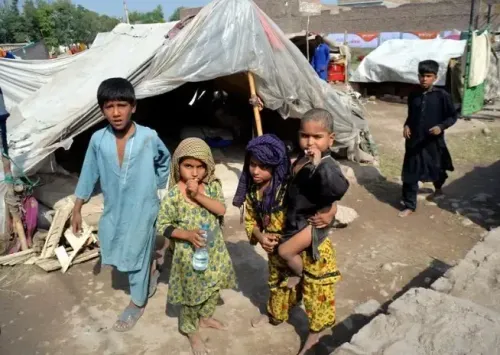
Pakistan's own poverty line condemns nearly 70 million people to deprivation — the highest share in 11 years — while military spending hits a historic high at $10.8 billion, more than three and a half times what the state spends keeping its poorest households alive. The numbers expose a budget that prioritises defence over citizens, even as the World Bank puts the true poverty headcount at 44.7 per cent.
Key Takeaways
Pakistan's official poverty line of PKR 8,484 per month leaves 70 million people ( 28.9% ) below the threshold — the highest rate in 11 years .
The poverty rate has jumped sharply from 21.9% recorded in the 2018–19 household survey.
World Bank data (June 2025) puts 44.7% of Pakistanis below its $4.20-a-day line, up from 39.8% under the old $3.65 measure.
Pakistan's defence budget hit a historic high of roughly $10.8 billion ( 2.08% of GDP ), more than 3.5 times its welfare allocation for the poorest households.
Structural weaknesses — narrow tax base, import dependence, repeated IMF bailouts — continue to compound the crisis.
Over-reliance on Saudi Arabia and Gulf financing reportedly increases Pakistan's vulnerability to foreign policy pressure, according to a separate report.
Pakistan's official poverty line — set at a monthly income of PKR 8,484 (approximately $3.50 per day) — has left roughly 70 million people, or 28.9 per cent of the population, below the threshold, according to a new report. This marks the highest poverty rate in 11 years and a sharp rise from the 21.9 per cent recorded in the previous household survey of 2018–19.
Official Line vs Global Benchmarks
The PKR 8,484 figure is calculated using a cost-of-basic-needs method, translating to roughly $3.50 a day — well below the World Bank's $4.20-a-day lower-middle-income poverty threshold. When measured against the World Bank benchmark, the picture worsens considerably: World Bank data released in June 2025 showed 44.7 per cent of Pakistanis falling below the $4.20 line, up from 39.8 per cent under the older $3.65 measure. The gap between Pakistan's self-reported figures and international benchmarks underscores a persistent credibility problem with how the country tracks and communicates economic distress.
A Pattern of Quiet Data Releases
The report flagged that Pakistan's economic data release pattern 'is consistent with a state that publishes its most uncomfortable statistics quietly and late.' Critics argue that the timing and framing of poverty disclosures serve to minimise political fallout rather than inform policy. This comes amid growing scrutiny of Islamabad's fiscal priorities, with the report contending that 'citizens' hardship ranks below other claims on the budget.'
Military Spending Dwarfs Social Welfare
Budget documents show defence spending surged to approximately 2.08 per cent of GDP — the largest military allocation in the country's history — worth roughly $10.8 billion. By comparison, the state's core defence outlay is more than three and a half times what it allocates to keep the poorest households afloat, and closer to five times when pensions and the development programme are factored in. The stark disparity raises pointed questions about whether Pakistan's budget reflects its stated commitment to poverty alleviation.
Structural Vulnerabilities Compound the Crisis
Pakistan's economy is structurally exposed on multiple fronts. A narrow tax base and heavy dependence on imports have repeatedly triggered balance-of-payments crises, forcing the country into successive International Monetary Fund (IMF) bailouts. A separate recent report warned of Pakistan's severe dependency on Gulf financing, with over-reliance on Saudi Arabia increasing the risk of foreign policy compromise. Meanwhile, import curbs introduced to stabilise foreign exchange reserves are reportedly easing immediate pressure on the external account but intensifying domestic shortages, stoking inflation and dragging on growth.
What Comes Next
With poverty at its worst in over a decade and structural reforms stalled, analysts warn that without a meaningful broadening of the tax base and a reorientation of budget priorities toward social spending, the cycle of IMF dependency and household hardship is unlikely to break. The divergence between Pakistan's official poverty metrics and World Bank figures will likely keep international scrutiny elevated in the months ahead.
Point of View
Poverty is not a crisis being managed; it is a choice being made. Pakistan's pattern of releasing uncomfortable data quietly and late is not bureaucratic inefficiency — it is political insulation. The World Bank's 44.7 per cent figure versus Islamabad's 28.9 per cent is not a rounding difference; it is a 16-percentage-point gap that represents tens of millions of people the official narrative prefers to keep invisible. Until Pakistan broadens its tax base and reorders its fiscal priorities, IMF bailouts will remain a recurring feature, not an emergency exit.
NationPress
22 Sept 2026
Frequently Asked Questions
What is Pakistan's official poverty rate in 2025?
Pakistan's official poverty rate stands at 28.9 per cent , meaning roughly 70 million people live below the government's own poverty line of PKR 8,484 per month. This is the highest rate in 11 years and a significant rise from 21.9 per cent recorded in the 2018–19 survey.
How does Pakistan's official poverty line compare to World Bank standards?
Pakistan's official line translates to approximately $3.50 a day , well below the World Bank's $4.20-a-day lower-middle-income threshold. When the World Bank measure is applied, 44.7 per cent of Pakistanis fall below the poverty line — nearly 16 percentage points higher than the government's own figure.
How much does Pakistan spend on defence compared to welfare?
Pakistan's defence budget has surged to roughly $10.8 billion , or 2.08 per cent of GDP — the largest military allocation in the country's history. Core defence spending is more than three and a half times the amount allocated to support the poorest households, and closer to five times when pensions and the development programme are included.
Why does Pakistan keep returning to the IMF for bailouts?
Pakistan's economy is structurally vulnerable due to a narrow tax base and heavy reliance on imports, which repeatedly triggers balance-of-payments crises. These structural weaknesses have forced the country into multiple IMF bailout programmes over the years, with no durable reform yet breaking the cycle.
What are the risks of Pakistan's reliance on Gulf financing?
According to a separate recent report, Pakistan's over-reliance on Saudi Arabia and Gulf financing increases its vulnerability to foreign policy compromise. At the same time, import curbs meant to protect foreign exchange reserves are reportedly intensifying domestic shortages, raising inflation, and weighing on economic growth.