PM Surya Ghar scheme crosses 50 lakh households, installations triple in 9 months
Synopsis
India's PM Surya Ghar scheme has done in two years what the previous decade could not — it has brought rooftop solar to over 50 lakh homes, with daily installations tripling in nine months and a record 5.06 lakh households added in July 2026 alone. With 19 lakh families now on zero electricity bills and 12 lakh earning from surplus power sales, this is the most tangible proof point yet of India's distributed clean energy ambition.
Key Takeaways
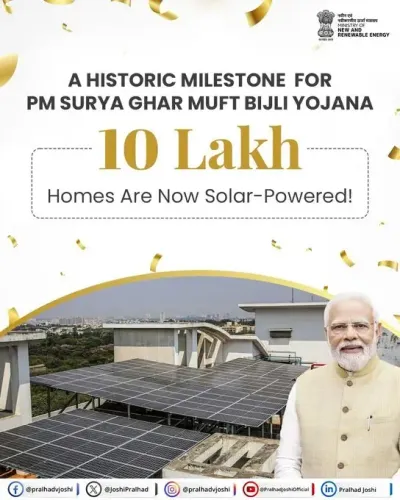
PM Surya Ghar: Muft Bijli Yojana has benefited more than 50.06 lakh households as of 4 August 2026 , just over two years after launch.
Daily installations tripled from 5,038 in October 2025 to nearly 16,328 in July 2026 ; July 2026 set a monthly record of 5.06 lakh new beneficiaries.
The government has released ₹28,024 crore in subsidies via DBT against a total outlay of ₹75,021 crore .
Nearly 19 lakh households now have zero electricity bills; more than 12 lakh earned a combined ₹421 crore selling surplus power in FY25 .
Cumulative rooftop solar capacity commissioned under the scheme stands at 14.8 GW .
More than 2.32 lakh people trained and 29,469 active vendors registered, generating employment across the solar value chain.
The PM Surya Ghar: Muft Bijli Yojana, billed as the world's largest domestic rooftop solar programme, has benefited more than 50.06 lakh households across India, the government announced on Tuesday, 4 August 2026. The milestone arrives just over two years after the scheme's launch and represents a dramatic leap from the 7.94 lakh rooftop solar installations recorded over the entire preceding decade.
Record Pace of Expansion
The programme is now adding roughly one lakh households every six days, according to the Ministry of New and Renewable Energy. The daily installation rate has surged more than three-fold in nine months — from 5,038 installations per day in October 2025 to nearly 16,328 installations per day in July 2026. July 2026 alone registered a record 5.06 lakh new beneficiary households, the highest monthly figure since the scheme's inception.
Financial Relief and Surplus Income
The government has disbursed ₹28,024 crore in subsidies directly to beneficiaries through the Direct Benefit Transfer (DBT) mechanism, out of a total scheme outlay of ₹75,021 crore. Nearly 19 lakh households are now receiving zero electricity bills as a result. More than 12 lakh households collectively earned ₹421 crore by selling surplus power back to the grid during FY25, generating an average additional income of approximately ₹3,500 per household annually.
Inclusion of Vulnerable Households
Around 1.6 lakh installations have been completed specifically for households under the Pradhan Mantri Awas Yojana (PMAY), Below Poverty Line (BPL) categories, and SC/ST communities across four states. The inclusion model has been approved for rollout across 12 states, signalling a deliberate push to extend clean energy access beyond urban and middle-income segments.
Jobs and Capacity Built Along the Solar Chain
The scheme has also generated employment across the solar value chain. A total of 34,219 vendors have registered under the programme, of which 29,469 are currently active. More than 2.32 lakh people have been trained under various capacity-building initiatives. Cumulatively, 14.8 GW of rooftop solar capacity has been commissioned under the scheme to date.
What This Signals for India's Clean Energy Push
This comes amid India's broader commitment to reaching 500 GW of non-fossil fuel capacity by 2030. The acceleration in PM Surya Ghar installations — particularly the near-tripling of daily additions — suggests that demand-side subsidies tied to direct benefit transfers can meaningfully move adoption curves in the residential solar segment. The scheme's trajectory will be closely watched as a model for scaling distributed renewable energy in large emerging economies.
Point of View
But the more telling number is the pace — daily installations have tripled in nine months, suggesting the subsidy-DBT model has finally cracked the adoption barrier that stalled rooftop solar for a decade. The previous ten years produced fewer than 8 lakh installations; this scheme matched that six times over in roughly 24 months. The unresolved question is grid readiness: as surplus power sellers cross 12 lakh households, distribution companies face rising reverse-flow pressure that state regulators have been slow to address. If grid infrastructure does not keep pace with rooftop additions, the scheme's financial promise to households — ₹3,500 a year in surplus income — could erode, and the political goodwill built on zero-bill messaging with it.
NationPress
20 Sept 2026
Frequently Asked Questions
What is the PM Surya Ghar: Muft Bijli Yojana?
PM Surya Ghar: Muft Bijli Yojana is the Indian government's flagship rooftop solar scheme, described as the world's largest domestic rooftop solar programme, with a total outlay of ₹75,021 crore. It subsidises rooftop solar installations for households and aims to eliminate or sharply reduce electricity bills for beneficiaries.
How many households have benefited from PM Surya Ghar so far?
More than 50.06 lakh households across India had benefited under the scheme as of 4 August 2026, just over two years after its launch. This compares with only 7.94 lakh rooftop solar installations recorded during the entire previous decade.
How much subsidy has the government released under PM Surya Ghar?
The government has disbursed ₹28,024 crore in subsidies directly to beneficiaries through the Direct Benefit Transfer mechanism. The scheme's total approved outlay is ₹75,021 crore.
Can households earn money by selling surplus solar power under this scheme?
Yes. More than 12 lakh households earned a combined ₹421 crore by selling surplus power to the grid during FY25, averaging approximately ₹3,500 in additional annual income per household. Nearly 19 lakh households are additionally receiving zero electricity bills.
What is the current pace of installations under PM Surya Ghar?
As of July 2026, the scheme was adding nearly 16,328 installations per day — more than three times the 5,038 daily installations recorded in October 2025. The programme is now benefiting approximately one lakh new households every six days.