Rajnath Singh: 'Make in India, Make for the World' must guide MSME vision
Synopsis
Defence Minister Rajnath Singh used a Greater Noida MSME platform to reframe India's manufacturing ambition — not just as domestic self-reliance, but as a bid for global supply-chain dominance. With India's MSME count nearly doubling to 8 crore and FTAs advancing with the US, UK, and EU, Singh's message was pointed: the window is open, but only for enterprises willing to invest in technology and quality now.
Key Takeaways
Defence Minister Rajnath Singh addressed an MSME event in Greater Noida on 1 September , calling for a manufacturing vision guided by 'Make in India, Make for India, and Make for the World' .
India's MSME count has grown from approximately 4.67 crore in 2012-13 to around 8 crore currently.
Singh urged MSMEs to invest in R&D and technology upgradation and partner with IITs, DRDO labs, and startups .
He highlighted Free Trade Agreements with the US, UK, New Zealand, Oman, Switzerland , and the EU as key export enablers.
High-opportunity sectors identified include drones, AI, robotics, cybersecurity, space , and quantum technologies .
The push is framed within the Viksit Bharat@2047 vision of a self-reliant, globally competitive India.
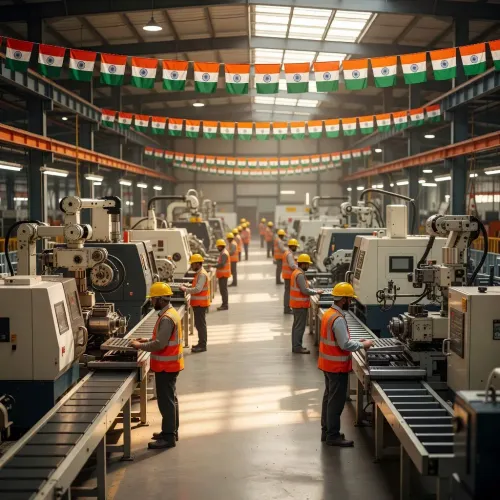
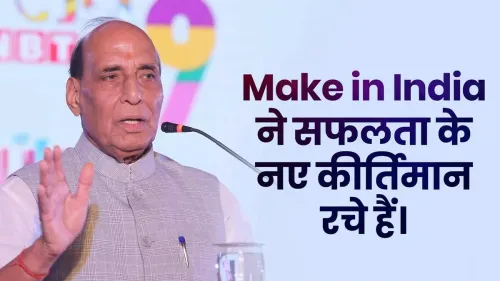
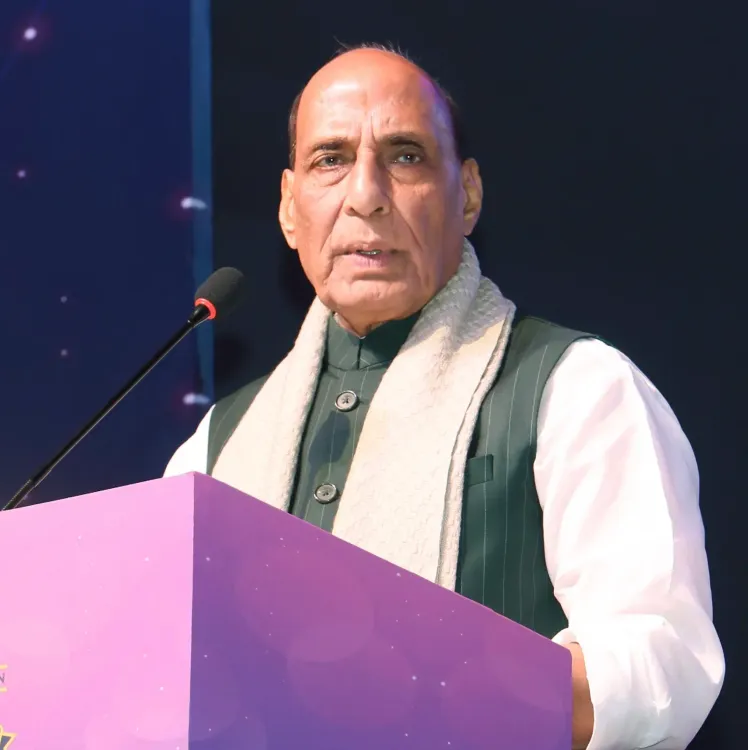
Defence Minister Rajnath Singh on Tuesday, 1 September called on Indian MSMEs to embrace the principle of 'Make in India, Make for India, and Make for the World' as the cornerstone of the country's manufacturing ambitions, urging small and medium enterprises to seize shifting global trade dynamics and position themselves as internationally competitive players. He was addressing an MSME event in Greater Noida.
Key Developments
Singh urged MSMEs to allocate a portion of their annual turnover to research, development, and technology upgradation. He also called on them to forge partnerships with universities, IITs, research institutions, DRDO laboratories, startups, and large industries to strengthen their technological capabilities and build scale.
The minister underscored that India's MSME base has expanded significantly — from approximately 4.67 crore enterprises in 2012-13 to around 8 crore at present — reflecting, in his view, a deepening entrepreneurial culture across the country.
Global Trade Opportunity and FTA Networks
Highlighting the realignment of global supply chains and rising demand for reliable manufacturing partners, Singh said these trends present a major opening for Indian MSMEs to expand their international footprint. He pointed to the government's efforts under Prime Minister Narendra Modi to advance Free Trade Agreements with key economies including the US, UK, New Zealand, Oman, Switzerland, and the European Union.
'These FTA networks open up a vast ocean of opportunities for global trade and exports for MSMEs and industries. They must fully leverage these international partnerships and trade agreements through government schemes such as Credit Guarantee Expansion and GST Rationalisation, and take Indian products to every corner of the globe,' Singh said.
Sectors Flagged as High-Opportunity
Singh identified a range of emerging technology domains as areas where MSMEs can carve out a global identity. These include drones, artificial intelligence, robotics, cybersecurity, advanced electronics, sensors, autonomous systems, advanced materials, space technologies, and quantum technologies.
He placed particular emphasis on the defence sector, noting that quality and reliability carry even greater weight when a component's performance directly affects the operational effectiveness of the armed forces. 'Indian MSMEs must establish their identity in global markets through quality and reliability,' he said.
Viksit Bharat@2047 as the Overarching Goal
Singh situated his remarks within the broader vision of Viksit Bharat@2047 — the government's long-term blueprint for India to become a globally competitive, technologically advanced, and self-reliant economy by the centenary of independence, while generating adequate employment for the country's youth. This comes amid sustained government push to raise India's manufacturing share of GDP, which has remained well below aspirational targets for over a decade.
With FTA negotiations advancing on multiple fronts and global supply chains continuing to diversify away from single-source dependence, the window for Indian MSMEs to capture a larger share of international manufacturing contracts may be narrowing — making Singh's call to act now more than just ceremonial.
Point of View
Not just domestic suppliers. Yet the gap between aspiration and execution remains wide — India's manufacturing share of GDP has barely moved despite years of PLI schemes and Make in India campaigns. The real question is whether FTA access alone can drive MSME internationalisation, or whether structural constraints — credit access, skilling deficits, and compliance costs — will blunt the opportunity before it is seized. Flagging defence-sector quality standards as a benchmark for all MSMEs is an interesting framing, but it raises the bar at precisely the moment when many smaller enterprises are still struggling with basic digital adoption.
NationPress
17 Oct 2026
Frequently Asked Questions
What did Rajnath Singh say about India's MSME manufacturing vision?
Defence Minister Rajnath Singh said India's manufacturing vision must be guided by the principle of 'Make in India, Make for India, and Make for the World'. Speaking at a Greater Noida MSME event on 1 September, he urged small and medium enterprises to invest in R&D, build technology partnerships, and leverage India's expanding FTA network to compete globally.
How many MSMEs are there in India currently?
According to Singh's remarks, India's MSME count has grown from approximately 4.67 crore in 2012-13 to around 8 crore at present. The minister cited this growth as evidence of an expanding entrepreneurial ecosystem.
Which countries is India negotiating Free Trade Agreements with?
Singh pointed to ongoing or advancing FTA negotiations with the US, UK, New Zealand, Oman, Switzerland, and the European Union. He said these agreements open significant export opportunities for Indian MSMEs through government schemes including Credit Guarantee Expansion and GST Rationalisation.
What sectors did Rajnath Singh identify as high-opportunity for MSMEs?
Singh identified drones, artificial intelligence, robotics, cybersecurity, advanced electronics, sensors, autonomous systems, advanced materials, space technologies, and quantum technologies as areas of significant opportunity for MSMEs. He gave particular emphasis to the defence sector, where component reliability directly affects armed forces effectiveness.
What is the Viksit Bharat@2047 vision Singh referred to?
Viksit Bharat@2047 is the government's long-term blueprint for India to become a globally competitive, technologically advanced, and self-reliant economy by 2047 — the centenary of independence. Singh framed MSME growth and manufacturing ambition as central to achieving this goal, including generating sufficient employment for India's youth.