Responsible Nations Index 2026: How WIF is redefining global success metrics
Synopsis
The Responsible Nations Index 2026 takes direct aim at a long-standing bias in global rankings: that power and wealth define national success. Built over three years with JNU and IIM Mumbai, it judges countries on how they treat people and the planet — a framework India is now championing as an alternative to Western-dominated indices.
Key Takeaways
The World Intellectual Foundation (WIF) released the inaugural Responsible Nations Index (RNI) 2026 report in Bengaluru on 27 June 2026 .
The RNI was first launched in January 2026 and evaluates nations on ethical governance , social well-being , environmental stewardship , and global responsibility .
The index is the outcome of a three-year research initiative involving JNU and IIM Mumbai .
WIF Chairman Professor Jagdish Mukhi argued that existing global indices are skewed toward measuring military and economic power rather than responsibility.
Mohandas Pai , former CFO of Infosys , said the index aims to ensure nations do not 'destroy the planet or harm the prospects of other people.' JNU Vice Chancellor Professor Santishree Dhulipudi Pandit described JNU's contribution as an 'antidote' to prevailing global frameworks.
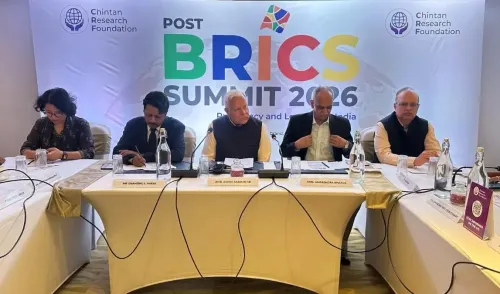
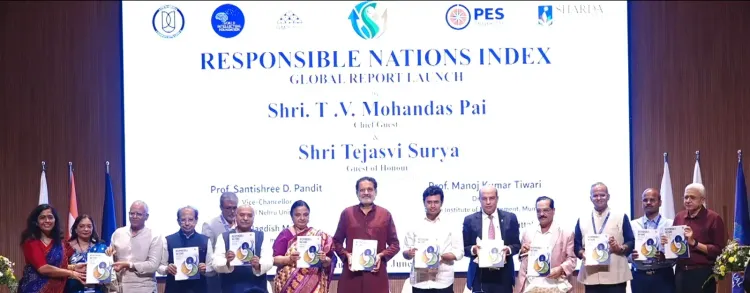
The World Intellectual Foundation (WIF) on Saturday, 27 June 2026, released the inaugural Responsible Nations Index (RNI) 2026 report in Bengaluru, introducing a first-of-its-kind global framework that measures how nations treat the planet and its people — moving well beyond conventional indicators of military might and economic output.
What the Responsible Nations Index Measures
Launched earlier in January 2026, the RNI evaluates countries across four pillars: ethical governance, social well-being, environmental stewardship, and global responsibility. The framework is the product of a three-year academic and policy research initiative led by the WIF, with scholarly contributions from Jawaharlal Nehru University (JNU) and the Indian Institute of Management (IIM) Mumbai.
Why a New Index Was Needed
WIF Chairman Professor Jagdish Mukhi explained the rationale behind the initiative, noting that existing global indices have largely been designed and produced by powerful nations. 'The thought behind this is that all the indices issued so far have largely been produced by the powerful countries of the world. They have assessed every country according to their own criteria. In many of those indices, the parameters are based on how powerful a country is, how much ammunition it has, how many weapons it possesses, and its overall strength,' Professor Mukhi said.
This critique reflects a growing concern among emerging economies that legacy ranking systems embed a geopolitical bias — rewarding military and economic dominance over sustainability or social equity. The RNI is positioned as a corrective to that imbalance.
What Experts Said at the Launch
T.V. Mohandas Pai, Chairman of Aarin Capital and former Chief Financial Officer and board member at Infosys, articulated the index's core philosophy at the event. 'The Responsible Nation Index has been developed to assess how nations treat the planet and the people of the world. While every country has the right to pursue its own interests, we all live on the same planet. We must ensure that whatever we do within our own country does not destroy the planet or harm the prospects of other people, because that is what it means to be a responsible nation. Our culture and civilisation have always taught us that we are part of one global family,' Pai said.
JNU Vice Chancellor Professor Santishree Dhulipudi Pandit highlighted the university's involvement, stating: 'We are the only university with 1,000 faculty members for 10,000 students and the only university funded by the Central Government of India... JNU is now presenting its own antidote.'
Significance and Broader Context
The RNI arrives at a moment when international discourse on development is increasingly questioning GDP-centric models. Frameworks such as the UN's Human Development Index and Bhutan's Gross National Happiness have previously challenged purely economic metrics, but the RNI's explicit inclusion of global responsibility as a standalone pillar is notably distinct. This comes amid heightened debate over climate commitments, AI governance, and the geopolitics of multilateral institutions.
Notably, the index draws its institutional weight from two Indian academic anchors — JNU and IIM Mumbai — signalling India's intent to position itself as a norm-setter in global governance discourse, not merely a rule-taker.
What Comes Next
The full RNI 2026 rankings and methodology are expected to be disseminated through WIF's global policy network following the Bengaluru release. Experts at the event indicated that the framework is designed to evolve annually, with broader country coverage anticipated in subsequent editions.
Point of View
But its credibility will hinge on methodology transparency and uptake beyond its founding institutions. India championing an alternative to Western-designed global indices is politically significant — yet the risk is that the RNI is perceived as a counter-narrative project rather than a rigorous measurement tool. The inclusion of JNU, which carries its own political associations, may invite scrutiny in international policy circles. The real test will come when the rankings are published: whether powerful nations score poorly and whether the WIF has the institutional standing to make that finding matter.
NationPress
26 Sept 2026
Frequently Asked Questions
What is the Responsible Nations Index (RNI) 2026?
The Responsible Nations Index 2026 is a global framework released by the World Intellectual Foundation that assesses countries on ethical governance, social well-being, environmental stewardship, and global responsibility. It was first launched in January 2026 and is designed to move beyond traditional measures of military and economic strength.
Who developed the Responsible Nations Index?
The RNI was developed by the World Intellectual Foundation over three years, with academic contributions from Jawaharlal Nehru University and the Indian Institute of Management Mumbai. WIF Chairman Professor Jagdish Mukhi led the initiative.
Why was the Responsible Nations Index created?
According to WIF Chairman Professor Jagdish Mukhi, existing global indices have largely been produced by powerful nations and measure countries by military and economic criteria. The RNI was created to provide an alternative framework centred on how nations treat people and the planet.
Where and when was the RNI 2026 report released?
The inaugural RNI 2026 report was released in Bengaluru on Saturday, 27 June 2026, at an event attended by academics, policy experts, and industry leaders including T.V. Mohandas Pai and JNU Vice Chancellor Professor Santishree Dhulipudi Pandit.
What role do JNU and IIM Mumbai play in the RNI?
Both Jawaharlal Nehru University and IIM Mumbai provided scholarly contributions to the three-year research initiative that underpins the RNI framework. JNU Vice Chancellor Professor Santishree Dhulipudi Pandit described the university's involvement as offering its own 'antidote' to prevailing global ranking systems.