Robotics and AI to power India's precision healthcare revolution: Dr Jitendra Singh
Synopsis
India's Science Minister Dr Jitendra Singh used SRS India 2026 to map out a bold vision: robotics and AI not just in the operating theatre but across every medical discipline, with the Genome India Programme potentially expanding to sequence every newborn — a staggering ambition for a nation of 1.4 billion that will hinge entirely on AI's ability to make sense of the data.
Key Takeaways
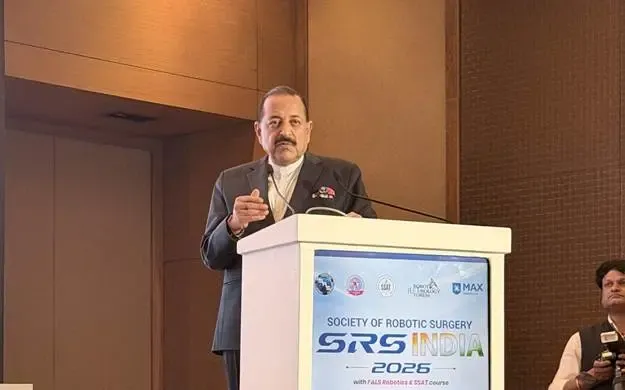
Dr Jitendra Singh addressed the International Conference of the Society of Robotic Surgery (SRS India 2026) in New Delhi on 2 October 2026 .
He said robotics, AI , and nanoscience will form an integrated ecosystem to deliver personalised, precision healthcare.
The Genome India Programme has already sequenced 10,000 individuals ; the Minister expressed hope for eventual sequencing of every newborn.
Dr Singh flagged nanomedicine and oral insulin development as examples of nano-level innovations transforming drug delivery.
He envisioned new sub-disciplines — robotic endocrinology and robotic cardiology — emerging alongside existing robotic surgery.
Union Minister of State (Independent Charge) for Science and Technology and Earth Sciences Dr Jitendra Singh on Friday, 2 October 2026, declared that robotics is set to become a foundational enabler across every branch of medicine in India — extending well beyond surgery into diagnostics, treatment, and therapy — as the country accelerates its shift toward precision and personalised healthcare.
Key Developments at SRS India 2026
Speaking at the International Conference of the Society of Robotic Surgery (SRS India 2026) in New Delhi, Dr Singh said robotics, artificial intelligence (AI), and nanoscience are expected to converge into an integrated ecosystem that will fundamentally transform how healthcare is delivered. This ecosystem, he argued, will enable treatments tailored specifically to individual patients rather than broad population groups.
Dr Singh, who is also a practising physician and diabetologist, urged the medical community not to view robotics solely through the lens of surgical technology. While robotic surgery currently represents the most visible application, he said future advancements could give rise to entirely new sub-disciplines — robotic medicine, robotic endocrinology, and robotic cardiology — mirroring the trajectory AI has already taken across multiple medical specialties.
Frontier Technologies and the Next Healthcare Phase
Highlighting the rapid pace of transformation in medical science, Dr Singh said the world is entering an era of frontier technologies driven by advances in AI, biotechnology, nuclear medicine, nanotechnology, and robotics. The next phase of healthcare, he said, will be increasingly shaped by genetically driven diagnostics and personalised treatment approaches based on an individual's genetic profile, lifestyle, dietary habits, and environmental factors.
He emphasised that patients suffering from the same disease may require markedly different treatment strategies depending on their biological and environmental characteristics — a core principle of precision medicine. Emerging technologies, he added, are making such customised healthcare delivery progressively more feasible.
Genome India Programme and the AI Imperative
Referring to the Genome India Programme, Dr Singh noted that 10,000 individuals have already been sequenced under the initiative. He expressed optimism that India could eventually move toward gene sequencing for every newborn. Managing and analysing genetic data at such a scale — for a population exceeding 1.4 billion — would, he said, require extensive deployment of both AI and robotics.
This comes amid a broader government push to position India as a global hub for biotechnology and deep-science innovation, with several initiatives under the Science and Technology Ministry aimed at translating research into clinical applications.
Nanomedicine and the Oral Insulin Frontier
Dr Singh also spotlighted the potential of nanomedicine to address longstanding healthcare challenges. Citing ongoing efforts to develop oral insulin, he said nano-level innovations could significantly improve drug delivery systems, opening new possibilities for treatment and disease management — particularly relevant for India's large diabetic population.
What Comes Next
As India's healthcare technology ecosystem matures, the convergence of robotics, AI, genomics, and nanomedicine is expected to accelerate, with conferences such as SRS India 2026 serving as key platforms for cross-disciplinary collaboration. The government's stated ambition of sequencing every newborn and scaling precision medicine will be closely watched for follow-through in policy and funding.
Point of View
But intent and infrastructure are different things. India's genomic sequencing ambitions — particularly sequencing every newborn — demand a data architecture and AI capacity that the country is still building. The oral insulin reference is a useful illustration of nanomedicine's promise, but it has been 'in development' globally for decades; the timeline to clinical reality remains unclear. What the speech signals, above all, is a government doubling down on deep-science as a healthcare strategy — the question is whether funding, regulation, and trained personnel will keep pace with the vision.
NationPress
2 Oct 2026
Frequently Asked Questions
What did Dr Jitendra Singh say about robotics and healthcare at SRS India 2026?
Dr Jitendra Singh said robotics is set to become a key enabler across every branch of medicine — not just surgery — and will converge with AI and nanoscience to deliver precision, personalised healthcare. He spoke at the International Conference of the Society of Robotic Surgery in New Delhi on 2 October 2026.
What is the Genome India Programme and how does it relate to precision medicine?
The Genome India Programme is a government initiative to sequence the genetic profiles of Indian citizens. As of the Minister's address, 10,000 individuals have been sequenced, and Dr Singh expressed hope that India could eventually sequence every newborn to enable genetically driven, personalised treatment.
What is robotic medicine and why is Dr Singh promoting it?
Robotic medicine refers to the application of robotics beyond surgery — into fields such as diagnostics, endocrinology, and cardiology. Dr Singh argued this mirrors AI's rapid adoption across medical specialties and represents the next frontier for healthcare technology in India.
How does nanomedicine fit into India's healthcare technology push?
Dr Singh highlighted nanomedicine as a way to address longstanding treatment challenges, citing efforts to develop oral insulin as an example of how nano-level innovations can improve drug delivery systems and expand treatment options.
Why does managing India's genomic data require AI and robotics?
With a population exceeding 1.4 billion, analysing genetic sequences on the scale envisioned by the Genome India Programme would generate enormous volumes of complex data. Dr Singh said AI and robotics would be essential to process and derive actionable clinical insights from such data at scale.