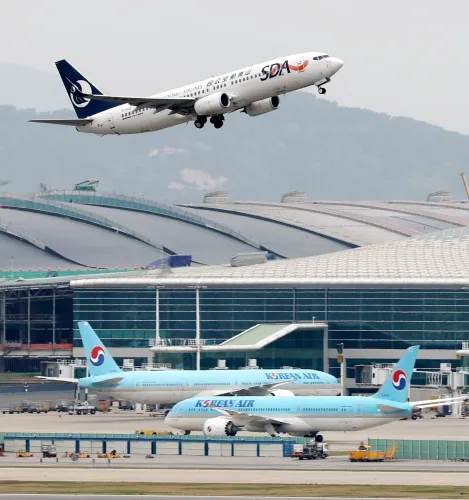
S. Korea budget airlines slash 900 flights as jet fuel prices surge 2.5x
Synopsis
South Korean budget carriers have slashed 900 round-trip flights and activated emergency cost measures as jet fuel prices hit US$214.71 per barrel — up 150% in two months. With T'way Air's debt ratio above 3,400% and Air Premia facing potential licence revocation, the Middle East conflict is testing the financial limits of the region's low-cost aviation sector.
Key Takeaways
South Korean low-cost carriers have cut 900 round-trip flights amid jet fuel prices surging 2.5 times since the Middle East conflict began.
Jeju Air trimmed 187 international round-trip flights (4% of operations); Jin Air cut 176 flights to destinations including Guam and Phu Quoc.
Singapore benchmark jet fuel price hit US$214.71 per barrel (16 March–15 April), up 150% from two months prior.
T'way Air and Jeju Air have introduced unpaid leave; Jin Air postponed safety incentive payments.
T'way Air's debt ratio exceeds 3,400% ; Air Premia faces potential licence revocation over capital impairment.
Airlines that posted solid Q1 2025 earnings are widely expected to slip into losses in Q2 2025 .
South Korean low-cost carriers have collectively cut 900 round-trip flights and introduced emergency measures including unpaid leave, as soaring jet fuel prices — driven by the ongoing Middle East conflict — threaten to push the sector into losses from the second quarter of 2025. Industry officials confirmed the cuts on Sunday, 10 May, warning that the total number of reductions is likely to climb further as airlines finalise their June schedules.
Scale of Flight Reductions
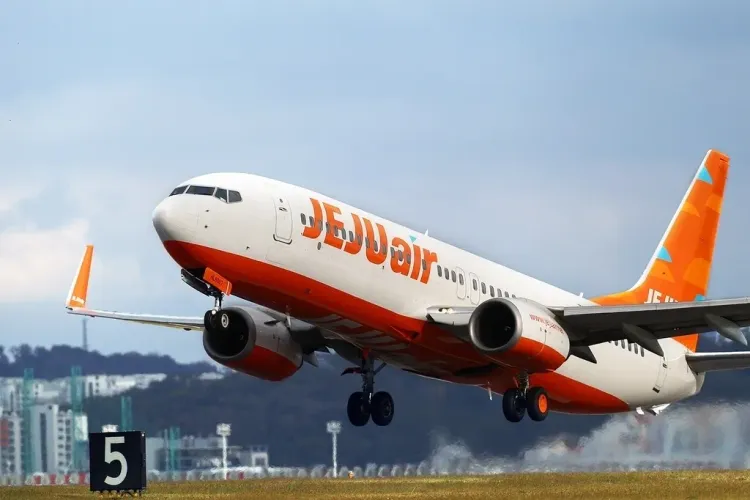
Jeju Air Co., South Korea's largest budget airline, has cut 187 round-trip international flights — equivalent to 4 percent of its total operations — on routes from Incheon to Bangkok, Singapore, and the Vietnamese cities of Da Nang and Phu Quoc during May and June. The carrier has also suspended its Vientiane route for two months since late April.
Jin Air Co. has trimmed 176 round-trip flights to destinations including Guam and Phu Quoc through the end of this month, with further reductions expected once its June schedule is confirmed.
Among full-service carriers, Asiana Airlines Inc. has cut 27 round-trip flights on six routes — including Phnom Penh and Istanbul — through July. Korean Air Co., South Korea's largest carrier overall, has not yet adjusted flight operations but confirmed it is monitoring the situation under an emergency management system.
Fuel Prices at the Core of the Crisis
Jet fuel prices have surged 2.5 times since the outbreak of the conflict. The average Singapore jet fuel price — the benchmark used for fuel surcharges — stood at US$214.71 per barrel for the period from 16 March to 15 April, up 150 percent from two months earlier.
The spike has compounded operational challenges: some Southeast Asian routes now require additional refuelling stops, sharply increasing per-flight costs.
Point of View
But the deeper story is structural fragility. South Korea's budget aviation sector expanded aggressively post-pandemic on the assumption of stable fuel costs — T'way Air's 3,400% debt ratio and Air Premia's capital impairment suggest that assumption was dangerously optimistic. The Middle East conflict has simply accelerated a reckoning that was already overdue. If Air Premia loses its licence, it will not just be a corporate failure — it will reshape competition on Southeast Asian leisure routes where Korean low-cost carriers have been fighting a margin war for years.
NationPress
26 Sept 2026
Frequently Asked Questions
Why are South Korean budget airlines cutting flights in 2025?
South Korean low-cost carriers are cutting flights because jet fuel prices have surged 2.5 times since the outbreak of the Middle East conflict, making several routes financially unviable. The average Singapore benchmark jet fuel price rose 150% in two months to US$214.71 per barrel.
Which South Korean airlines have cut flights and by how much?
Jeju Air cut 187 round-trip international flights (4% of its operations), Jin Air trimmed 176 round-trip flights, and Asiana Airlines reduced 27 round-trip flights on six routes. The total industry-wide reduction stands at 900 round-trip flights, with more expected as June schedules are finalised.
What emergency measures have South Korean airlines introduced?
T'way Air and Jeju Air have introduced unpaid leave programmes, while Jin Air has postponed safety incentive payments. Korean Air, Asiana Airlines, Jin Air, and T'way Air have all activated emergency management systems.
Is Air Premia at risk of losing its operating licence?
Air Premia was in a state of capital impairment at the end of 2024. Industry watchers have warned that if the company fails to resolve the issue, its operating licence could be revoked by South Korean aviation authorities.
How will the fuel price surge affect South Korean airline earnings?
Airlines posted solid first-quarter 2025 earnings, but analysts widely expect many carriers — especially budget airlines — to slip into losses in the second quarter due to soaring fuel costs, weaker travel demand, and a depreciating Korean won.