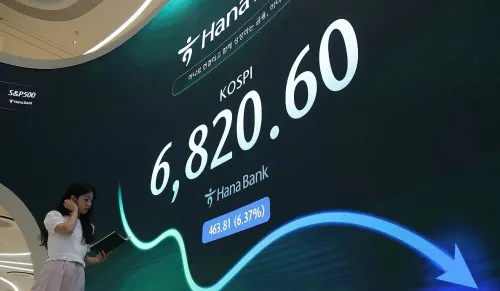
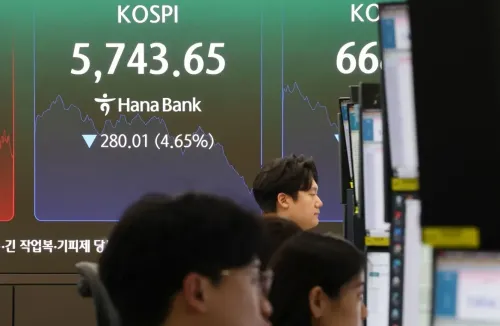
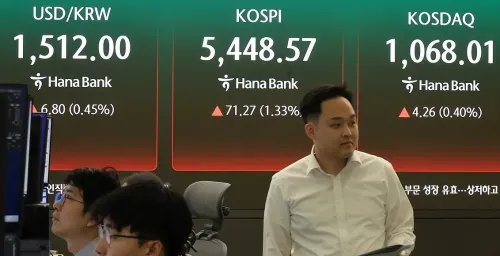
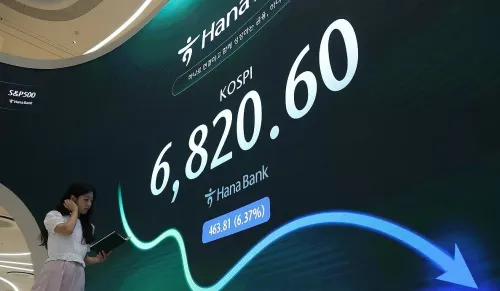
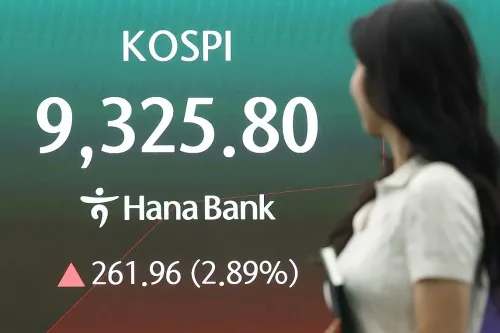
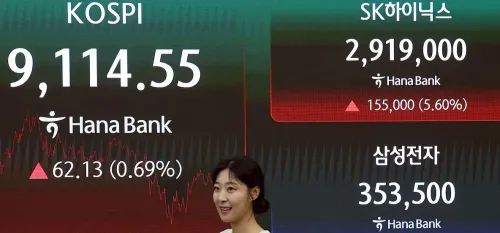
KOSPI drops 4% as Samsung, SK Hynix slide on US tech losses, inflation fears
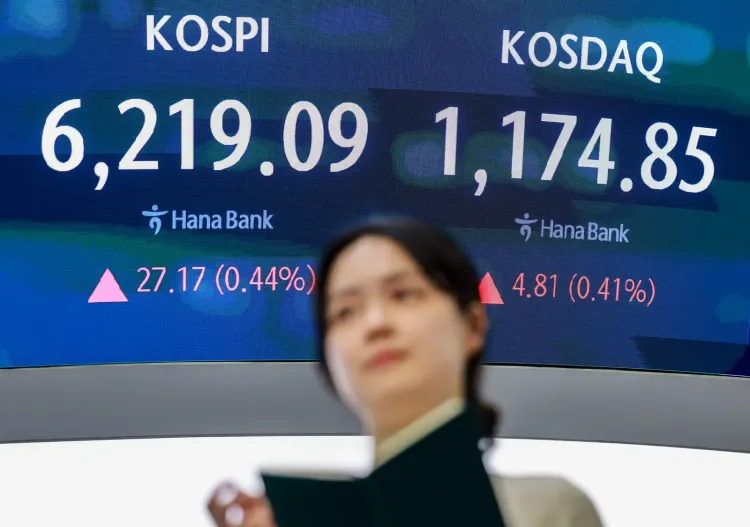
Synopsis
Seoul's KOSPI tumbled over 4% in early trade on 13 October, with Samsung Electronics and SK Hynix among the hardest hit as US tech losses and anxiety over Wednesday's US inflation print rattled investor confidence. A sell-side sidecar was activated — a rare circuit-curb signal that captures just how hard the opening sell pressure hit.
Key Takeaways
The KOSPI was trading down 257.59 points (4.03%) at 6,126.65 as of 9:15 am on 13 October , after opening 3.1% lower .
The bourse operator activated a sell-side sidecar on the KOSPI amid the sharp early decline.
Samsung Electronics fell 4.79% ; chipmaker SK Hynix slid 5.61% ; Hyundai Motor shed 5% .
Entertainment stocks bucked the trend: Hybe rose 1.47% and SM Entertainment gained 1.8% .
South Korea's Q3 bond and CD sales rose 11.1% year-on-year to 178.3 trillion won , per Korea Securities Depository data.
The Bank of Korea raised its key rate to 3% in back-to-back hikes in July and August 2026 — the first such consecutive moves since January 2023 .
Seoul's benchmark Korea Composite Stock Price Index (KOSPI) plunged sharply on Tuesday, 13 October, opening 3.1 percent lower before extending declines to trade down 257.59 points, or 4.03 percent, at 6,126.65 as of 9:15 am local time. The sell-off was triggered by overnight losses in US technology stocks and mounting investor caution ahead of key corporate earnings and the release of critical US inflation data.
Market Circuit Breaker Activated
The intensity of the early decline was sharp enough to prompt the bourse operator to activate a sell-side sidecar on the KOSPI — a temporary programme-trading curb designed to slow automated selling during rapid market drops. The activation underscored the severity of the session's opening pressure, which quickly spread beyond the technology sector.
Tech Giants Lead the Decline
Technology stocks bore the brunt of the selling. Samsung Electronics, the market's largest constituent, fell 4.79 percent, while chipmaking rival SK Hynix declined a steeper 5.61 percent. Both companies are heavily exposed to global semiconductor demand cycles, making them particularly sensitive to shifts in US tech sentiment. Defence conglomerate Hanwha Aerospace dropped 3.71 percent, and leading automaker Hyundai Motor shed 5 percent, reflecting broad-based risk aversion rather than sector-specific news.
What Spooked Investors
Overnight on Wall Street, US stocks ended on a mixed note — the Dow Jones Industrial Average edged up 0.38 percent, while the tech-heavy Nasdaq Composite fell 0.44 percent. The divergence highlighted pressure specifically on technology names, which have outsized influence on Asian markets. Investors are closely watching the US Consumer Price Index (CPI) report due Wednesday (US time), which is expected to shape expectations for the US Federal Reserve's upcoming October rate-setting meeting. Any upside inflation surprise could harden the case for rates staying higher for longer, a scenario that historically weighs on growth and tech stocks globally.
Pockets of Strength in Entertainment
Not all stocks were caught in the downdraft. Hybe, the agency representing K-pop group BTS, rose 1.47 percent, while rival entertainment agency SM Entertainment climbed 1.8 percent. The resilience of entertainment names amid a broad sell-off suggests selective investor interest in domestically-driven revenue streams less exposed to US macro variables. The Korean won was trading at 1,335.70 won per US dollar, marginally firmer by 0.1 won from the previous session's close.
Bond and CD Market Data in Focus
Separately, data released on Tuesday showed that combined sales of bonds and certificates of deposit (CDs) in South Korea rose 11.1 percent year-on-year in the third quarter, reaching 178.3 trillion won (approximately US$134 billion), according to figures from the Korea Securities Depository. Bond issuance led the growth, jumping 13.8 percent on-year to 166.4 trillion won, even as CD issuance contracted 16.8 percent to 11.9 trillion won. Quarter-on-quarter, however, total debt instrument sales dipped 1.9 percent. This comes after the Bank of Korea raised its key interest rate to 3 percent across two consecutive meetings in July and August — the first back-to-back hikes since January 2023 — which has broadly supported bond market activity by lifting yields. How the market navigates the imminent US inflation print and subsequent Fed signalling will be critical in determining whether Tuesday's losses mark a floor or a prelude to further pressure.
Point of View
In effect, as a leveraged proxy for US tech sentiment — when the Nasdaq wobbles, Samsung and SK Hynix amplify the shock. The activation of a sell-side sidecar so early in the session points to algorithmic selling of unusual velocity, not merely cautious human repositioning. The more consequential question is what the US CPI print on Wednesday delivers: a hot number would not just pressure the Fed — it would extend the pain into Korean exporters whose earnings outlooks are already hostage to dollar strength and softening global chip demand. The Bank of Korea's two successive rate hikes this year add another layer of domestic constraint, narrowing the policy buffer if the external environment deteriorates further.
NationPress
13 Oct 2026
Frequently Asked Questions
Why did Seoul's KOSPI fall sharply on 13 October?
The KOSPI fell over 4% on 13 October, dragged down by losses in US technology stocks overnight and investor caution ahead of the US Consumer Price Index report due Wednesday. Samsung Electronics and SK Hynix, both sensitive to global tech and semiconductor demand, led the decline.
What is a sell-side sidecar and why was it activated?
A sell-side sidecar is a temporary curb on programme trading activated when a stock index drops sharply in a short period; it is designed to slow automated sell orders and prevent a cascade. It was activated on the KOSPI on Tuesday after the index fell more than 3% at the open, signalling unusually intense selling pressure.
Which South Korean stocks fell the most on Tuesday?
SK Hynix was the steepest faller among major stocks, declining 5.61%, followed by Hyundai Motor down 5% and Samsung Electronics down 4.79%. Hanwha Aerospace dropped 3.71%. Entertainment stocks Hybe and SM Entertainment were among the few gainers.
What is the significance of the upcoming US CPI data for Asian markets?
The US Consumer Price Index report, due Wednesday US time, will offer clues on the Federal Reserve's likely stance at its October rate-setting meeting. A higher-than-expected inflation reading could reinforce expectations of rates staying elevated, which tends to pressure growth and technology stocks globally, including in South Korea.
What did South Korea's bond market data show for Q3?
Combined bond and certificate of deposit sales in South Korea rose 11.1% year-on-year in the third quarter to 178.3 trillion won (about US$134 billion), according to Korea Securities Depository data. Bond issuance grew 13.8%, though CD issuance fell 16.8%, and total debt instrument sales were down 1.9% from the previous quarter.