Seoul Stock Market Loses Early Gains Due to Tech Declines
Synopsis
Seoul's stock market witnessed a decline in earlier gains as major tech shares faced downward pressure from foreign sell-offs. Despite retail and institutional buying, the KOSPI index struggled amid geopolitical tensions affecting market sentiment.
Key Takeaways
Seoul's stock market faced declines due to foreign tech sell-offs.
The KOSPI index showed an initial rise but lost ground.
Domestic investors bought local shares amid foreign selling.
Geopolitical tensions are affecting market sentiment.
The Korean won is trading slightly higher against the US dollar.
Seoul, March 20 (NationPress) South Korean equities saw a reduction in their earlier progress on Friday morning as major tech stocks experienced declines due to foreign selling pressure.
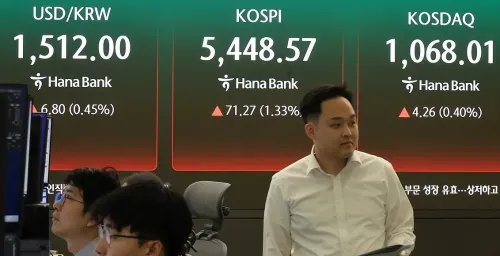
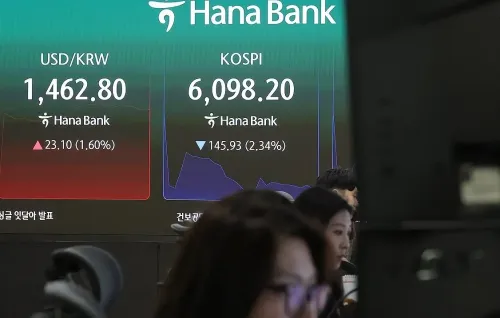
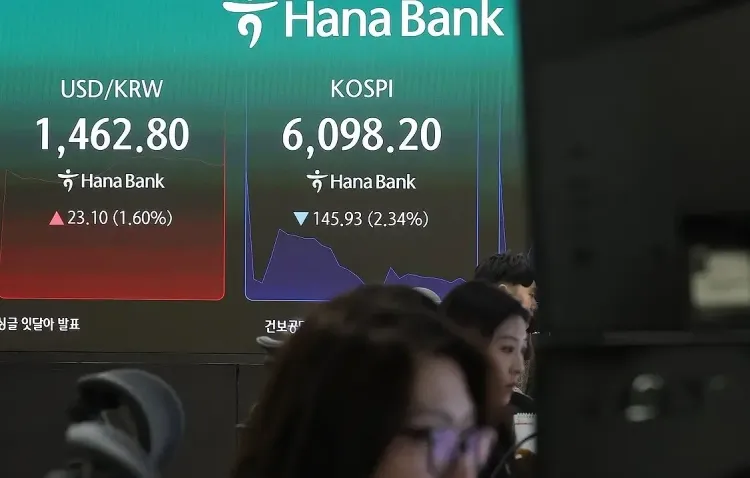
The benchmark Korea Composite Stock Price Index (KOSPI) rose by 26.43 points, equivalent to 0.46 percent, reaching 5,789.65 as of 11:20 a.m., according to Yonhap news agency.
However, the KOSPI reversed its gains as foreign investors sold a net 1.26 trillion won (approximately US$842 million). Domestic retail investors and institutional buyers invested 746.4 billion won and 524.8 billion won in local equities, respectively.
In the previous trading session, the Dow Jones Industrial Average ended down by 0.44 percent, the tech-heavy Nasdaq composite fell by 0.28 percent, and the S&P 500 slipped by 0.27 percent, despite recovering from most of their earlier losses following statements from Israeli Prime Minister Benjamin Netanyahu that the conflict with Iran could conclude more swiftly than anticipated, along with U.S. President Donald Trump's request for no further strikes on Iranian energy assets.
This week, Israel initiated an attack on the South Pars gas field, Iran's largest, prompting Iran to retaliate with a strike on a significant liquefied natural gas facility in Qatar.
In Seoul's market, leading company Samsung Electronics declined by 0.25 percent, while its competitor SK hynix fell by 0.2 percent.
On the upside, LG Energy Solution, a prominent battery manufacturer, gained 0.94 percent, and Doosan Enerbility, a power plant manufacturer, surged by 3.29 percent.
Both bio and financial sectors showed positive momentum.
Samsung Biologics rose by 2.4 percent, and Celltrion increased by 0.62 percent.
Shinhan Financial experienced a rise of 1.14 percent, while Mirae Asset Securities climbed by 1.95 percent. Trading firm Samsung C&T soared by 2.92 percent.
Conversely, AI investment firm SK Square dropped by 1.8 percent, and defense giant Hanwha Aerospace saw a significant decline of 4.73 percent.
Major shipbuilder HD Hyundai Heavy lost 0.71 percent, and Samsung Electro-Mechanics fell by 2.71 percent.
The Korean won was trading at 1,496.6 won against the U.S. dollar at 11:20 a.m., reflecting an increase of 4.4 won from the previous session.
On Thursday, the won had reached a new 17-year low, breaching the psychologically and technically significant threshold of 1,500 won.
Point of View
It's important to note that the fluctuation in the Seoul stock market reflects broader geopolitical tensions and investor sentiment. The interplay between foreign investment and domestic buying patterns will continue to shape market dynamics in South Korea.
NationPress
7 Oct 2026
Frequently Asked Questions
What caused the decline in Seoul's stock market?
The decline was primarily driven by significant sell-offs from foreign investors in major tech shares, despite domestic buying from retail and institutional investors.
How did the KOSPI index perform today?
The KOSPI index initially rose by 26.43 points but later trimmed its gains as foreign selling pressure increased.
What are the current trends in South Korean tech stocks?
South Korean tech giants like Samsung Electronics and SK hynix experienced declines, reflecting broader market challenges.
What geopolitical factors are influencing the market?
Tensions related to conflicts in the Middle East, particularly involving Iran and Israel, are influencing market sentiment and investor behavior.
How is the Korean won performing against the US dollar?
The Korean won was trading at 1,496.6 won against the US dollar, showing a slight increase from the previous session.