South Korean Stock Market Struggles Amid Hormuz Tensions
Synopsis
As global oil prices fluctuate due to the ongoing Hormuz blockade, South Korean stocks face a challenging landscape. The KOSPI index sees notable declines, while some sectors, such as nuclear construction, thrive amidst the turmoil.
Key Takeaways
KOSPI Index fell by 1.37% amidst ongoing global oil price fluctuations.
Samsung Electronics and SK Hynix saw declines of 1.76% and 1.08%, respectively.
Daewoo Engineering surged by 24.19% as investors turned to nuclear construction firms.
Financial stocks reacted negatively, with KB Financial and Shinhan Financial down 0.54% and 1.31%.
The government has introduced a fuel price cap to mitigate consumer costs amid the crisis.
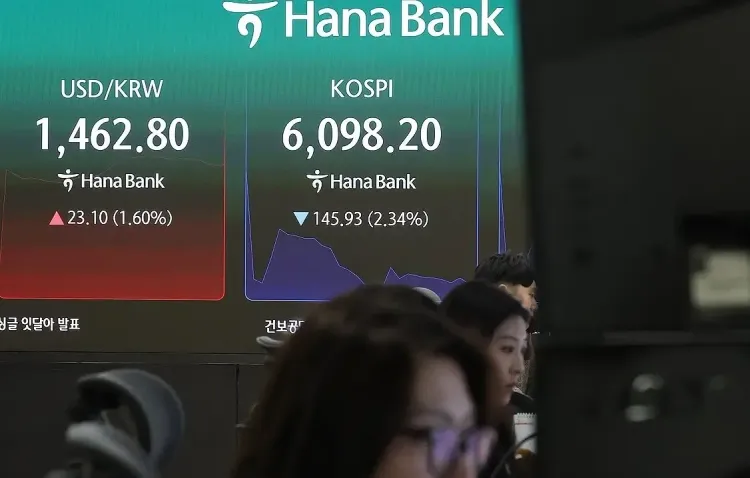
Seoul, March 13 (NationPress) - South Korean equities saw a reduction in losses towards the end of Friday morning, yet they remained in the red as global oil prices experienced volatility following the new Iranian leadership's commitment to maintain the blockade of the Strait of Hormuz.
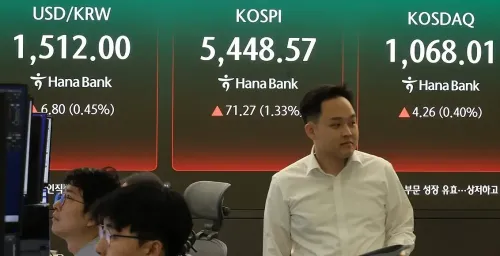
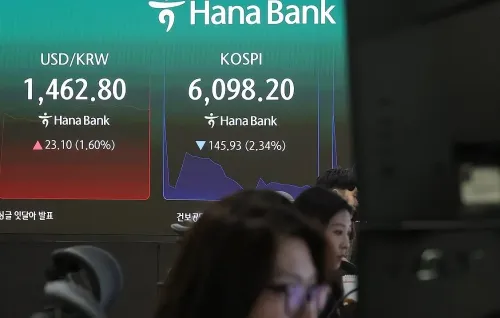
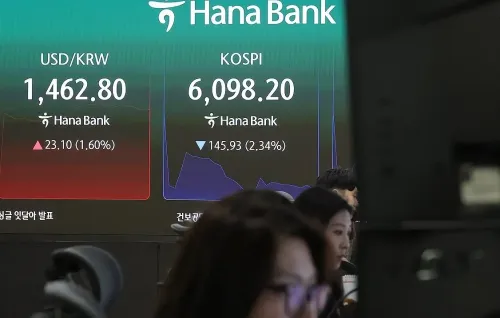
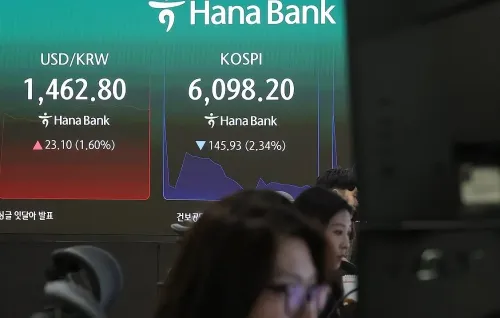
The Korea Composite Stock Price Index (KOSPI) declined by 76.62 points, or 1.37 percent, landing at 5,506.63 as of 11:20 a.m.
After significant fluctuations, global crude prices have returned to around $100, with disruptions at this crucial Middle Eastern waterway showing no signs of abating, despite U.S. President Donald Trump’s assertions that the conflict is approaching resolution, as reported by Yonhap news agency.
In the Seoul market, leading technology firm Samsung Electronics witnessed a 1.76 percent drop, while SK Hynix fell by 1.08 percent.
In light of global oil supply interruptions, investors turned their attention to nuclear power plant construction firms, with Daewoo Engineering & Construction surging by 24.19 percent and Hyundai Engineering & Construction rising by 5.27 percent.
Financial institutions experienced a downturn, with KB Financial decreasing by 0.54 percent and Shinhan Financial dropping by 1.31 percent.
The major online portal, Naver, saw a slight increase of 0.11 percent, while Kakao's stock price remained stable at 50,400 won.
The Korean won was valued at 1,486.7 won against the U.S. dollar, down 5.5 won from the previous trading session.
On Friday, Industry Minister Kim Jung-kwan called for oil refineries and gas stations to support the government's newly implemented fuel price cap system, designed to mitigate cost pressures resulting from the ongoing Middle East crisis.
Kim made this appeal during a meeting with representatives from South Korean oil refineries, gas stations, and the Korea National Oil Corp., coinciding with the launch of the fuel price cap system, as per the Ministry of Trade, Industry and Resources.
The temporary price cap came into effect at midnight on Thursday, establishing maximum prices for products supplied by oil refineries to gas stations and distributors.
The initial price ceilings were set at 1,724 won (approximately US$1.16) per liter for regular gasoline, 1,713 won per liter for diesel, and 1,320 won per liter for lamp oil.
Point of View
The current fluctuations in the South Korean stock market reflect the broader uncertainties in global oil supply, especially given the geopolitical tensions in the Middle East. The government's proactive measures to control fuel prices aim to stabilize the economy, showcasing a commitment to safeguarding consumer interests amidst external pressures.
NationPress
26 Sept 2026
Frequently Asked Questions
What is causing the decline in South Korean stocks?
The decline is mainly attributed to fluctuations in global oil prices due to the ongoing blockade of the Strait of Hormuz by Iran.
How is the South Korean government responding to the oil crisis?
The South Korean government has implemented a fuel price cap system to alleviate cost burdens on consumers.
What impact do oil prices have on the South Korean economy?
Oil prices significantly influence the South Korean economy, affecting inflation rates and the overall cost of living.
Which sectors are performing well amidst the stock market decline?
Nuclear power plant construction firms have seen gains, with notable increases in stocks of Daewoo Engineering & Construction and Hyundai Engineering & Construction.
What are the current exchange rates for the Korean won?
As of the latest trading session, the Korean won is valued at 1,486.7 won against the U.S. dollar.