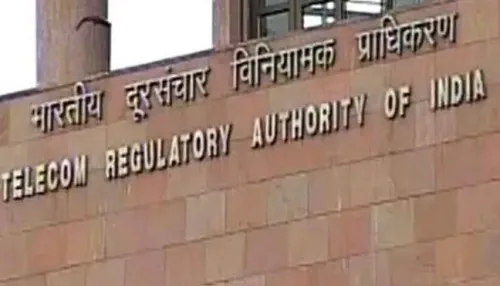
TRAI releases V2X consultation paper, invites stakeholder comments by May 28

Synopsis
TRAI has formally launched a public consultation on regulating Vehicle-to-Everything (V2X) communication — a technology that underpins autonomous driving and smart mobility. With India already the world's fastest-growing connected car market at 25% YoY growth, the regulatory framework TRAI develops could determine how quickly India transitions to fully connected, autonomous roads.
Key Takeaways
TRAI released a V2X Communication consultation paper on 30 April 2026 , following a DoT reference dated 1 December 2025 .
Stakeholder comments are due by 28 May 2026 ; counter-comments by 11 June 2026 .
India is the fastest-growing connected car market globally, with 25% year-on-year growth in 2024, according to Counterpoint Research .
Globally, 75% of passenger cars sold in 2024 had embedded cellular connectivity, up from 71% in 2023.
Over half of all cars sold globally are projected to feature embedded 5G by 2028 .
The Telecom Regulatory Authority of India (TRAI) on Thursday, 30 April 2026, released a consultation paper on the Regulatory Framework for Vehicle-to-Everything (V2X) Communication, opening a formal public consultation process for one of the most consequential emerging technologies in India's connected mobility landscape. The paper was placed on TRAI's official website following a reference from the Department of Telecommunications (DoT), Ministry of Communications, dated 1 December 2025.
Background and Regulatory Mandate
The DoT had formally requested TRAI to furnish recommendations under Clause 11(1)(a) of the TRAI Act, 1997, specifically on the regulatory mechanism for V2X communication. The consultation paper is TRAI's first structured step toward developing a comprehensive regulatory framework for the technology, which enables vehicles to wirelessly interact with other vehicles, road infrastructure, pedestrians, and cellular networks.
V2X communication is widely regarded as foundational to autonomous driving, real-time traffic management, and road safety systems. It facilitates the sharing of critical data — including location, speed, and surroundings — between vehicles and their environment in milliseconds.
Consultation Timeline and How to Participate
TRAI has invited written comments from all stakeholders on the issues raised in the consultation paper by 28 May 2026, with counter-comments accepted until 11 June 2026. Stakeholders have been encouraged to submit responses in electronic form to Akhilesh Kumar Trivedi, Advisor (Networks, Spectrum and Licensing), TRAI, at advmn@trai.gov.in. The Ministry of Communications confirmed the development in an official statement.
India's Fast-Growing Connected Car Market
The consultation comes at a significant inflection point for India's automotive sector. According to a recent report by Counterpoint Research, India emerged as the fastest-growing market for connected cars globally, registering a 25 per cent year-on-year increase in 2024. This surge has been driven primarily by domestic automakers integrating connectivity features across their vehicle lineups.
Globally, nearly 75 per cent of all passenger cars sold in 2024 came with embedded cellular connectivity, up from 71 per cent the previous year. The global connected car market recorded an overall 8 per cent year-on-year growth, reflecting accelerating demand for smart mobility solutions.
The 5G and Autonomous Driving Horizon
The Counterpoint Research report further projected that over half of all cars sold globally will feature embedded 5G connectivity by 2028, significantly enhancing V2X communication capabilities, faster data transmission, and autonomous driving functions. This makes the regulatory groundwork that TRAI is now laying all the more time-sensitive — spectrum allocation, interoperability standards, and liability frameworks will all need to be resolved before large-scale V2X deployment becomes viable in India.
Notably, this is the first time TRAI has formally taken up V2X regulation, marking a shift from treating connected vehicles as a purely automotive concern to recognising them as a telecommunications policy priority. With the stakeholder consultation window closing in June, TRAI's eventual recommendations to DoT will shape how India positions itself in the global race toward smart, autonomous mobility.
Point of View
Yet the country has no dedicated regulatory framework for the spectrum, safety standards, or interoperability that V2X demands. The risk is that automakers and telecom operators will entrench proprietary systems before TRAI finalises its recommendations, making post-facto standardisation far harder. The June deadline for counter-comments is tight for a technology with implications spanning spectrum policy, road safety law, data privacy, and autonomous vehicle liability. The real test will be whether TRAI's eventual recommendations are bold enough to future-proof India's roads for the 5G-and-beyond era, or whether they default to the cautious, incremental approach that has historically slowed spectrum reform.
NationPress
17 Sept 2026
Frequently Asked Questions
What is the TRAI V2X consultation paper about?
The TRAI consultation paper addresses the regulatory framework needed for Vehicle-to-Everything (V2X) communication in India — a wireless technology that allows vehicles to interact with other vehicles, infrastructure, pedestrians, and networks. It was released on 30 April 2026 following a formal reference from the Department of Telecommunications.
What is Vehicle-to-Everything (V2X) communication?
V2X is a wireless technology that enables vehicles to share real-time data on location, speed, and surroundings with other vehicles (V2V), road infrastructure (V2I), pedestrians (V2P), and cellular networks (V2N). It is a core enabler of autonomous driving and smart traffic management.
When is the deadline to submit comments on the TRAI V2X paper?
Stakeholders can submit written comments by 28 May 2026 and counter-comments by 11 June 2026. Submissions should be sent electronically to Akhilesh Kumar Trivedi, Advisor (Networks, Spectrum and Licensing), TRAI, at advmn@trai.gov.in.
Why is India's connected car market significant in this context?
India is the fastest-growing connected car market globally, with a 25% year-on-year increase in 2024, according to Counterpoint Research. This rapid growth makes a clear regulatory framework for V2X communication urgent, as automakers are already integrating connectivity features across their lineups.
What is the outlook for 5G and V2X globally by 2028?
Counterpoint Research projects that over half of all cars sold globally will feature embedded 5G connectivity by 2028, enabling more advanced V2X communication, faster data transmission, and enhanced autonomous driving capabilities.