Rajnath Singh Calls for Stronger Civil-Military Integration
Synopsis
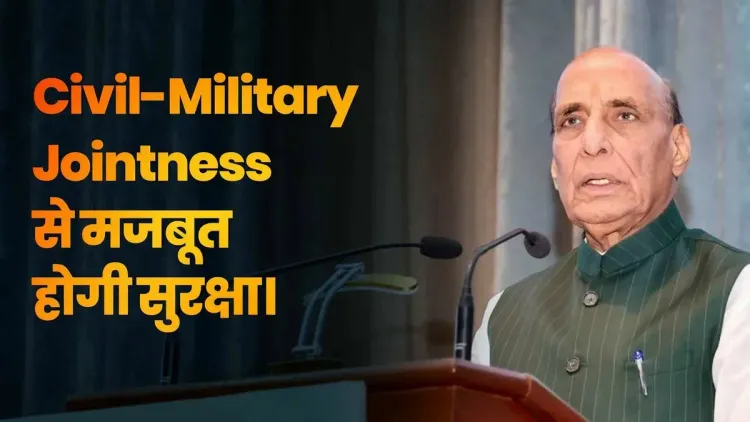
Defence Minister Rajnath Singh on August 3, 2026, called for deeper civil-military jointness, institutional memory, and policy stability to strengthen India's defence ecosystem — reaffirming the structural reform agenda launched with the CDS post and Department of Military Affairs in 2019.
Key Takeaways
Union Defence Minister Rajnath Singh on August 3, 2026 called for better jointness and integration between military and civil components of the defence establishment.
He identified institutional memory , policy stability , and effective governance as the pillars of a stronger defence ecosystem.
The Chief of Defence Staff post and the Department of Military Affairs were both created in December 2019 to drive exactly this kind of civil-military integration.
The DMA was operationalised in 2020 to institutionalise military inputs into defence policy and reduce bureaucratic silos.
The next major test of the integration agenda is the proposed integrated theatre commands , still under deliberation.
The architecture of India's defence governance is once again under the spotlight. Union Defence Minister Rajnath Singh on Monday, August 3, 2026, underscored the imperative of deeper jointness between the military and civilian components of the defence establishment, arguing that institutional memory, policy stability, and effective governance are the true pillars of a resilient defence ecosystem.
In his post, Singh wrote: 'Military aur Civil Components ke beech behtar Jointness aur Integration, Institutional Memory, Policy Stability aur prabhavi Governance ke madhyam se Defence Ecosystem ko nayi mazbooti dega' — 'Better jointness and integration between military and civil components will lend new strength to the defence ecosystem through institutional memory, policy stability, and effective governance.'
The 2019 Reforms That Set This in Motion
Singh's remarks carry the weight of structural change already underway. In December 2019, the government created the post of Chief of Defence Staff (CDS) — a landmark move designed to drive jointness across the three services and bridge the long-standing gap between the uniformed military and the civilian bureaucracy within the Ministry of Defence.
Simultaneously, the Department of Military Affairs (DMA) was notified and operationalised by 2020, institutionalising military inputs directly into policy architecture. Together, these two steps marked the most significant restructuring of India's higher defence management in decades.
Why 'Institutional Memory' Is the Key Phrase Here
The specific invocation of 'institutional memory' is telling. One of the persistent criticisms of India's civil-military interface has been the churn of civilian officials rotating through defence postings with little domain continuity — while military officers bring operational depth but limited policy tenure. The DMA was conceived, in part, to address exactly this gap.
Policy stability — another term Singh highlights — points to the broader ambition: that defence decisions should not reset with every administrative shuffle, but accumulate into a coherent, long-horizon strategy. It is a quiet but pointed argument for structural permanence over bureaucratic improvisation.
Theatre Commands and What Comes Next
The integration agenda has its next major test in the proposed integrated theatre commands — a reorganisation of the armed forces into unified, geographically-oriented commands under single commanders drawing from all three services. The initiative has been in deliberation for several years, and any forward movement is expected to be signalled in upcoming defence policy statements or budget sessions.
Singh's emphasis on governance and jointness suggests the political will at the top remains firmly behind the reform trajectory — even as the operational and institutional details continue to be worked through.
India's defence ecosystem has been reshaped significantly since 2019. The minister's message on Monday is a reminder that the work of integration is not a moment — it is a marathon, and the finish line keeps moving forward.
Point of View
And its inclusion suggests the DMA's mandate may be up for further strengthening. For a minister who has stewarded the defence portfolio since 2019, the framing also serves a political purpose: anchoring the BJP government's legacy in structural, long-horizon defence governance rather than episodic procurement headlines.
NationPress
3 Aug 2026
Frequently Asked Questions
What did Rajnath Singh say about civil-military integration?
Rajnath Singh said that better jointness and integration between military and civil components, combined with institutional memory, policy stability, and effective governance, will lend new strength to India's defence ecosystem.
What is the Department of Military Affairs in India?
The Department of Military Affairs (DMA) was created within the Ministry of Defence in December 2019 and operationalised in 2020 to institutionalise military inputs into defence policy and improve civil-military synergy.
When was the Chief of Defence Staff post created in India?
The post of Chief of Defence Staff was established by the Government of India in December 2019 to drive jointness and integration across the three armed services and with the civilian side of the defence ministry.
What are integrated theatre commands in India?
Integrated theatre commands are a proposed reorganisation of India's armed forces into unified, geography-based commands drawing personnel from all three services under a single commander — a reform that has been under deliberation for several years.
Why is institutional memory important in India's defence policy?
Institutional memory ensures continuity in defence decision-making despite bureaucratic rotations, so that policy knowledge and strategic priorities accumulate over time rather than resetting with each administrative change.