Women make up 43% of Ayush workforce; exceed 60% in wellness: Govt report

Synopsis
India's Ayush sector — often seen as a niche healthcare segment — is emerging as a surprisingly gender-inclusive employer: women make up 43% of its overall workforce and exceed 60% in wellness sub-segments. With the sector valued at $36.92 billion and growing at nearly 17% annually, the employment opportunity for women in traditional medicine is larger, and faster-growing, than most realise.
Key Takeaways
Women account for 43 per cent of the overall Ayush services workforce , according to the Ministry of Ayush .
Female representation exceeds 60 per cent in spas and wellness resorts, 58 per cent in educational institutes, 57 per cent in day-care centres, and 53 per cent in hospitals.
The Ayush services economy was valued at $36.92 billion in FY2024-25 , growing at a CAGR of 16.91 per cent since FY2022-23.
The sector supports around 1.76 million livelihoods , with over one million in standalone and local clinics.
Standalone clinics are the largest revenue segment at $16.21 billion (43.9%) ; day-care centres contributed a further $10.13 billion .
Findings were released in the Ayush Service Sector Report by RIS on Ayurveda Day 2026 .
Women account for 43 per cent of the overall Ayush services workforce in India, with female participation surpassing 50 per cent in several organised segments of the industry, the Ministry of Ayush said on 8 October 2026. The findings, released on Ayurveda Day 2026, underscore how India's traditional medicine sector is quietly becoming one of the more gender-inclusive corners of the healthcare economy.
Key Findings from the Ayush Services Report
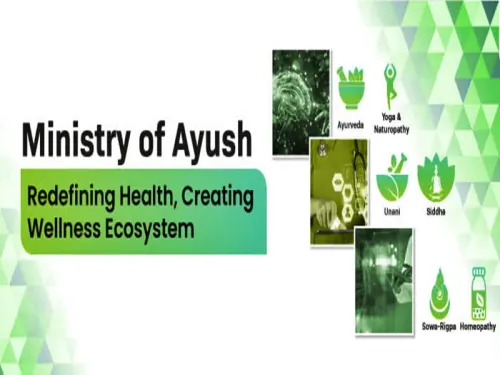
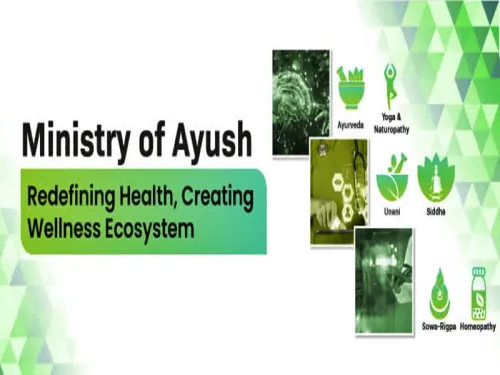
The data comes from the Ayush Service Sector Report, a study conducted by the Research and Information System for Developing Countries (RIS). The sector — encompassing Ayurveda, Yoga and Naturopathy, Unani, Siddha, Sowa-Rigpa and Homoeopathy — shows particularly strong female representation in wellness-oriented sub-segments.
According to the report, women constitute more than 60 per cent of the workforce in spas and wellness resorts. Female representation stands at 58 per cent in educational institutes, 57 per cent in day-care centres, and 53 per cent in hospitals — all above the sector-wide average.
The Scale of the Ayush Economy
The Ayush services economy was estimated at US $36.92 billion in FY2024-25, recording a compound annual growth rate (CAGR) of 16.91 per cent since FY2022-23. The sector directly supports around 1.76 million livelihoods across healthcare, wellness, education and allied services.
More than one million livelihoods are concentrated in local and standalone clinics alone, reflecting the sector's deep employment footprint across both urban and rural India. Standalone clinics are also the largest revenue-generating segment, contributing an estimated $16.21 billion — or 43.9 per cent of total sector revenue. Day-care centres added a further $10.13 billion, with the two segments together accounting for more than 70 per cent of industry revenue.
What the Government Said
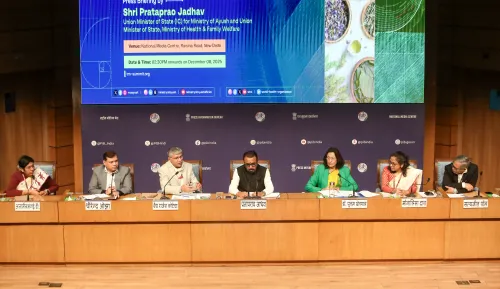
Union Minister of State (Independent Charge) for Ayush and Minister of State for Health and Family Welfare Prataprao Jadhav said the expansion of the Ayush sector is creating meaningful employment opportunities across multiple domains. He noted that growth in the sector is not only strengthening India's broader healthcare ecosystem but also opening avenues for entrepreneurship, skill development and greater participation of women in the workforce.
Why This Matters
The numbers are notable in the context of India's wider female labour force participation challenge, where women remain significantly underrepresented across most formal sectors. The Ayush sector's trajectory suggests that traditional medicine and wellness — often dismissed as informal or supplementary — are developing structured, scalable employment pathways, particularly for women. This is the first comprehensive mapping of women's contribution to the Ayush workforce at this level of segmental detail. With the sector growing at nearly 17 per cent annually, the employment dividend for women could widen considerably in the years ahead.
Point of View
IT, and finance — sectors where the numbers are stubbornly low. The Ayush data offers a quieter counter-narrative: a sector growing at 17% annually where women already outnumber men in several key sub-segments. The critical question the report does not fully answer is whether this participation translates into quality employment — with stable pay, formal contracts, and advancement pathways — or whether it reflects the sector's historically informal character, where women fill lower-tier roles. As Ayush formalises and scales, ensuring that women's numerical dominance in wellness and education converts into equitable earnings will determine whether this is a genuine success story or a headcount statistic.
NationPress
8 Oct 2026
Frequently Asked Questions
What percentage of the Ayush workforce is women?
Women make up 43 per cent of the overall Ayush services workforce in India, according to the Ministry of Ayush. In specific segments such as spas and wellness resorts, female representation exceeds 60 per cent.
What is the Ayush Service Sector Report 2026?
It is a comprehensive study conducted by the Research and Information System for Developing Countries (RIS) and released on Ayurveda Day 2026. The report maps employment, revenue and female participation across the Ayush ecosystem, covering Ayurveda, Yoga, Unani, Siddha, Sowa-Rigpa and Homoeopathy.
How big is India's Ayush services economy?
The Ayush services economy was estimated at US $36.92 billion in FY2024-25, recording a compound annual growth rate of 16.91 per cent since FY2022-23. It directly supports around 1.76 million livelihoods.
Which Ayush sub-sectors employ the most women?
Spas and wellness resorts lead with women comprising more than 60 per cent of the workforce, followed by educational institutes at 58 per cent, day-care centres at 57 per cent, and hospitals at 53 per cent.
What did Minister Prataprao Jadhav say about the Ayush sector's role for women?
Union Minister of State Prataprao Jadhav said the sector's growth is opening avenues for entrepreneurship, skill development and greater workforce participation for women. He added that it is also strengthening India's broader healthcare ecosystem.