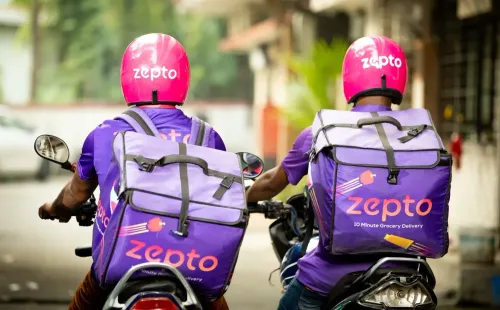
Zepto raises free delivery threshold by up to 100% to ₹299, matching rivals
Synopsis
Zepto has quietly doubled its free-delivery floor during peak hours — from ₹149 to ₹299 — and lifted the standard threshold by a third to ₹199. With Blinkit and Swiggy Instamart at similar levels, India's quick-commerce giants are no longer competing on delivery cost. The race is now about margins, and consumers are footing part of the bill.
Key Takeaways
Zepto raised its free-delivery minimum order value to ₹299 during peak-demand periods — a 100% jump from the earlier ₹149 .
During normal hours, the new threshold is ₹199 , up 33.55% from the previous level.
The revised thresholds align Zepto with rivals Blinkit (owned by Eternal ) and Swiggy Instamart .
Zomato raised its platform fee by ~19% to ₹14.90 per order (pre-GST) in March 2025 .
Swiggy followed with a 17% platform fee hike to ₹17.58 per order.
The moves reflect a sector-wide push to improve order-level economics amid rising delivery costs.
Zepto has revised its minimum order value for free delivery, raising it by up to 100% to ₹299 during peak-demand periods and by 33.55% to ₹199 during normal hours — up from the earlier threshold of ₹149. The move, reported on 19 August, brings the quick-commerce platform's free-delivery floor in line with competitors Blinkit and Swiggy Instamart.
What Changed and Why
According to customer reports, the ₹299 threshold applies during periods of high demand, while the standard threshold now stands at ₹199. The earlier baseline was ₹149, meaning regular-hour customers are paying a roughly one-third higher entry point for free delivery.
The revision is part of a broader effort by quick-commerce platforms to improve order-level economics — balancing rising delivery costs against customer retention. A higher minimum order value nudges shoppers to add more items to their carts, potentially lifting average order values and improving contribution margins on smaller orders.
The Trade-Off for Customers
While the change benefits platform economics, it could test consumer behaviour. Quick-commerce users often place small, convenience-driven orders — a handful of items needed urgently — and a higher threshold may deter low-value purchases or push some customers toward alternatives.
Notably, the revised thresholds now mirror those of Eternal-owned Blinkit and Swiggy's Instamart, suggesting the sector is converging on a common pricing floor rather than competing on delivery cost alone.
A Sector-Wide Pricing Shift
Zepto's move follows a series of fee increases across India's online delivery ecosystem. In March 2025, Zomato raised its platform fee by approximately 19%, or ₹2.40 per order, taking the pre-GST charge to ₹14.90 from ₹12.50. Swiggy subsequently raised its own platform fee by 17% to ₹17.58 per order, up from ₹14.99 — a hike of roughly ₹2.59 including pre-GST charges.
Across the board, delivery platforms are experimenting with order thresholds, platform fees, and surge-based pricing as they seek sustainable unit economics without alienating their core user base.
What This Means for the Market
India's quick-commerce sector has expanded rapidly, but profitability at the order level remains a challenge. The convergence of free-delivery thresholds among the top three players — Zepto, Blinkit, and Instamart — signals that the price-war phase may be giving way to a margin-consolidation phase. How customers respond to these changes will be a key indicator of demand elasticity in the segment.
Point of View
Blinkit, and Instamart is not coincidental — it signals a tacit end to the subsidy-driven growth phase that defined quick commerce's early expansion. All three platforms now effectively charge the same entry price for free delivery, removing a key differentiator. The real question is whether Indian consumers, accustomed to near-zero delivery costs, will absorb these increases quietly or begin to churn. If basket sizes rise, platforms win on economics; if order frequency drops, the growth story gets complicated. Either way, the era of cheap quick commerce is quietly closing.
NationPress
3 Oct 2026
Frequently Asked Questions
What is Zepto's new minimum order value for free delivery?
Zepto's free-delivery threshold is now ₹199 during normal hours and ₹299 during peak-demand periods, up from the earlier ₹149. The change was reported on 19 August 2025.
How does Zepto's new threshold compare to Blinkit and Swiggy Instamart?
Zepto's revised thresholds now align with those of Blinkit and Swiggy Instamart, both of which operate at similar free-delivery minimums. This marks a convergence across the top three quick-commerce platforms in India.
Why has Zepto raised its free-delivery minimum order value?
The move is aimed at improving order-level economics — higher minimum order values encourage customers to add more items, lifting average order values and reducing the cost burden of delivering small-ticket orders.
Have other platforms also raised delivery-related charges recently?
Yes. Zomato raised its platform fee by approximately 19% to ₹14.90 per order (pre-GST) in March 2025, and Swiggy followed with a 17% hike to ₹17.58 per order. Across the sector, platforms are adjusting pricing to improve margins.
How will this affect customers who place small orders?
Customers who frequently place low-value, convenience-driven orders may face delivery charges if their cart falls below the new threshold. This could either push them to add more items or reconsider placing small orders altogether.