Are US-India Relations at Their Lowest in 25 Years?
Synopsis
A recent discussion among US strategic experts highlights the fragile state of US-India relations, citing political mistrust and stalled trade talks. With significant geopolitical pressures at play, experts warn that the partnership is in jeopardy, raising concerns about its future direction and the broader implications for the Indo-Pacific region.
Key Takeaways
US-India relations are currently very fragile.
Political mistrust and stalled trade talks are major issues.
China’s rise prompts the need for a stronger partnership.
India maintains strategic autonomy in its foreign relations.
Functional cooperation continues despite political tensions.
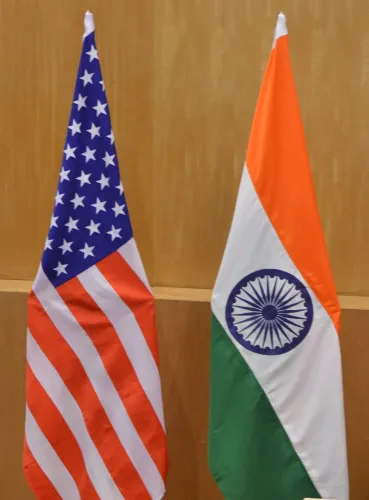
Washington, Dec 4 (NationPress) A panel of distinguished American strategic analysts has issued a warning that the relationship between the United States and India is currently experiencing one of its most vulnerable periods in nearly 25 years. Political distrust, stalled trade negotiations, and geopolitical challenges are testing what has traditionally been viewed as a vital alliance within the Indo-Pacific region.
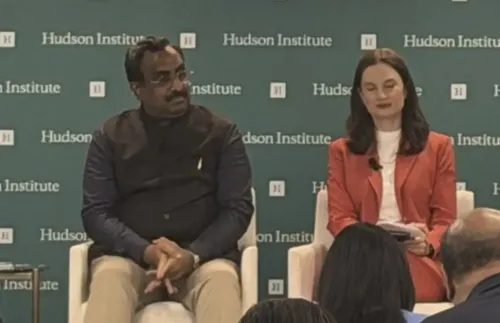
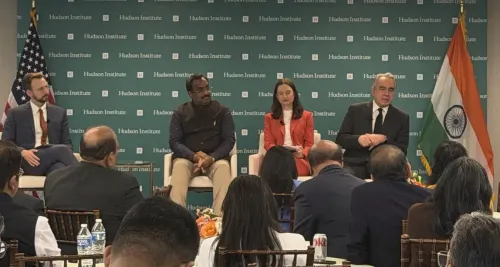
For the past quarter-century, both American and Indian governments have made concerted efforts to enhance the US-India partnership, as noted by Richard Fontaine from the Centre for a New American Security (CNAS) during a discussion in the nation’s capital on Wednesday (local time).
This effort was generally perceived as “a crucial response to China and the security challenges in the Indo-Pacific,” he explained.
“However, we find ourselves in a different situation now,” Fontaine remarked, highlighting ongoing trade disputes, escalating rhetoric, and the sentiment among some in Washington that relations are currently at their “lowest point in the last 25 years.”
‘In the worst shape in nearly 25 years’
Lisa Curtis, a Senior Fellow and Director of the Indo-Pacific Security Program at CNAS and a former senior official in the first Trump administration, provided the most alarming assessment. “The US-India relationship is likely in the worst condition it has been in close to 25 years,” she stated.
Curtis contended that “this moment feels particularly dire.” There had been high expectations that President Trump would positively affect the US-India relationship, especially during his first term.
She referenced Trump's February 2020 visit to India, the 'Howdy Modi' event in 2019, and the US's support during India’s border crisis with China as instances when the relationship was “at an all-time high.”
Instead, she noted, significant tariff increases, “degrading and insulting social media posts” by senior officials, and the invitation to Pakistan Army Chief Gen. Asim Munir to the Oval Office shortly after a major terrorist attack in Jammu and Kashmir indicated a steep decline. “It is genuinely disappointing to witness how far this relationship has deteriorated,” Curtis expressed.
Curtis cautioned that Prime Minister Narendra Modi's reception of President Vladimir Putin this week will likely be viewed in Washington as “bad timing” but not entirely unexpected given US pressures on India. “India values its strategic autonomy,” she stated, adding that Delhi is “demonstrating it will not be bullied by the United States.”
‘Nothing easy or natural’ about the partnership
Lindsey Ford, a Senior Fellow at the Observer Research Foundation America and a former Senior Director for South Asia at the White House, concurred with this assessment, noting that the downturn reflects the lack of political champions on both sides.
“There is nothing simple or inherent about how we have arrived at our current state,” she said, rejecting the frequently used term “natural allies.” The partnership, she argued, “requires high-level champions in both governments,” and currently, it remains unclear who those champions are in Washington or New Delhi.
Ford emphasized that the rationale for rebuilding trust remains significant. “If you believe that China’s rise poses a generational challenge to US security and prosperity… a closer US-India relationship is essential,” she asserted.
A stable balance of power in the Indo-Pacific, she continued, is unattainable “if you do not have a strong India that is more aligned with the United States.”
India's diversification and the Russia question
Tanvi Madan, a Senior Fellow at the Brookings Institution, underscored that India’s ongoing outreach to Russia and China should be viewed as part of its enduring diversification strategy rather than an indication of a major realignment.
India aims for “security, prosperity, status, but also autonomy,” maintaining a “diversified portfolio of partners” across the West, Asia, and Eurasia.
She argued that the Putin visit must be contextualized. Engagements with Japan, Australia, South Korea, and Europe have been “far more substantive,” she stated, and India’s trade imbalance with Russia—now second only to China—explains Delhi’s push for Moscow to import more Indian goods. “There are real limits to the Russia-India relationship,” she noted, citing Moscow’s connections with Pakistan and China.
Madan acknowledged that despite political tensions, “functional cooperation is ongoing,” including defense exercises and technology collaborations. This moment illustrates both the “fragility of the relationship” and its “resilience.”
Point of View
It's imperative to acknowledge the ongoing challenges in US-India relations. While the historical ties between these two nations have been robust, the current political climate and external pressures pose significant risks. Maintaining open dialogue and fostering mutual understanding is essential. We must approach this matter with careful consideration and a commitment to strengthening our alliance.
NationPress
1 Oct 2026
Frequently Asked Questions
What factors are affecting US-India relations?
Political distrust, stalled trade talks, and geopolitical pressures are significantly influencing the current state of US-India relations.
Why do experts believe US-India relations are at a low point?
Analysts indicate that rising tensions, trade disputes, and a lack of high-level champions have contributed to the perception that relations are at their lowest in 25 years.
What role does China play in US-India relations?
China's rise is viewed as a major factor driving the need for a stronger US-India partnership to address security challenges in the Indo-Pacific.
How does India's relationship with Russia affect its ties with the US?
India's outreach to Russia is seen as part of its diversification strategy and does not necessarily indicate a shift away from its relationship with the US.
What are the implications of Modi's meeting with Putin?
Modi's meeting with Putin is considered controversial and may be perceived as bad timing by US officials, highlighting India's strategic autonomy.