Australia, Vanuatu sign Nakamal Agreement barring foreign military bases
Synopsis
Australia and Vanuatu have formalised a treaty that explicitly bars foreign military bases on Vanuatu's territory — a pointed move as China's Namele Agreement with the island nation remains unsigned, pending Beijing's clearance. The Nakamal Agreement hands Canberra a significant strategic win in the contested Pacific.
Key Takeaways
Australia and Vanuatu signed the Nakamal Agreement in Canberra on 29 June .
The treaty bars any foreign military base on Vanuatu's territory and keeps its critical infrastructure free from militarisation.
Vanuatu reaffirmed Australia as its primary policing partner and will prioritise policing requests to Pacific Islands Forum members.
Cooperation covers policing , maritime security , cyber security , intelligence , and infrastructure .
A separate Namele Agreement between Vanuatu and China remains unsigned, pending clearance from Beijing , according to PM Napat.
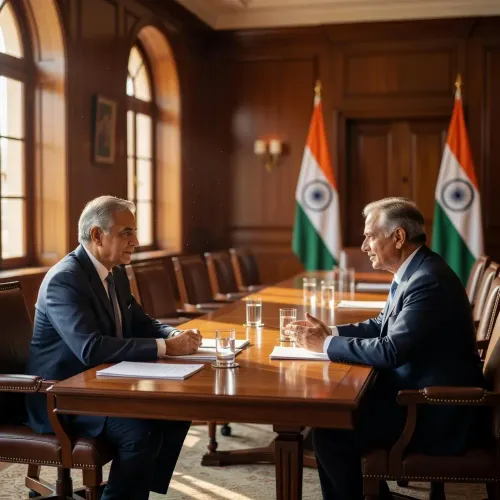
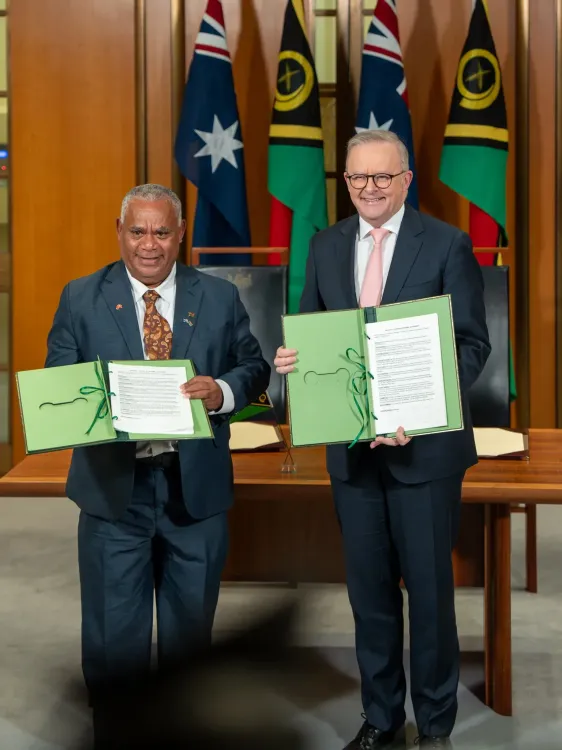
Australia and Vanuatu signed the landmark Nakamal Agreement in Canberra on Monday, 29 June, committing that no foreign military base will be established on Vanuatu's soil and that the island nation's critical infrastructure will remain free from militarisation. Australian Prime Minister Anthony Albanese made the announcement at a joint press conference alongside Vanuatu Prime Minister Jotham Napat.
What the Nakamal Agreement Covers
The treaty enshrines Vanuatu's sovereign decision to bar any foreign military presence on its territory. Under its terms, both nations committed to transparency — including advance notice where possible — on matters affecting sovereignty, peace, or regional stability.
The agreement also elevates cooperation across policing, maritime security, cyber security, intelligence sharing, and infrastructure. Vanuatu reaffirmed Australia as its longstanding primary policing partner and agreed to prioritise policing requests to Pacific Islands Forum members.
What the Two Leaders Said
Speaking at the joint press conference, Albanese described the pact as a milestone in bilateral ties. 'Our agreement reflects and confirms Australia's role as Vanuatu's largest and most comprehensive economic, security and development partner. A responsibility that we take seriously. Above all, it is built on an equal partnership,' he said.
Albanese added that the agreement 'encapsulates Vanuatu's sovereign decision not to permit its territory to be used for any foreign military base or infrastructure and that Vanuatu's critical infrastructure remains free from militarisation.' He also posted on X: 'Australia and Vanuatu have taken our relationship to new heights. With the signing of the historic Nakamal Agreement, we're building a stronger and more secure Pacific. It's a win for Australia. A win for Vanuatu. And a win for our region.'
Vanuatu PM Napat called the signing 'a significant step,' saying: 'Australia and Vanuatu are close neighbours, trusted partners and enduring friends. Today's meeting reaffirms our shared commitment to continuing to strengthen the comprehensive partnership between our two countries, founded on mutual respect, trust and our common vision for peaceful, stable and prosperous Pacific.'
The China Question: Namele Agreement in the Background
The signing comes amid a separate, unsigned agreement between Vanuatu and China — the Namele Agreement. When asked whether that deal would be signed or shelved, Napat said it was 'yet to be signed once I get the clearance from Beijing,' adding that his government is 'transparent' and intends to share the document publicly. The status of the Namele Agreement has drawn close regional attention, given broader concerns about Chinese strategic influence in the Pacific.
Regional Significance
The Nakamal Agreement arrives at a moment of heightened strategic competition in the Pacific, with both the United States and China seeking deeper ties with island nations. By locking in a no-military-base clause and reaffirming Australia's primacy as a policing partner, the deal is widely seen as a counterweight to that pressure. Notably, the agreement explicitly frames security as 'the shared responsibility of the Pacific family' — language that aligns with the Pacific Islands Forum's longstanding consensus-based approach.
Both governments are expected to advance implementation measures in the coming months, with policing capacity-building and infrastructure cooperation among the near-term priorities.
Point of View
Canberra has secured a structural guarantee that directly addresses fears of Chinese military foothold in the Pacific — without naming Beijing once. The timing is deliberate: the Namele Agreement between Vanuatu and China remains unsigned, and Napat's public acknowledgement that he is awaiting 'clearance from Beijing' reveals the quiet pressure small Pacific states navigate. Australia's framing of the deal as an 'equal partnership' is important optics, but the asymmetry in economic and security capacity is real — and Vanuatu's room to manoeuvre will depend on whether Canberra delivers on the infrastructure and policing commitments that give this treaty its practical weight.
NationPress
28 Sept 2026
Frequently Asked Questions
What is the Nakamal Agreement between Australia and Vanuatu?
The Nakamal Agreement is a bilateral security and partnership treaty signed in Canberra on 29 June, under which Vanuatu commits to barring any foreign military base on its territory and keeping critical infrastructure free from militarisation. It also deepens cooperation on policing, maritime security, cyber security, and intelligence between the two nations.
Why does the Nakamal Agreement matter for the Pacific region?
The agreement is significant because it locks in a no-military-base guarantee at a time of heightened strategic competition in the Pacific, with both the United States and China seeking influence among island nations. It reinforces Australia's role as Vanuatu's primary security partner and aligns with the Pacific Islands Forum's consensus-based approach to regional security.
What is the Namele Agreement, and how does it relate to this treaty?
The Namele Agreement is a separate, unsigned agreement between Vanuatu and China. Vanuatu PM Jotham Napat confirmed on 29 June that it has not yet been signed and is awaiting clearance from Beijing. Its status has drawn regional attention given broader concerns about Chinese strategic influence in the Pacific.
What specific areas does the Nakamal Agreement cover?
Beyond the military-base prohibition, the agreement covers police training and equipment, maritime security, cyber security, intelligence cooperation, and infrastructure. Vanuatu also agreed to prioritise policing requests to Pacific Islands Forum members, with Australia as its longstanding primary policing partner.
Who signed the Nakamal Agreement?
The agreement was signed by Australian Prime Minister Anthony Albanese and Vanuatu Prime Minister Jotham Napat at a ceremony in Canberra on 29 June.