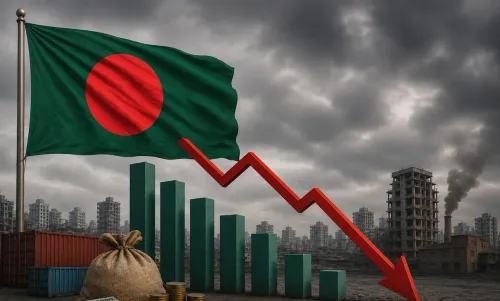
Bangladesh has world's 2nd-highest bad loan rate, trails only war-torn Ukraine

Synopsis
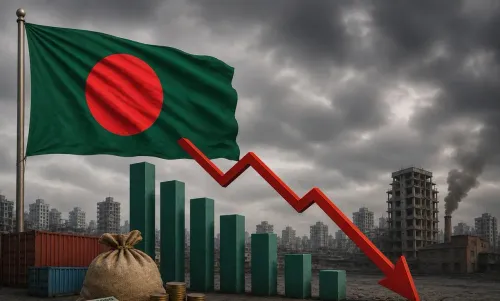
Bangladesh's banking sector is in deeper distress than almost any country on earth — second only to a nation at war. With a negative capital ratio, stressed assets at 61% of the loan book, and political lending cited as a root cause, the crisis is structural, not cyclical. For South Asia, it is a cautionary tale about what happens when credit discipline is sacrificed for political convenience.
Key Takeaways
Bangladesh has the world's second-highest NPL ratio at 32.26 per cent , behind only war-torn Ukraine at 37.35 per cent .
Non-performing loans rose to Tk 5.89 lakh crore by end- March 2025 , up Tk 31,000 crore in just three months.
Stressed assets — including restructured loans — total Tk 11.2 lakh crore , or roughly 61 per cent of the banking system's loan book.
The sector's CRAR turned negative at -2.64 per cent by end- 2025 , against a regulatory minimum of 12.5 per cent .
By contrast, Pakistan holds a CRAR of 20.8 per cent , Sri Lanka 19.4 per cent , and India 17.2 per cent .
Bankers attribute the crisis to politically influenced lending and weak credit discipline, according to the report.
Bangladesh has climbed to the position of the world's second-highest non-performing loan (NPL) ratio, with nearly one-third of all bank lending classified as defaulted, according to a new report. The country's NPL ratio stands at 32.26 per cent, placing it behind only Ukraine — whose banking sector has been ravaged by ongoing conflict — and ahead of Chad and Guinea on the global rankings.
Where Bangladesh Stands Globally
Ukraine tops the global list with an NPL ratio of 37.35 per cent, a figure that largely reflects the economic destruction wrought by war. Bangladesh follows at 32.26 per cent, ahead of Chad at 31.51 per cent and Guinea at 31.15 per cent. Within the South Asian Association for Regional Cooperation (SAARC) region, Bangladesh holds the dubious distinction of the highest NPL ratio — a reflection, according to the report, of weak credit discipline, politically influenced lending, and poor loan recovery mechanisms.
Scale of the Bad Loan Crisis
Data from Bangladesh Bank showed that non-performing loans climbed to Tk 5.89 lakh crore by end-March 2025, rising by Tk 31,000 crore in just three months. Total outstanding loans in the country stood at Tk 18.25 lakh crore. When restructured loans and special mention accounts are included, stressed assets reach Tk 11.2 lakh crore — roughly 61 per cent of the banking system's entire loan book, according to the report.
Capital Position Deteriorates Sharply
The sector's capital buffer has eroded at an alarming pace. The aggregate Capital to Risk-Weighted Assets Ratio (CRAR) fell to -2.64 per cent at end-2025, down from 3.08 per cent a year earlier — far below the regulatory minimum of 12.5 per cent. By comparison, Pakistan's banking sector maintained a CRAR of 20.8 per cent, followed by Sri Lanka at 19.4 per cent and India at 17.2 per cent, underscoring the scale of Bangladesh's divergence from its regional peers.
Political Lending and Structural Weaknesses
Bankers cited in the report argued that politically influenced lending decisions had systematically weakened credit standards, with many loans reportedly approved on the basis of connections rather than borrowers' actual repayment capacity. Md Touhidul Alam Khan, Managing Director and CEO of NRBC Bank, said Bangladesh's extreme divergence from regional peers showed that 'neighbouring economies insulated their banking sectors through strict macro prudential discipline, while Bangladesh repeatedly absorbed corporate and credit shocks.'
A surge in defaulted loans forces banks to maintain higher provisioning and bear increased litigation costs, in turn reducing profitability and limiting their ability to extend fresh credit to productive sectors of the economy — a cycle that critics argue is now deeply entrenched.
What Comes Next
The findings, published by Dhaka-based The Business Standard, are likely to intensify pressure on Bangladesh's financial regulators to enforce stricter credit governance and accelerate loan recovery. Whether the interim administration can break the cycle of politically driven credit allocation remains the central question for the country's banking sector in the months ahead.
Point of View
Where loan approvals tracked connections rather than creditworthiness. The comparison with SAARC peers is damning: India, Pakistan, and Sri Lanka — each with their own fiscal challenges — have all maintained positive capital buffers. Bangladesh has not. The deeper risk is that a banking sector this impaired cannot efficiently allocate capital to growth, which means the NPL crisis is not just a financial problem but a drag on the country's broader economic trajectory. Without genuine political will to insulate credit decisions from patronage networks, regulatory fixes alone will not hold.
NationPress
8 Oct 2026
Frequently Asked Questions
What is Bangladesh's current non-performing loan ratio?
Bangladesh's NPL ratio stands at 32.26 per cent, making it the second-highest in the world, according to a report by Dhaka-based The Business Standard. This means nearly one-third of all bank lending in the country is classified as defaulted.
Which country has the highest NPL ratio globally?
Ukraine tops the global list with an NPL ratio of 37.35 per cent, a figure largely driven by the economic destruction caused by the ongoing conflict. Bangladesh ranks second at 32.26 per cent, followed by Chad and Guinea.
How bad is Bangladesh's banking sector capital position?
The aggregate Capital to Risk-Weighted Assets Ratio (CRAR) for Bangladesh's banking sector turned negative, falling to -2.64 per cent at end-2025, down from 3.08 per cent a year earlier. The regulatory minimum is 12.5 per cent, meaning the sector is critically undercapitalised.
What is driving Bangladesh's bad loan crisis?
Bankers cited in the report attribute the crisis primarily to politically influenced lending decisions, where loans were approved based on connections rather than borrowers' repayment capacity. Weak credit discipline and poor loan recovery mechanisms have compounded the problem over time.
How does Bangladesh compare with other SAARC nations on banking health?
Bangladesh has the highest NPL ratio among SAARC nations. On capital adequacy, it trails significantly: Pakistan holds a CRAR of 20.8 per cent, Sri Lanka 19.4 per cent, and India 17.2 per cent — all well above the 12.5 per cent regulatory minimum that Bangladesh has failed to meet.