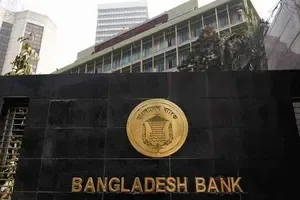
Bangladesh banks' CRAR at minus 2.64%, worst in South Asia: Report
Synopsis
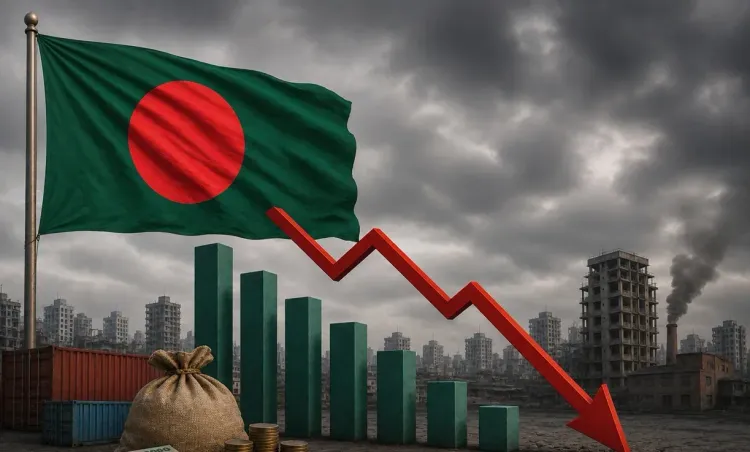
Bangladesh's banks have turned technically insolvent on a system-wide basis, with a CRAR of minus 2.64% — the worst in South Asia and far below the Basel III floor of 10%. With NPLs at 32.26% of total loans as of March 2026 and regulatory deferral shields set to expire, experts warn the worst may not yet be priced in.
Key Takeaways
Bangladesh's CRAR fell to minus 2.64 per cent by end- 2025 , the weakest in South Asia .
By comparison, India's CRAR stood at 17.20% , Pakistan's at 20.80% , and Sri Lanka's at 19.40% .
Non-performing loans reached Tk 5,88,704 crore ( 32.26% of total loans) by March 2026 , up from 30.60% at end-2025.
The crisis was triggered by concealed bad loans surfacing after the Awami League government fell in August 2024 .
Many banks hold regulatory deferral facilities that are masking the true scale of losses; experts warn conditions could worsen when these expire.
Basel III norms require a minimum CRAR of 10% plus a 2.5% conservation buffer — thresholds Bangladesh's system currently fails to meet.
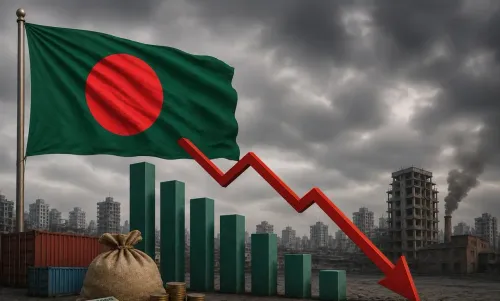
Bangladesh's banking sector slipped into a full-blown capital crisis by the end of 2025, with its Capital to Risk-Weighted Assets Ratio (CRAR) plunging to minus 2.64 per cent — the weakest in South Asia — after a wave of previously concealed bad loans surfaced, according to a report by Dhaka-based The Daily Star. The negative ratio signals that Bangladesh's banks collectively lack the capital buffer required to absorb losses if borrowers default.
South Asia Comparison
The scale of Bangladesh's distress becomes stark when set against its neighbours. At the end of 2025, India's CRAR stood at a healthy 17.20 per cent, Pakistan's at 20.80 per cent, and Sri Lanka's at 19.40 per cent. Under international Basel III norms, banks are required to maintain a minimum capital adequacy ratio of 10 per cent, plus an additional 2.5 per cent conservation buffer — a threshold Bangladesh's banking system now falls dramatically short of.
How the Crisis Unfolded
The deterioration accelerated after the fall of the Awami League-led government in August 2024, which triggered a reckoning with years of hidden non-performing loans. Syed Mahbubur Rahman, managing director and chief executive officer of Mutual Trust Bank and a former chairman of the Association of Bankers, Bangladesh (ABB), attributed the negative capital position directly to widespread financial scams embedded in the system over years.
Rahman also flagged a regulatory time-bomb: many banks have availed themselves of regulatory deferral facilities — mechanisms that allow institutions to delay recognising losses or meeting certain compliance requirements. He warned that the financial position of these banks could deteriorate further once those deferral windows expire.
Bad Loans at Alarming Levels
Non-performing loans (NPLs) are the primary pressure point. According to Bangladesh Bank data, bad loans surged to Tk 5,57,217 crore, representing 30.60 per cent of total loans, by the end of 2025. The situation worsened into the new year, with NPLs climbing further to Tk 5,88,704 crore — or 32.26 per cent of total loans — by March 2026.
Expert Warning on the Path Forward
Mustafa K Mujeri, executive director of the Institute for Inclusive Finance and Development (InM) and a former chief economist of Bangladesh Bank, was unequivocal about what is needed. 'If policymakers want to restore the banking sector to a healthy and sustainable position, there is no alternative to taking strong and decisive corrective measures,' he said.
This comes amid broader questions about governance and regulatory oversight in Bangladesh's financial system, where politically connected lending reportedly shielded bad assets from disclosure for years. With deferral facilities set to expire and NPLs still rising, the window for corrective action is narrowing.
Point of View
The headline figure of minus 2.64% could look optimistic in hindsight. The political dimension matters too — the mass emergence of hidden NPLs only after a change of government suggests that Bangladesh's supervisory framework was either captured or deliberately blinded during the Awami League era. Restoring credibility will require not just recapitalisation but a structural overhaul of how connected lending is monitored and disclosed.
NationPress
26 Sept 2026
Frequently Asked Questions
What does Bangladesh's negative CRAR of minus 2.64% mean?
It means Bangladesh's banking sector, on an aggregate basis, no longer holds enough capital to cover its risk-weighted assets — effectively a system-wide capital shortfall. Under Basel III norms, banks are required to maintain at least 10% CRAR plus a 2.5% buffer; Bangladesh's figure of minus 2.64% at end-2025 is the weakest in South Asia.
Why did Bangladesh's banking crisis worsen after August 2024?
The fall of the Awami League-led government in August 2024 removed political cover that had reportedly allowed banks to conceal non-performing loans for years. Once the new administration took over, a large volume of previously hidden bad loans came to light, sharply eroding the sector's capital position.
How bad are Bangladesh's non-performing loans?
According to Bangladesh Bank data, NPLs stood at Tk 5,57,217 crore — 30.60% of total loans — at end-2025, and rose further to Tk 5,88,704 crore (32.26%) by March 2026. That ratio is among the highest for any major banking system globally.
What are regulatory deferral facilities and why do they matter?
Regulatory deferral facilities allow banks to delay recognising losses or fulfilling certain compliance requirements. Syed Mahbubur Rahman of Mutual Trust Bank has warned that many Bangladeshi banks are currently relying on these deferrals to mask their true financial weakness, and that conditions could worsen significantly once the facilities expire.
What do experts say is needed to fix Bangladesh's banking sector?
Mustafa K Mujeri, former chief economist of Bangladesh Bank, has stated that 'there is no alternative to taking strong and decisive corrective measures' to restore the sector to health. Analysts broadly agree that recapitalisation alone will be insufficient without deeper governance and supervisory reforms.