Bangladesh policy rate cut to 9.5% may not fix private credit slump
Synopsis
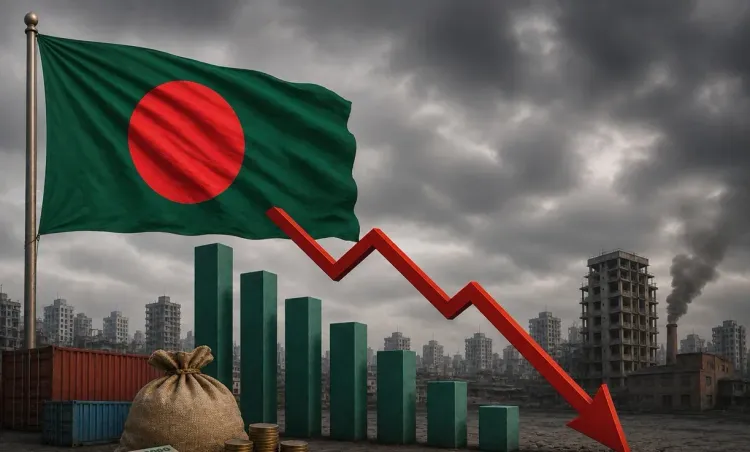
Bangladesh's central bank has cut rates, but a new Asia Times report says the real problem isn't the price of money — it's a collapse in viable corporate demand, infrastructure failures, and a banking system where bad loans now exceed 32% of all outstanding credit. A half-point rate cut, the report argues, cannot fix what is fundamentally a structural crisis.
Key Takeaways
Bangladesh's central bank cut its policy rate by 50 basis points to 9.5 per cent last week to ease lender funding costs.
Private sector credit grew just 4.98 per cent year-on-year in May , down from 7.17 per cent the previous year.
Public sector credit surged 20.78 per cent , making state borrowing the dominant driver of domestic credit.
Non-performing loans reached nearly 5.89 lakh crore taka ( $47.65 billion ), exceeding 32 per cent of total outstanding loans by late March .
The World Bank estimated Bangladesh's banking system capital-to-risk-weighted-assets ratio fell to -2.6 per cent by end of 2025 .
Analysts warn infrastructure gaps and weak corporate demand — not borrowing costs — are the core impediments to private investment.
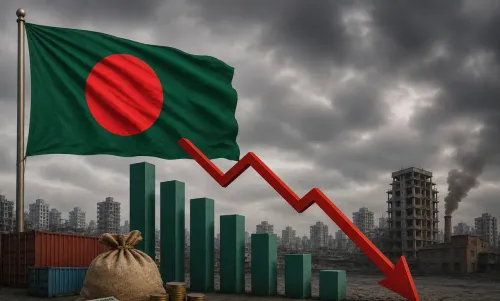
Bangladesh's central bank last week reduced its benchmark policy rate by 50 basis points to 9.5 per cent, aiming to lower funding costs for financially stressed lenders. However, a new report warns the move may fall well short of reversing what it describes as an 'alarming slowdown in private investment' gripping the country's economy.
The Credit Growth Crisis
According to the report by Asia Times, credit extended to private firms expanded just 4.98 per cent year-on-year in May, a sharp deceleration from 7.17 per cent recorded the previous year. The report characterised this as 'a sluggish pace for a country aspiring to rapid industrialisation.'
In stark contrast, public sector credit surged 20.78 per cent over the same period, indicating that state borrowing has effectively become the primary engine of domestic credit creation — a structural imbalance that a rate cut alone cannot resolve.
Why Monetary Easing May Not Be Enough
The Asia Times report argues that the fundamental obstacle to private investment is not the cost of borrowing, but a scarcity of viable corporate demand. 'Lowering central-bank funding costs is intended to reduce commercial lending rates and render stalled capital projects viable once again. However, the true impediment to expansion is not the price of money, but a dearth of viable corporate demand,' it noted.
Compounding the problem are persistent infrastructure deficits — including frequent gas and power interruptions — that render many stalled projects unviable regardless of interest rate levels. The report observed that 'the financial penalty of idle capacity, backup diesel generators, and missed export deadlines far outweighs minor savings on bank loans.'
Bad Loans and Institutional Fragility
Non-performing loans in Bangladesh's banking system climbed to nearly 5.89 lakh crore taka ($47.65 billion) by late March, exceeding 32 per cent of total outstanding loans. This scale of bad debt is widely seen as discouraging lenders from extending fresh credit.
The World Bank estimated that the banking system's capital-to-risk-weighted-assets ratio dipped to -2.6 per cent by the end of 2025. Lenders burdened by non-performing assets are reportedly tempted to hoard capital, restrict lending to a narrow tier of blue-chip clients, or redirect funds into government securities rather than productive enterprise.
'Aggregate liquidity masks deep institutional fragility, leaving weak banks incapable of extending productive credit regardless of central bank policy,' the report said.
What Comes Next
The rate cut signals the central bank's intent to ease monetary conditions, but analysts and the Asia Times report suggest that without structural repairs — addressing infrastructure gaps, resolving the bad-loan crisis, and rebuilding bank capital buffers — the transmission of lower rates into real economic activity will remain limited. Bangladesh's path to the rapid industrialisation it aspires to may require policy interventions that go well beyond the central bank's toolkit.
Point of View
Lower rates do not unlock credit — they simply make it cheaper for weak banks to stay inert. The deeper issue is that public sector borrowing is crowding out private credit, and infrastructure failures are killing the business case for investment before any loan is even considered. Dhaka needs a banking sector clean-up and an infrastructure push; the central bank can only do so much from the sidelines.
NationPress
20 Sept 2026
Frequently Asked Questions
Why did Bangladesh's central bank cut the policy rate?
The central bank reduced its benchmark rate by 50 basis points to 9.5 per cent to lower funding costs for financially stressed lenders and stimulate corporate borrowing. The move was intended to make stalled capital projects viable again amid weak private investment.
Why might the rate cut fail to revive private credit in Bangladesh?
According to an Asia Times report, the core problem is not the cost of credit but a lack of viable corporate demand. Infrastructure shortfalls — including frequent gas and power outages — and a banking sector weighed down by bad loans mean that cheaper money alone cannot restart private investment.
How severe is Bangladesh's non-performing loan problem?
Non-performing loans climbed to nearly 5.89 lakh crore taka ($47.65 billion) by late March, surpassing 32 per cent of total outstanding loans. The World Bank estimated the banking system's capital-to-risk-weighted-assets ratio fell to -2.6 per cent by end-2025, indicating deep institutional fragility.
How does public sector borrowing compare to private credit growth in Bangladesh?
Public sector credit surged 20.78 per cent year-on-year, while private sector credit expanded just 4.98 per cent — down sharply from 7.17 per cent the previous year. This divergence suggests state borrowing is crowding out private credit creation.
What structural reforms does Bangladesh need beyond rate cuts?
Analysts and the Asia Times report point to the need for resolving the bad-loan crisis, rebuilding bank capital buffers, and addressing persistent infrastructure gaps in power and gas supply. Without these, the transmission of lower interest rates into productive lending is expected to remain weak.