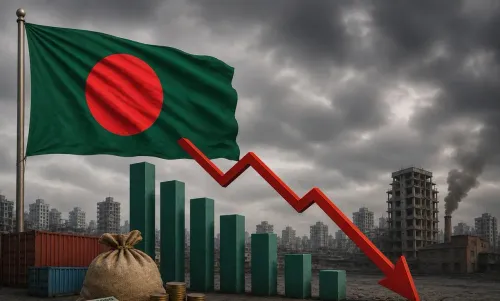
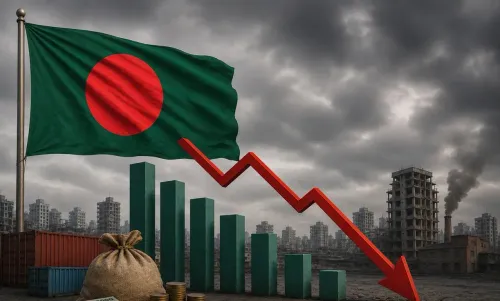
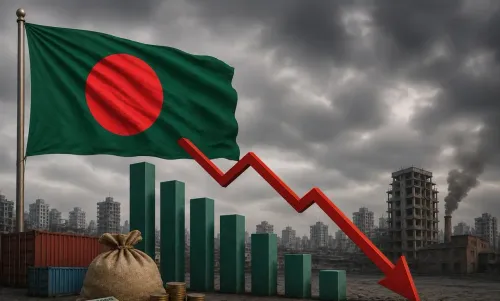
Bangladesh's $26 Billion Debt Crisis: A Looming Economic Catastrophe

Synopsis
Bangladesh must repay $26 billion in foreign debt between 2026–2030 — nearly two-thirds of all debt it has repaid in 54 years of independence. With annual repayments peaking at $5.5 billion by 2030 and the IMF risk threshold looming, experts warn it could take Bangladesh until 2063 to escape its current debt burden.
Key Takeaways
Bangladesh must repay $26 billion in external debt between fiscal years 2026 and 2030 , nearly two-thirds of all debt repaid in its 54-year history.
Bangladesh's total external debt reached $77 billion as of June 2024 , equal to 19 per cent of national income .
The country's debt servicing-to-revenue ratio of 16.5 per cent is approaching the IMF's risk threshold of 18 per cent .
Annual repayments will peak at $5.5 billion by 2030 , equivalent to roughly three months of Bangladesh's monthly remittance income of $2 billion .
Major infrastructure projects including the $11 billion Ruppur Nuclear Power Project , Padma Rail Link , and Karnaphuli Tunnel — financed through foreign loans — are key contributors to the debt burden.
At current trends, Bangladesh will not be debt-free until 2063 — a full 37 years from now.
New Delhi, April 24 (NationPress): Bangladesh is staring down a severe external debt crisis, with the country obligated to repay a staggering $26 billion in foreign loans between fiscal years 2026 and 2030 — a repayment burden that experts warn could severely strain the nation's already fragile economy. The alarm was raised in a detailed analysis published by the Dhaka Tribune, which underscores just how dramatically the country's debt servicing obligations have escalated in recent years.
The Scale of the Crisis: Numbers That Tell a Stark Story
To understand the gravity of the situation, consider this: in the 54 years since Bangladesh's independence, the country spent a cumulative total of $40 billion on external debt repayment. Yet in just the next five years alone, it must repay nearly two-thirds of that entire historical amount.
As of June 2024, Bangladesh's total external debt stood at $77 billion, equivalent to 19 per cent of its national income — a ratio that has been climbing steadily. The country's debt servicing-to-government-revenue ratio currently sits at 16.5 per cent, dangerously close to the International Monetary Fund (IMF)'s risk threshold of 18 per cent.
Looking further ahead, the picture darkens considerably. Over the 10 fiscal years from 2026 to 2035, Bangladesh's total external debt repayments are projected to reach $51 billion. Annual repayments are expected to peak at approximately $5.5 billion by 2030.
The Remittance Lifeline — And Its Limits
Between 2021 and 2025, Bangladesh earned approximately $2 billion per month from remittances — a critical foreign exchange lifeline. At that rate, the peak annual repayment of $5.5 billion would consume roughly three months' worth of remittance income in a single year.
More alarmingly, if current debt accumulation and repayment trends continue unchanged, it will take Bangladesh until 2063 — a full 37 years — to completely free itself from its present debt obligations. This projection raises serious questions about fiscal sovereignty and long-term economic planning in Dhaka.
Infrastructure Ambitions and the Foreign Loan Trap
A significant driver of Bangladesh's debt surge has been the country's appetite for large-scale infrastructure development, much of it financed through foreign borrowing. Key projects include:
The $11 billion Ruppur Nuclear Power Project, the Karnaphuli Tunnel, the Padma Rail Link, and the third terminal of Shahjalal International Airport in Dhaka — all of which were funded substantially through bilateral and multilateral foreign loans.
Critically, repeated delays in project implementation have ballooned costs beyond original estimates, automatically inflating Bangladesh's debt repayment obligations. This is a pattern seen across developing economies where infrastructure ambition outpaces institutional capacity to execute on schedule.
Structural Weaknesses Compounding the Problem
Bangladesh has also struggled to broaden its tax base. Direct tax revenues have consistently fallen short of targets, leaving the government with limited fiscal headroom to absorb external shocks or accelerate debt repayment without cutting essential services.
On the international front, several bilateral and multilateral lenders have revised their lending terms — raising interest rates, shortening repayment windows, and reducing grace periods. These structural shifts in global lending conditions have compounded the pressure on Dhaka's debt servicing capacity.
Global disruptions have also played a significant role. The COVID-19 pandemic, the Russia-Ukraine war, and the ongoing Middle East conflict have each negatively impacted Bangladesh's exports, foreign direct investment inflows, and remittance earnings — the three pillars of its external payment capacity.
What This Means for Bangladesh's Economic Future
The convergence of rising repayment obligations, a narrowing tax base, global economic headwinds, and tightening lender terms creates a perfect storm for Bangladesh's fiscal stability. Analysts warn that without urgent structural reforms — including aggressive tax base expansion, improved project execution efficiency, and renegotiation of loan terms where possible — Bangladesh risks entering a debt trap that constrains public spending on health, education, and social protection for decades.
Notably, this crisis is unfolding at a time when Bangladesh is navigating significant political transition following the ouster of former Prime Minister Sheikh Hasina in 2024, adding layers of governance uncertainty to an already complex economic challenge.
As repayment deadlines approach and global financial conditions remain volatile, all eyes will be on whether Dhaka can negotiate relief from key creditors — including China, Russia, Japan, and the World Bank — and whether the IMF's ongoing support programme can provide enough of a buffer to prevent a full-blown sovereign debt crisis in the coming years.
Point of View
With little attention paid to expanding the domestic tax base or building institutional capacity for timely project delivery. The irony is sharp: the very projects meant to signal Bangladesh's development ambitions — the nuclear plant, the tunnel, the rail link — are now the anchors dragging its fiscal future underwater. What makes this particularly dangerous is the timing: a country in political transition, with a weakened revenue base and a global lending environment that is tightening, is the last entity that can afford a $5.5 billion annual repayment peak. The mainstream narrative celebrates Bangladesh's 'development story'; the harder truth is that much of it was borrowed progress, and the bill is now due.
NationPress
1 Oct 2026
Frequently Asked Questions
How much does Bangladesh owe in external debt as of 2024?
As of June 2024, Bangladesh's total external debt stood at $77 billion, which is approximately 19 per cent of its national income. This ratio has been rising steadily over recent years.
How much will Bangladesh spend on debt repayment between 2026 and 2030?
Bangladesh is projected to spend $26 billion on external debt repayments in the five fiscal years from 2026 to 2030. This is nearly two-thirds of the $40 billion Bangladesh spent on external debt repayment across its entire 54-year history since independence.
What are the main reasons behind Bangladesh's growing debt crisis?
The crisis stems from a combination of large foreign-loan-funded infrastructure projects (including the $11 billion Ruppur Nuclear Power Project), project implementation delays, a narrow tax base, and tightening global lending conditions. Global disruptions like COVID-19, the Ukraine war, and the Middle East conflict have also weakened Bangladesh's export and remittance earnings.
Is Bangladesh at risk of breaching the IMF's debt risk threshold?
Bangladesh's debt servicing-to-government-revenue ratio currently stands at 16.5 per cent, just below the IMF's risk threshold of 18 per cent. Analysts warn this buffer is thin and could be breached if repayment pressures intensify without corresponding revenue growth.
How long will it take Bangladesh to become debt-free at the current rate?
According to the Dhaka Tribune analysis, if current trends continue, Bangladesh will not fully repay its existing debt burden until 2063 — approximately 37 years from now. Annual repayments are expected to peak at around $5.5 billion by 2030.