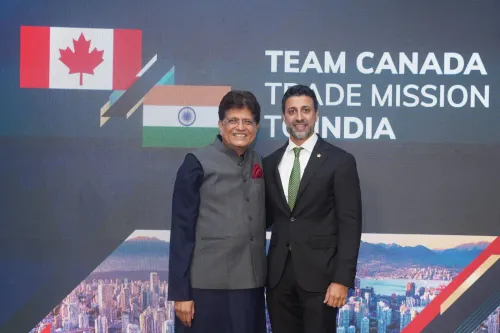
Canada-India CEPA talks near conclusion ahead of Modi's December visit
Synopsis
Canada-India trade ties are accelerating toward a landmark deal: the Business Council of Canada says CEPA negotiations are close to conclusion and could be sealed during PM Modi's December visit to Canada. The article also flags Mumbai's transformation as a key opportunity and warns Ottawa that rivals are competing hard for a foothold in India's fast-growing economy.
Key Takeaways
The Business Council of Canada says Canada-India CEPA negotiations are nearing a conclusion.
PM Narendra Modi's visit to Canada in December 2026 is seen as a potential milestone for finalising the deal.
Parallel talks on a Foreign Investment Promotion and Protection Agreement (FIPA) are also ongoing.
Mumbai is highlighted as a critical hub for the next stage of bilateral economic engagement.
Both sides view the relationship as a hedge against economic coercion and supply-chain disruption.
Canada is urged to move quickly, as rival countries are equally determined to secure a position in India's market.
Relations between Canada and India are improving at a rapid pace, with growing confidence that negotiations on a Comprehensive Economic Partnership Agreement (CEPA) are nearing a conclusion, according to an article published by the Business Council of Canada. The momentum, the article notes, should allow leaders to finalise negotiations during Prime Minister Narendra Modi's anticipated visit to Canada in December 2026.
What the CEPA Would Mean
The CEPA has featured prominently in recent discussions among Canadian and Indian business leaders seeking stronger economic ties. However, the Business Council of Canada frames the agreement not as a destination but as a starting point — describing it as 'the beginning, not the end, of the bilateral journey.'
Parallel to the CEPA talks, negotiations are also under way on a Foreign Investment Promotion and Protection Agreement (FIPA). Canadian businesses remain deeply interested in stronger investment protections, making the investment treaty the logical next priority once the trade deal is sealed. The article also stresses that Canada must ensure the CEPA is fully implemented and that businesses are equipped to capitalise on the opportunities it creates.
Mumbai's Rising Role in Bilateral Ties
The Business Council of Canada article singles out Mumbai — India's financial hub — as a city poised to play a pivotal role in the next stage of economic relations between the two countries. It describes the scale of construction across Mumbai as 'remarkable,' observing that it is 'difficult to imagine another city undergoing as much transformation, at such speed and scale' over the next decade.
The article urges Canada to engage more deliberately with fast-growing states such as Maharashtra, noting that Indian capital formation is accelerating and Canadian investment is already present on the ground.
Economic Resilience and Strategic Diversification
Both Canadian and Indian business leaders, according to the article, see an urgent need for the two countries to work more closely so as to reduce vulnerability to economic coercion. India has faced significant disruptions to its supply chains and trade flows in recent years and is actively seeking reliable partners. The article frames the bilateral relationship not merely as a market-access play but as a broader strategy of diversification and economic resilience in an increasingly uncertain global environment.
Competition and What Canada Must Do Next
The article sounds a note of urgency for Canada, warning that it faces 'stiff competition from countries and companies that are equally determined to secure a place' in the Indian market. The recommended roadmap: conclude the CEPA, pursue a modern investment agreement, implement the trade deal effectively, and deepen engagement with high-growth Indian states. The political relationship is improving, Canadian capital is present, but execution speed will be decisive, the article argues.
With Prime Minister Modi's December visit now serving as a potential milestone, the next few weeks are likely to see intensified back-channel diplomacy between New Delhi and Ottawa to align positions before any formal signing ceremony.
Point of View
'Canada must') reflects anxiety that Ottawa has been too slow to match the pace of India's other suitors, including the EU and Gulf states. The CEPA, if concluded during Modi's December visit, would mark a genuine diplomatic reset after years of strained ties, but the harder work — FIPA, implementation, state-level engagement — lies beyond the headline deal. India, for its part, has learned to use trade-deal momentum as a strategic signal; a Modi visit to Canada would itself be a high-value diplomatic gesture. The real test is whether Canadian capital follows political goodwill at the scale India's infrastructure pipeline demands.
NationPress
21 Oct 2026
Frequently Asked Questions
What is the Canada-India CEPA?
The Comprehensive Economic Partnership Agreement (CEPA) is a broad trade deal being negotiated between Canada and India, aimed at strengthening market access, economic ties, and bilateral commerce. Negotiations are reportedly nearing conclusion, with PM Modi's December 2026 visit to Canada identified as a potential milestone for finalising the agreement.
When could the Canada-India CEPA be signed?
According to the Business Council of Canada, the existing negotiating momentum could allow leaders to conclude negotiations during PM Narendra Modi's visit to Canada in December 2026. No official signing date has been confirmed.
What comes after the CEPA in Canada-India relations?
The Business Council of Canada identifies the Foreign Investment Promotion and Protection Agreement (FIPA) as the logical next priority once the CEPA is concluded. Effective implementation of the trade deal and deeper engagement with fast-growing Indian states like Maharashtra are also flagged as critical next steps.
Why is Mumbai highlighted in the Canada-India trade context?
The Business Council of Canada article describes Mumbai as India's financial hub undergoing remarkable transformation, calling it poised to play an important role in the next stage of bilateral economic relations. It urges Canadian businesses and policymakers to engage more deliberately with Maharashtra.
Why is the Canada-India economic relationship seen as strategically important?
Both Canadian and Indian business leaders view closer ties as a way to reduce vulnerability to economic coercion and supply-chain disruptions. India is actively seeking reliable partners, and Canada is positioned as one such partner — making the relationship about strategic diversification and resilience, not just market access.